


Bitcoin’s latest rebound above $80,000 has pulled retail sentiment sharply higher, with Santiment’s social data showing a 1.37 bullish-to-1.00 bearish commentary ratio across crypto social media. The reading marks the highest level of positive Bitcoin crowd sentiment in roughly four months.
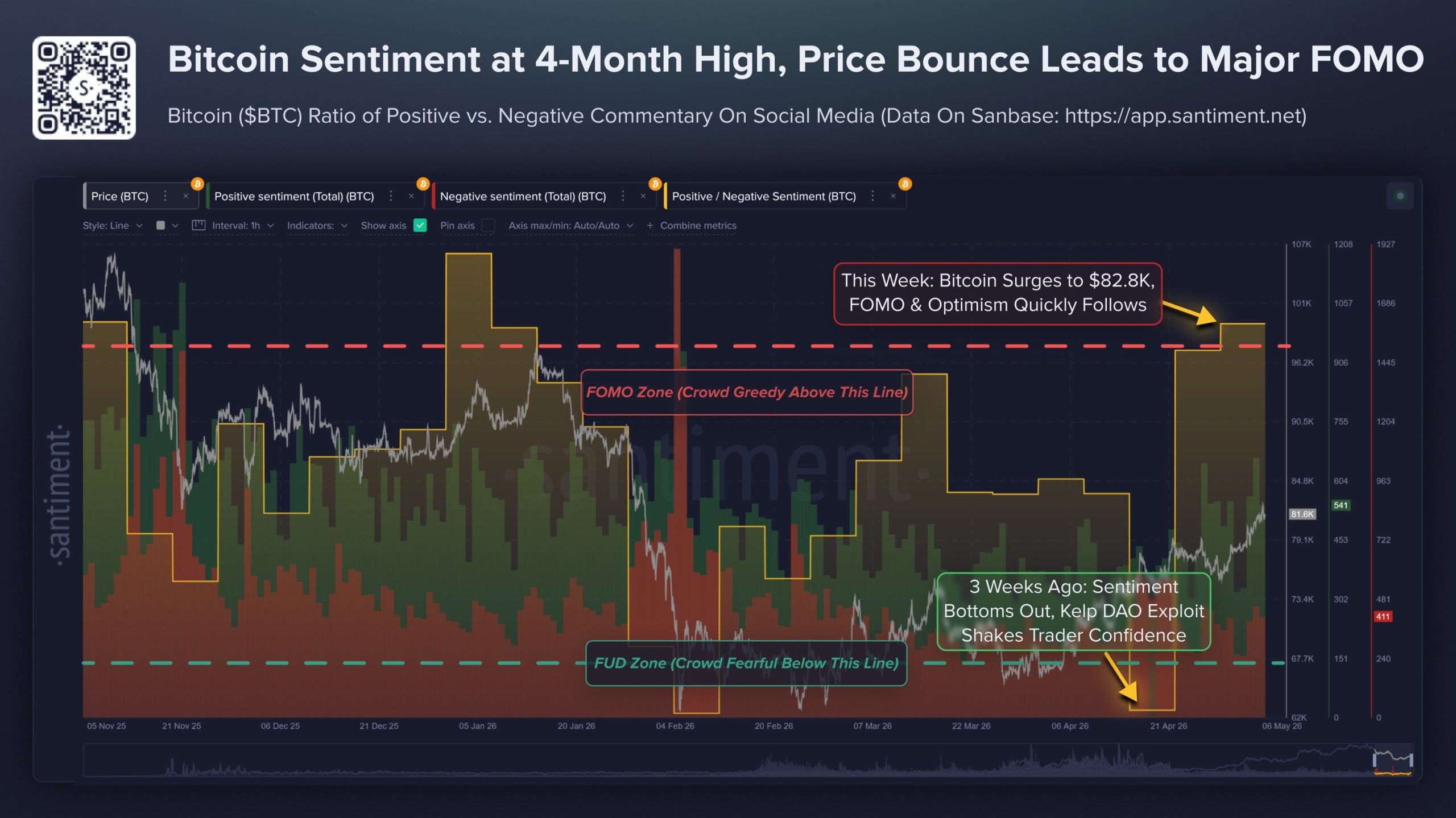
BTC traded near $81,600 on CoinGecko, up about 8% over seven days, after reclaiming the $80,000 area during a broad market recovery. Bitcoin dominance remained near 58.6%, keeping BTC as the main liquidity anchor while altcoins followed with more uneven moves.

The sentiment rebound follows several weeks of uncertainty across crypto markets. Macro fears, geopolitical tension, exploit headlines, and weaker on-chain participation had kept many retail traders cautious through April. Bitcoin’s return above $80,000 has now shifted social commentary back toward upside targets, including renewed discussion around $85,000, $90,000, and $100,000 levels.
Bitcoin Demand Leads While Ethereum Lags
The sentiment jump is also arriving while Bitcoin’s market structure looks stronger than Ethereum’s. CryptoQuant’s April supply-demand analysis separated Bitcoin’s rebound from Ethereum’s move, finding active BTC demand while ETH’s recovery was driven more by reduced selling pressure.
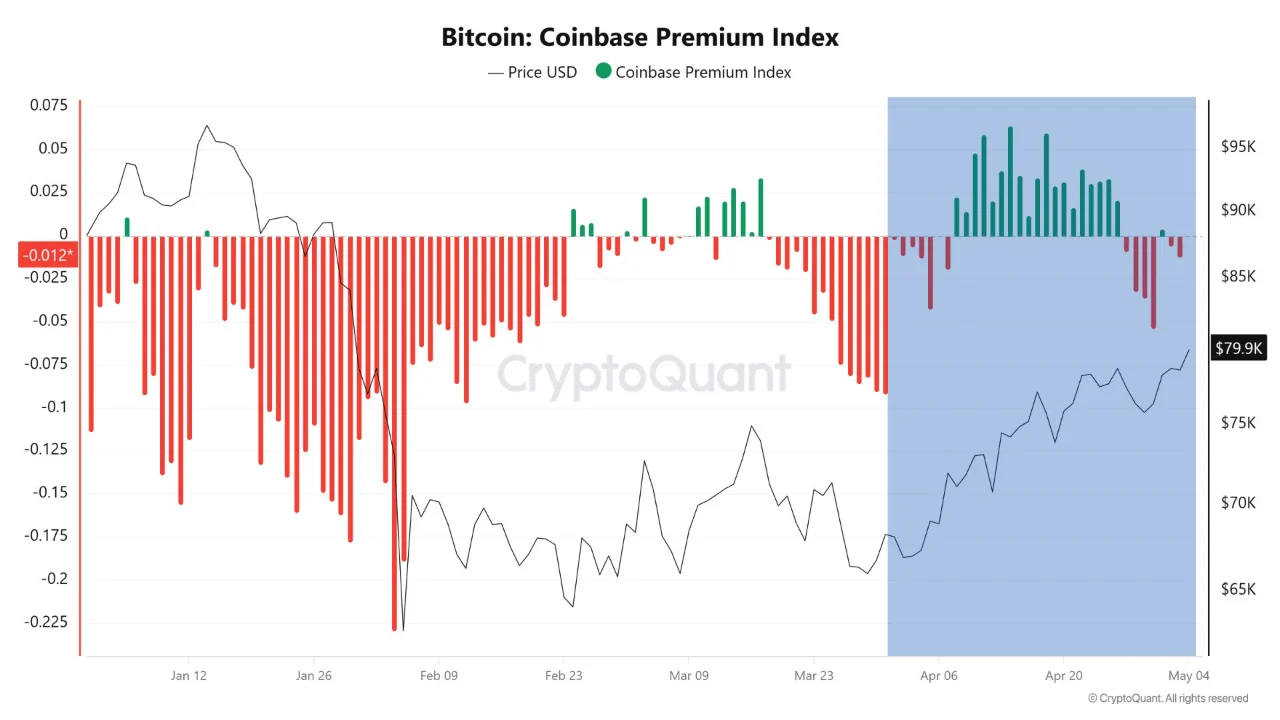
Bitcoin demand led in April while Ethereum lagged. The reading points to selective capital rotation rather than a full-market recovery. Until ETH shows stronger spot demand, Bitcoin dominance is likely to remain supported, especially with BTC still absorbing most of the market’s liquidity and ETF-driven flows.
Ethereum has recovered alongside the broader market, but its demand profile has not matched Bitcoin’s. Reduced selling pressure can help price stabilize, but sustained upside usually requires stronger spot accumulation, deeper volume, and broader participation from buyers rather than simply fewer sellers leaving the market.
Bullish Crowds Can Add Volatility
High positive sentiment is not automatically bearish, but it often changes the risk profile of a rally. When traders become heavily aligned around further upside, late long entries, crowded leverage, and reduced downside hedging can make price moves more fragile.
Santiment’s framework treats extreme retail optimism as a contrarian warning rather than a direct breakout confirmation. Bitcoin can continue climbing while sentiment stays bullish, but the chance of sharp pullbacks rises when social feeds become one-sided and traders start treating higher prices as the default path.
The current setup is already showing a stronger leverage component. Large Bitcoin traders on Hyperliquid have pushed net long exposure to a new high for the year, adding fuel to the recovery while also increasing liquidation risk if BTC fails to hold its reclaimed range.
The technical picture still revolves around the next resistance band. Bitcoin has recovered the $80,000 area, but a recent BTC technical setup placed the 200-day average near $83,000 as the level that can turn the move from a rebound into a broader expansion attempt. A weak rejection near that area would likely test whether bullish social sentiment has run ahead of spot demand.
April Fear Has Flipped Into FOMO
The shift from April fear to May optimism has been fast. Earlier bearish positioning gave Bitcoin room to rebound as weak hands exited and ETF demand returned. A recent market recovery story tied the move back above $80,000 to renewed inflows and a calmer risk backdrop.
Crypto security pressure has not disappeared. Fresh DeFi incidents, including the TrustedVolumes exploit tied to 1inch resolver infrastructure, have kept risk management in focus even as Bitcoin sentiment improves.
Bitcoin’s stronger price, rising social optimism, and heavier long positioning now sit in the same trade. Sustained ETF demand and a clean move above the $83,000 area would give bulls stronger confirmation, while a loss of the $80,000 zone would expose late longs that entered after the sentiment spike. The next Bitcoin move is likely to be shaped less by social excitement alone and more by whether spot demand can keep absorbing leverage-driven positioning near resistance.



Be the first to comment