


Nvidia is still one of the largest winners of the AI boom, but its stock is now lagging the wider semiconductor trade by the largest relative margin in more than two years. The latest market screens show NVDA underperforming chip peers even as the broader semiconductor group pushes higher on AI infrastructure demand, memory pricing, and earnings momentum.
NVDA recently traded near $207, up more than 5% on the day, while the VanEck Semiconductor ETF (SMH) and iShares Semiconductor ETF (SOXX) also gained about 5%. The daily move looked strong on the surface, but the relative-performance gap has built over longer windows. Barron’s placed Nvidia among the weakest performers in the PHLX Semiconductor Sector Index over the past month and quarter, even as AMD, memory stocks, and other chip names accelerated.

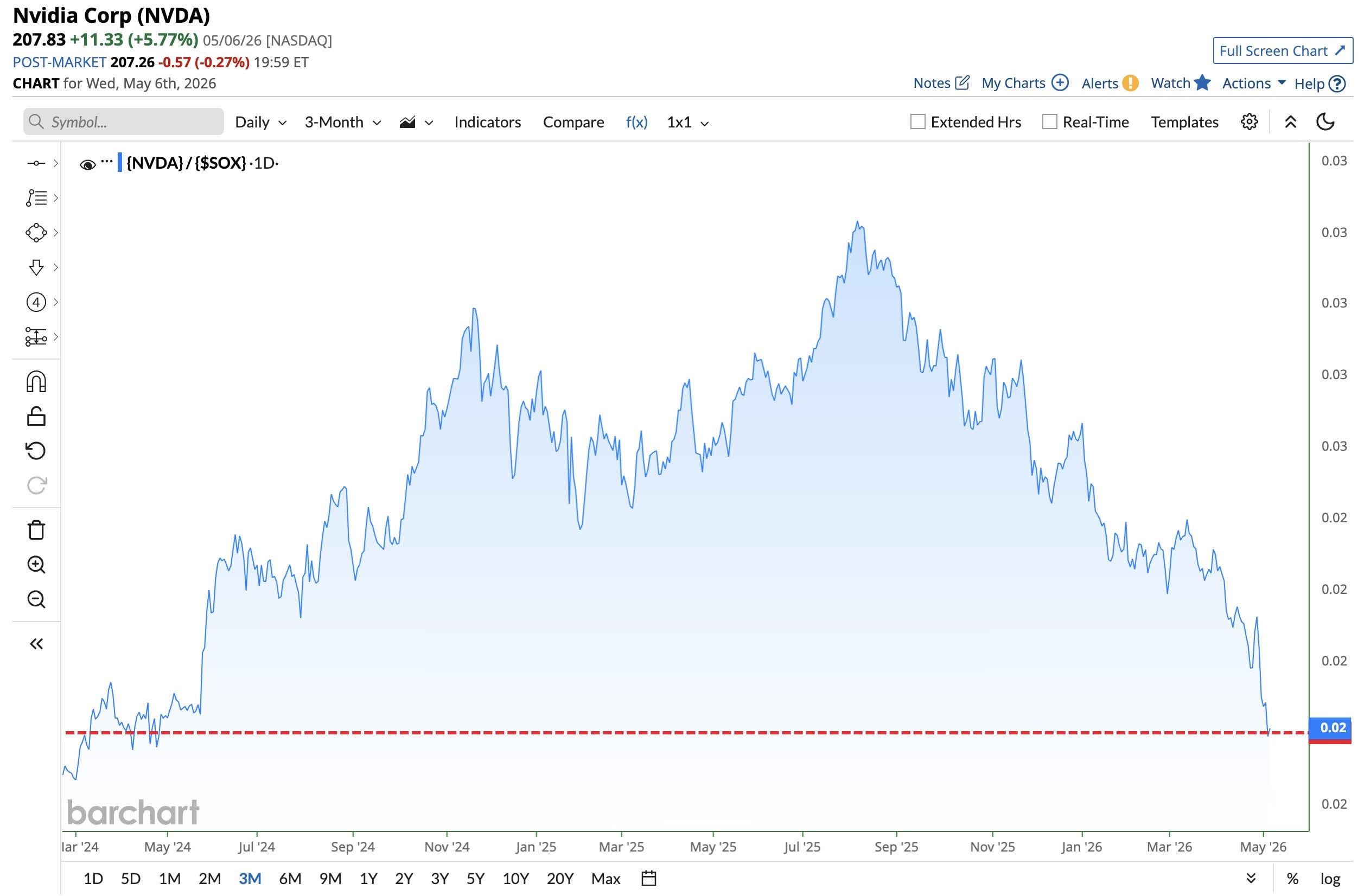
The underperformance is not about Nvidia losing its role in AI. The company still dominates high-end accelerator demand and remains central to training and inference infrastructure. The stock problem is valuation, scale, and rotation. With Nvidia already worth more than $5 trillion, smaller semiconductor names can react more aggressively to earnings beats, AI supply deals, or fresh data-center orders.
AMD, Memory And Storage Stocks Take More Attention
AMD has become one of the clearest beneficiaries of the rotation. The stock jumped after stronger results and guidance, helped by data-center demand, AI accelerator traction, and server CPU growth. Investors are no longer only rewarding the company with the largest GPU share. They are also buying the suppliers that can capture AI spending through CPUs, memory, storage, networking, and data-center infrastructure.
That is the same theme behind the recent AI chip supercycle across the semiconductor market. Capital has moved into a broader hardware stack as AI models require more compute, faster memory, more storage, higher-bandwidth networking, and larger power-hungry data centers.
Sandisk has shown the most extreme version of that trade. The stock has jumped almost 4,000% over the past year as AI data-center demand pushed memory and storage pricing sharply higher. The latest Sandisk breakout story placed the stock near $1,500 after its post-spin-off rally, Nasdaq-100 inclusion, and earnings-driven surge.
AI Demand Is Spreading Across The Stack
The market is also rewarding companies tied to physical AI capacity. Recent infrastructure deals have shown that the bottleneck is not only chips, but also power, cooling, data-center access, and deployment speed. Anthropic’s move to use SpaceX’s Colossus 1 compute capacity highlighted the scale of demand for Nvidia H100, H200, and GB200 systems, while also showing how AI buyers are racing to secure complete clusters rather than individual components.
Nvidia still benefits from that demand, but investors are now pricing a broader set of winners. AMD can gain from CPU and accelerator share. Sandisk can gain from NAND and enterprise storage. Networking, power, and packaging suppliers can gain from the buildout required to make AI systems work at scale.
That rotation explains why Nvidia can rise on the day and still lag the group over longer windows. The AI trade has not disappeared. It has widened. Nvidia remains the core name in the accelerator layer, while fresh momentum is moving into companies where earnings, supply constraints, and customer contracts still offer more room for upside surprise.



Be the first to comment