

Blockchains cannot naturally read the outside world. A smart contract can see wallet balances, token transfers, block numbers, and on-chain state, but it cannot know the latest Treasury fund NAV, gold reserve amount, private credit payment status, stock price, or real estate valuation without external data.
That is where oracles enter the RWA stack. Oracles connect off-chain information to on-chain systems so tokenized assets can be priced, monitored, used as collateral, or integrated into DeFi markets. For RWAs, oracle data is not only about price. It can include net asset value, assets under management, reserve balances, fund yield, collateral status, credit performance, redemption status, and issuer metadata.

Chainlink’s tokenized asset data framework captures the core problem: tokenized assets need external information such as market prices, ownership data, and reserve values because blockchains cannot access that data by themselves. Without reliable oracle data, an RWA token can exist on-chain while smart contracts remain blind to the asset behind it.
What Oracles Price In RWA Markets
RWA oracles can deliver several types of data. The simplest is market price. A tokenized commodity, stock-like product, or bond exposure may need a price feed so lending markets, dashboards, or settlement systems can value it.
The next layer is NAV. Tokenized funds and Treasury products often rely on net asset value rather than a continuous exchange price. NAV reflects assets minus liabilities and can include fund expenses, accrued yield, and portfolio value. Chainlink’s on-chain NAV work explains how smart contracts can calculate or consume NAV data for tokenized assets so valuation becomes more transparent and timely.
Another layer is proof of reserves. A tokenized or wrapped asset may need reserve data to show that off-chain or cross-chain collateral exists. Chainlink Proof of Reserve supports reserve verification for tokenized and wrapped assets, including circuit-breaker style designs when reserves fall below required levels.
RWA oracles can also carry yield, AUM, maturity, credit, custody, and transfer data. Chainlink SmartData focuses on enriched asset data such as NAV, AUM, yields, and reserves, which is exactly the kind of information tokenized funds and institutional assets need.
How Price Data Gets On-Chain
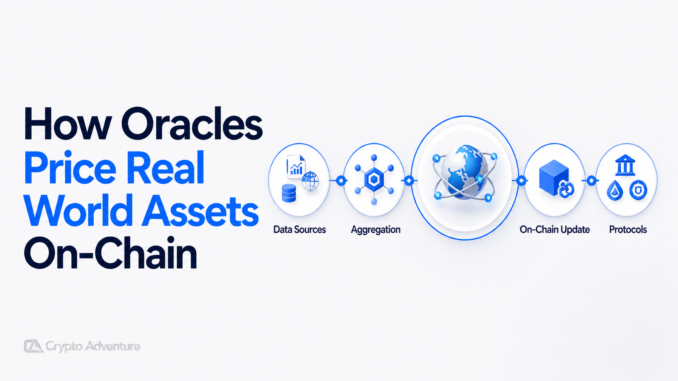
The process starts with a data source. For liquid assets, that source may be exchanges, market makers, fund administrators, custodians, benchmark providers, or trading venues. For tokenized funds, data may come from asset managers, transfer agents, administrators, or NAV calculation agents. For private credit, data may come from loan servicers, asset managers, borrower reports, and payment data.
The oracle network then validates, aggregates, or transmits that information into a smart contract-readable format. A DeFi lending protocol can use the feed to calculate collateral values. A tokenized fund can use it to publish NAV. A stablecoin or wrapped asset can use reserve feeds to prevent minting when collateral is insufficient.
This design turns off-chain financial data into programmable information. The result is not only a displayed price. It is data that can trigger borrowing limits, liquidations, subscriptions, redemptions, transfers, or risk controls.
NAV Is Not The Same As Market Price
RWA pricing often depends on NAV, not a spot market price. This matters because many real-world assets do not trade every second. A money market fund, private credit vehicle, or tokenized real estate product may have a calculated value rather than a deep order book.
NAV can be more stable than market price, but it can also lag. If the underlying assets are liquid Treasuries, NAV may update reliably. If the assets are private loans or property, the valuation may depend on models, appraisals, repayment data, and manager reporting.
Users should understand what the oracle is publishing. A price feed based on liquid market trades is different from a NAV feed based on administrator calculations. Both can be valid, but they serve different purposes and carry different risks.
Proof Of Reserve And Backing Data
For tokenized assets, reserves are part of price confidence. A token can trade near a target value because users believe it is backed by real assets. If reserves weaken, the token price can break away from the intended value.
Proof-of-reserve feeds can help smart contracts monitor whether backing exists. A lending market, bridge, stablecoin protocol, or tokenized asset platform can use reserve data as a risk control. If backing falls below a threshold, the protocol can pause minting, reduce collateral value, restrict borrowing, or alert users.
Reserve feeds are not a complete audit by themselves. They need reliable data sources, named custodians, clear methodology, and legal rights behind the reserve. They are strongest when combined with issuer reporting, independent attestations, smart contract controls, and transparent redemption rules.
Oracle Risk
Oracle risk appears when the data is wrong, late, incomplete, or manipulated. In RWA markets, bad oracle data can cause incorrect collateral values, unfair liquidations, bad redemptions, or mispriced token transfers.
The first risk is stale data. A private asset valuation that updates monthly should not be treated like a live exchange price. The second risk is source quality. A feed is only as strong as the underlying administrator, exchange, custodian, or issuer reporting. The third risk is methodology. Users need to know whether the feed shows NAV, mark-to-market price, reserve value, redemption value, or another metric.
The fourth risk is integration design. A DeFi protocol may use a correct feed incorrectly. For example, a restricted RWA token may have a reliable NAV, but if the protocol cannot liquidate it during stress because transfers require whitelisting, the collateral value may be overstated.
Why RWA Oracles Are Harder Than Crypto Price Feeds
ETH/USD pricing can be built from deep exchange liquidity. Many RWA assets do not have that simplicity. A tokenized fund may need administrator NAV. A private credit pool may need borrower payment data. A real estate product may need appraisals and net operating income. A commodity token may need vault records and physical redemption rules.
This makes RWA oracle design more like financial data infrastructure than ordinary crypto price feeds. The oracle must understand asset type, issuer, custodian, rights, restrictions, and valuation timing.
RWA data platforms and schemas track more fields because the asset is more complex. A token balance alone cannot explain whether the asset is liquid, redeemable, restricted, backed, or correctly valued.
How Users Should Evaluate RWA Oracle Data
Users should first identify the metric. Is the feed showing price, NAV, reserve value, yield, AUM, or redemption value? Each metric answers a different question.
Next comes update frequency. A feed that updates daily, weekly, or monthly should not be used like a real-time trading price. The underlying asset controls the right update cadence.
Then comes source quality. Strong feeds use credible administrators, custodians, exchanges, issuers, benchmark sources, or reserve attestations. Weak feeds depend on opaque calculations or single-party reporting without safeguards.
Finally, users should check protocol use. If an RWA token is collateral, the lending market should account for transfer restrictions, redemption timing, liquidation routes, and oracle delay. A good price feed does not solve a bad market design.
Conclusion
Oracles price real-world assets on-chain by turning off-chain financial data into smart contract-readable information. That data can include prices, NAV, reserves, yield, AUM, custody, and credit metrics.
RWA oracles are harder than ordinary crypto price feeds because the underlying assets are legal and financial claims, not only liquid tokens. The strongest oracle systems combine reliable sources, clear methodology, reserve transparency, suitable update frequency, and careful protocol integration. Users should always check what the oracle measures, how often it updates, and whether the protocol using it understands the real asset behind the token.


Be the first to comment