


What to know:
- NVIDIA stock has rallied to a $5.5 trillion valuation within three-and-a-half years amid artificial intelligence expansion.
- NVIDIA managed to reach a record valuation of $5.5 trillion in spite of earning no money from China owing to the US semiconductor export regulations.
- Compute networks Render, Akash Network, and io.net will be using Nvidia GPUs for AI infrastructure support.

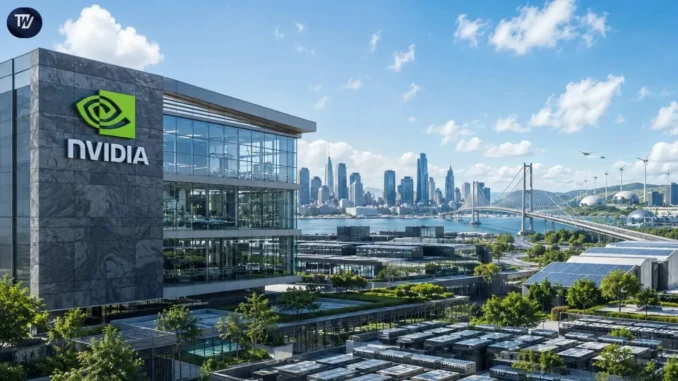
NVIDIA market cap has surged to an unprecedented $5.5 trillion, making the chipmaker the first publicly traded company to achieve the historic valuation milestone. The rally reflects continued investor confidence in the company’s leadership across artificial intelligence infrastructure, high-performance GPUs, and data center technologies despite intensifying geopolitical and competitive pressures globally.
Shirish mentioned in X post that Nvidia became worth almost $5.5 trillion, while the value of the company was around $400 billion only three-and-a-half years ago. The recent rise of the NVIDIA market cap became a great example of AI infrastructure expansion, demonstrated in the ongoing investment period.
However, despite the incredible success of the company, Nvidia is still not earning anything from China, due to existing restrictions on exports of Nvidia chips used to build artificial intelligence solutions to China imposed by the United States.

Also Read | CFTC Backs Kalshi as Ohio Targets Prediction Markets
NVIDIA Market Cap Growth Fueled by AI Infrastructure Demand
Investor optimism has remained strong as global demand for AI training and inference hardware continues accelerating across hyperscalers, enterprises, and sovereign AI initiatives. NVIDIA market cap has significantly outperformed major technology competitors during the AI boom, benefiting from expanding enterprise adoption and increasing infrastructure spending tied to next-generation artificial intelligence deployment worldwide.
Analysts have also emphasized the rise of Nvidia’s dominance in AI compute infrastructure amid shifting workloads towards more sophisticated autonomous systems. Agentic inference, characterized by AI reasoning, planning, and performing a series of actions, will likely demand a considerable increase in computing capabilities compared to the simple response generation inferences commonly found in existing commercial settings.
NVIDIA’s strategy of combining GPU architectures, network devices, and CUDA software platforms has helped boost the company’s competitiveness as clients look to optimize infrastructure for the processing of increasingly complex AI workloads on an enterprise-wide level.
Crypto and Web3 Face GPU Infrastructure Challenges
Another area that NVIDIA’s expanding grip on AI computing infrastructure may impact is that of cryptocurrencies and Web3. Decentralized compute networks like Render, Akash Network, and io.net rely extensively on Nvidia GPUs to enable distributed computing services utilized for artificial intelligence and machine learning algorithms in decentralized settings.
Given the ever-increasing complexity of artificial intelligence workloads, the surge in demand for Nvidia market cap equipment may create challenges for decentralized GPU markets.
The industry continues to watch whether decentralized compute networks can compete effectively against vertically integrated AI infrastructure solutions owned by Nvidia and large hyperscale technology corporations that operate on an enterprise-wide basis across the globe.
Also Read | Coinbase Loans Surpass $2.3 Billion After Solana Integration Launch



Be the first to comment