

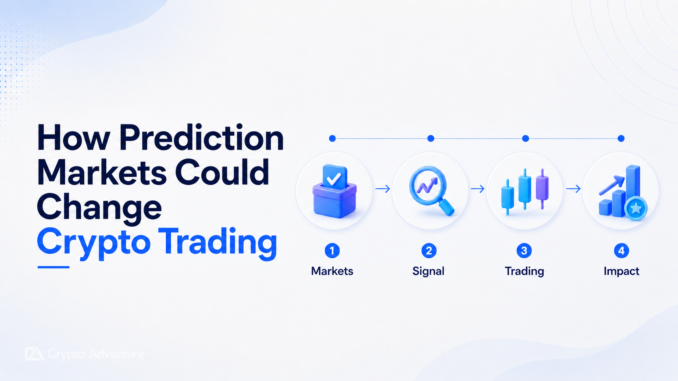
Prediction markets turn uncertain events into tradable contracts. A user can buy or sell exposure to a defined outcome, such as whether Bitcoin closes above a level, whether a central bank cuts rates, whether a candidate wins an election, or whether a protocol launch happens by a specific date. The price becomes a live probability signal, not just a chart or opinion thread.
That creates a new layer for crypto trading. Traditional crypto markets revolve around spot tokens, perpetual futures, options, staking, liquidity pools, and onchain flows. Prediction markets add event exposure. Instead of asking only whether BTC will rise or fall, traders can isolate specific catalysts: ETF approval odds, election outcomes, inflation surprises, token launches, exchange listings, court decisions, or protocol upgrades.

The category is no longer niche. Polymarket’s volume milestone shows how quickly event-based trading has become part of the crypto information cycle. The next phase may not be prediction markets replacing spot or perps. It may be prediction markets becoming another instrument inside the same trading stack.
From Opinions To Tradable Probabilities
Crypto trading is crowded with opinions. Analysts publish price targets. Influencers post charts. Traders argue about narratives. Prediction markets compress those views into a live price. A YES contract trading near 70 cents implies the market is pricing that event around 70%, although spreads, fees, liquidity, and participant bias can distort the clean probability reading.
Polymarket helped popularize this format with YES/NO outcome tokens and order-book trading. Kalshi brings event contracts into a regulated U.S. exchange structure. Hyperliquid HIP-4 pushes the idea into a trading-native onchain environment, where outcome contracts can sit closer to spot and perpetual markets.
That shift matters because price discovery becomes more granular. A BTC trader may no longer need to express every thesis through spot or perps. A macro-focused user can trade the outcome directly. A hedger can offset a specific event risk. A market maker can quote probability around news rather than only token price.
Better Hedging Around Crypto Catalysts
Prediction markets could make crypto hedging more precise. Perps and options are useful, but they often hedge price movement rather than the event itself. A trader worried about a court ruling, governance vote, ETF decision, or macro release may not want broad short exposure. They may want exposure to that exact outcome.
A user holding BTC spot could use an event contract to hedge a short-term downside catalyst without closing the long-term position. A perp trader could combine perpetual futures with an outcome market around a specific settlement level. A DeFi user exposed to a governance vote could buy event protection if liquid markets exist.
This is where prediction markets may connect with the same decision path as spot vs perps. Spot gives ownership. Perps give leveraged exposure. Prediction markets give bounded event exposure. Together, they allow more precise trade construction.
New Liquidity Around News
Crypto markets already trade news aggressively. The difference is that most news trading flows through token prices. If a lawsuit matters for XRP, traders buy or sell XRP. If an ETF decision matters for BTC, traders buy or sell BTC. Prediction markets can separate the event from the asset.
That separation can improve market structure. A trader may believe an ETF decision will be approved but also believe BTC is overextended. Instead of taking a messy long BTC position, the trader can express the approval view directly if a liquid market exists. Another trader can take the opposite side without shorting BTC.
The result is cleaner information. Token prices combine many forces: liquidity, macro conditions, leverage, market-maker positioning, funding, investor flows, and unrelated risk appetite. Event contracts isolate one question. That can make crypto markets more readable, especially around binary catalysts.
The Professionalization Problem
Prediction markets look simple, but they are not easy money. Markets can become dominated by faster, better-capitalized, and better-informed traders. Recent Polymarket profit concentration data shows why casual users should treat prediction trading as competitive finance rather than a public poll with payouts.
The same problem exists in perps and spot, but prediction markets add event-specific information gaps. A trader with better polling models, legal access, sports data, order-flow tools, or research speed can have a major edge. In thin markets, a single informed trader can move odds before casual users understand why.
This means prediction markets could change crypto trading in two directions at once. They can democratize probability data for everyone watching the market, while still concentrating profits among the participants with the best information and execution.
Composability With DeFi And Perp DEXs
The most crypto-native future is not just a prediction-market app. It is prediction markets as composable financial primitives. Outcome tokens could be used in structured products, collateral rules, hedging vaults, risk dashboards, governance markets, and trading strategies.
Hyperliquid’s HIP-4 is important because it places outcome contracts near a high-performance onchain trading system. That could let active users trade BTC outcomes, spot assets, and perps inside one environment rather than moving between isolated apps. It also gives market makers a reason to quote outcome risk beside existing crypto derivatives.
This is where prediction markets overlap with the broader perp DEX evolution. DeFi derivatives are moving away from simple swaps and toward full market infrastructure: order books, collateral systems, fee tiers, oracles, and risk engines. Outcome markets fit naturally into that expansion if settlement quality and liquidity improve.
Main Risks
The biggest risk is resolution. A market can trade well and still fail if the outcome rules are unclear. Prediction markets need strong oracle design, objective settlement sources, dispute paths, and wording that does not create confusion when real events become messy.
The second risk is legal classification. Event contracts can touch derivatives law, gambling rules, sports betting, elections, commodities, and consumer protection. Kalshi’s regulated model and the CFTC’s 2026 event-contract rulemaking process show that this market is still moving through active regulatory definition.
The third risk is insider information. Prediction markets can be exposed to private knowledge about events, court decisions, government actions, sports injuries, company launches, and political moves. That makes surveillance and market design central to long-term credibility.
Conclusion
Prediction markets could change crypto trading by adding a direct market for events, probabilities, and information. Instead of forcing every thesis through spot tokens or perpetual futures, traders can isolate specific outcomes and build cleaner hedges around catalysts.
The strongest opportunity is integration. Polymarket proved the consumer demand. Kalshi pushed event contracts through a regulated exchange model. Hyperliquid HIP-4 shows how outcome markets can become part of an onchain trading stack beside spot and perps.
The category will not be risk-free. Liquidity, legal status, oracle quality, insider information, and professional trader dominance all matter. Prediction markets become valuable when they produce useful probability signals and tradable hedges. They become dangerous when users mistake a simple YES/NO interface for a simple market.


Be the first to comment