

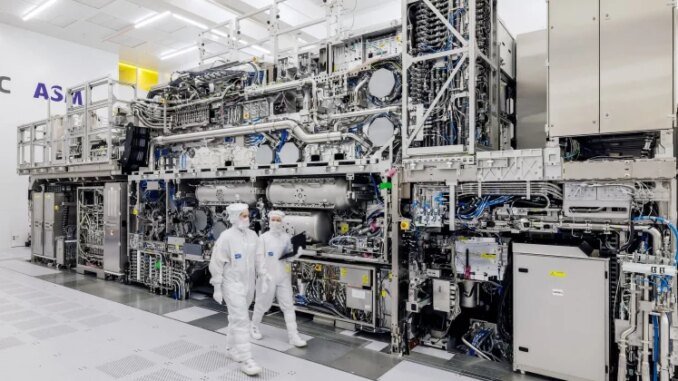

India just took its most concrete step toward becoming a semiconductor manufacturing nation. Tata Electronics and ASML, the Dutch company whose lithography machines are essentially the beating heart of every advanced chip fab on Earth, announced a partnership on May 16 to develop India’s first commercial 300 mm semiconductor wafer fabrication plant.
The facility, located in Dholera, Gujarat, represents an investment of approximately 91,000 crore rupees, roughly $11B to $12B.
What the Dholera fab actually looks like
The plant is designed to produce 50,000 wafers per month, focusing on chips built at 28 to 110 nanometer process nodes. These aren’t the bleeding-edge 3 nm chips powering the latest iPhones or Nvidia GPUs. They’re the workhorses of the semiconductor world: analog and logic chips that go into cars, industrial equipment, telecom infrastructure, and consumer electronics.
The partnership goes beyond simply shipping machines to Gujarat. It includes the deployment of ASML’s advanced lithography tools, training programs for local talent, and the development of R&D infrastructure.

The announcement was made during Indian Prime Minister Narendra Modi’s visit to the Netherlands, framed as part of a broader India-Netherlands alliance in critical technologies.
Building on the PSMC foundation
This isn’t Tata Electronics’ first move in chipmaking. The Dholera fab builds on an earlier technology transfer agreement with Taiwan’s Powerchip Semiconductor Manufacturing Corporation, or PSMC. That deal provided Tata with the foundational manufacturing know-how needed to operate a fab. ASML’s partnership layers on the critical equipment and technical support.
Tata’s total investment in semiconductor technology reportedly reaches $14B, including collaborations with Intel. The Dholera fab is the flagship project, but it sits within a broader strategy to position Tata Electronics as a vertically integrated player in chip manufacturing and assembly.
What this means for investors
The 28-110 nm node range is strategically smart. These mature process nodes are where demand is most stable and where the capital expenditure per unit of capacity is far more manageable than chasing cutting-edge nodes. Companies like GlobalFoundries and UMC have built profitable businesses precisely in this space.
For ASML, the partnership opens a new market for its tools at a time when the company faces export restrictions on selling its most advanced EUV systems to China. India’s fab won’t need EUV, since 28 nm and above uses older deep ultraviolet (DUV) lithography, but it’s still a meaningful new revenue stream and a long-term relationship with what could become a significant chipmaking nation.
Investors watching this space should track three things: construction timelines for the Dholera facility, any announcements about anchor customers committing to wafer purchases, and India’s progress on building the supporting ecosystem of chemical suppliers, equipment maintenance firms, and specialty gas providers that every fab depends on.



Be the first to comment