
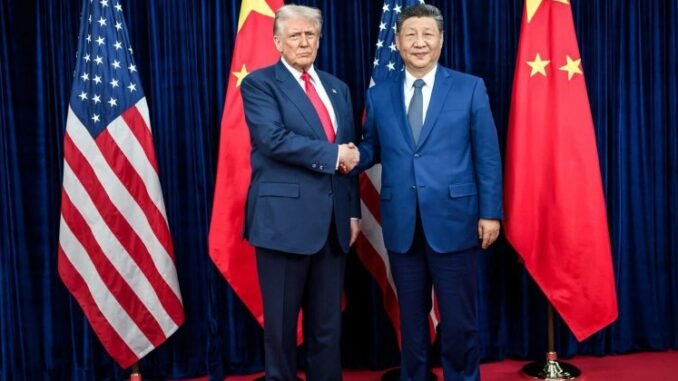

The US and China just shook hands on what the White House is calling a landmark trade agreement. The deal spans tariffs, critical minerals, fentanyl precursor controls, semiconductor disputes, and agricultural market access, touching virtually every friction point that has defined the economic relationship between the world’s two largest economies.
What’s actually in the deal
China has committed to issuing general licenses for exports of rare earths, gallium, germanium, antimony, and graphite. These are the building blocks of everything from electric vehicle batteries to advanced semiconductors to defense systems.
China is also suspending expanded export controls that were announced on October 9, 2025.
On the fentanyl front, China has agreed to controls on precursor chemicals, the raw ingredients that flow through supply chains (often via Mexico) before ending up as synthetic opioids on American streets.

The deal includes an end to retaliatory tariffs and investigations that had been targeting US semiconductor firms.
The agreement also includes expanded market access for US agricultural products.
The ghost of phase one
The phase one trade deal, signed in January 2020, was similarly ambitious in scope. That deal was widely criticized for one simple reason: China didn’t meet its purchase commitments. The agreement called for substantial increases in Chinese purchases of US goods, and the targets were never hit. Some of the shortfall was attributable to COVID-19 disrupting global trade. Some of it wasn’t.
What this means for investors
Gallium and germanium are essential for compound semiconductors used in 5G infrastructure, military radar systems, and LED technology. Graphite is a key component of lithium-ion battery anodes. Antimony has applications in flame retardants and ammunition.
Investors would be wise to watch for three signals in the coming months. First, whether China’s general licenses for critical mineral exports translate into actual increased shipments. Second, whether the semiconductor investigation pause is formalized or remains an informal understanding. Third, whether agricultural purchase volumes actually increase or whether the commitment remains aspirational.



Be the first to comment