

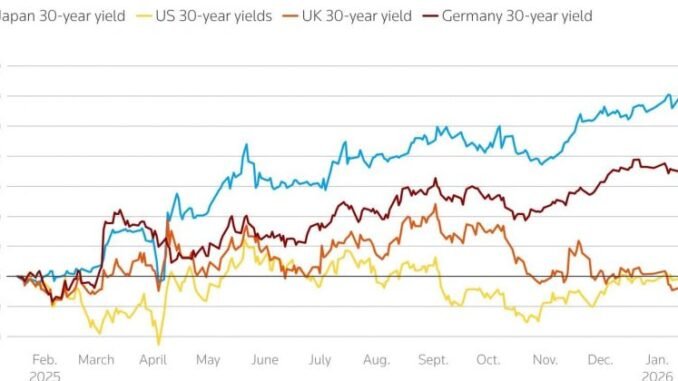

Japan’s government bond market is having a moment. And not the good kind.
JGB prices have fallen sharply as yields surged across the curve. The 30-year JGB yield hit approximately 4%, a level not seen since Japan first launched the instrument back in 1999.
The numbers tell the story
The selloff hasn’t been subtle. Japan’s 30-year yield climbed roughly 30 basis points to approximately 3.92% in recent trading, while the 40-year yield surged to around 4.24%. Both represent record highs. The 10-year yield rose to about 2.38%, its highest level in decades.
The Bank of Japan previously capped the 10-year yield at 0.5% under its yield-curve control policy. Long-term yields now exceed 4%. Over the past year alone, the 30-year yield has risen by 1.27 percentage points.

Japan carries a debt-to-GDP ratio of approximately 230%. When borrowing costs were near zero, servicing that mountain of debt was manageable. At 4% on the long end, the math starts to get uncomfortable.
Why this matters beyond Tokyo
Japan is the world’s largest net foreign creditor, holding roughly $5 trillion in overseas assets. Japanese institutional investors have been some of the biggest buyers of US Treasuries, European sovereign debt, and corporate bonds for decades. With JGBs suddenly offering yields that look attractive relative to their historical baseline, there’s a strong incentive for Japanese capital to come home.
Japan’s Government Pension Investment Fund, the world’s largest pension fund at roughly $1.8 trillion in assets, is already reevaluating its bond allocations. If GPIF and similar institutions shift even a modest portion of their foreign bond holdings back into JGBs, the downstream effects could push US and European yields higher.
What this means for crypto investors
Rising bond yields globally create a gravitational pull on risk assets, and crypto is no exception. Higher yields mean tighter financial conditions. Tighter financial conditions mean less liquidity sloshing around looking for a home in speculative assets. Bitcoin and other digital assets have historically been sensitive to these dynamics, rallying when liquidity is abundant and struggling when it contracts.
If Japanese institutional repatriation of capital puts upward pressure on US Treasury yields, the Federal Reserve’s calculus gets more complicated. Higher long-term rates driven by foreign selling, rather than domestic inflation, create a different policy challenge.



Be the first to comment