

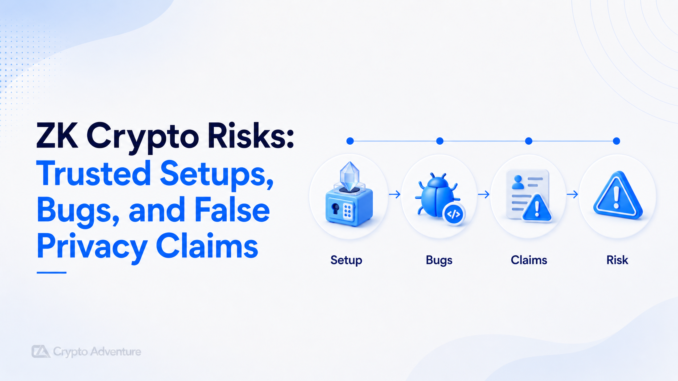

Zero-knowledge technology is one of the most important areas in crypto. It can help blockchains scale, protect user privacy, verify identity attributes, prove reserves, support private DeFi, and reduce unnecessary data exposure. The technology is powerful, but it is not magic.
A ZK system can be mathematically impressive and still fail in practice. The proof circuit can contain a bug. The trusted setup can be mishandled. The app can leak metadata. The front end can expose users. The issuer behind a credential can be weak. A protocol can use ZK language while revealing more than users expect.

That is why ZK risk needs plain-language analysis. Users should not assume that any product with “ZK” in the name automatically provides privacy, security, or decentralization. ZK proves a specific statement under specific assumptions. Everything around that proof still matters.
Trusted Setup Risk
Some ZK systems need a trusted setup. This is a process that generates public parameters used by the proof system. If the secret material from the setup, often called toxic waste, is preserved or reconstructed by an attacker, the system can become unsafe.
Multi-party ceremonies reduce this risk because security can hold if at least one honest participant destroys their secret contribution. That does not make the setup irrelevant. It means users and builders need to understand which proof system is being used, whether it needed a trusted setup, how the ceremony was handled, and whether parameters are circuit-specific or universal.
Ethereum’s zero-knowledge overview explains the basic setup trade-off clearly: some zk-SNARK systems rely on shared reference strings generated through ceremonies, while other proof systems avoid the same setup assumptions. For users, the practical point is simple. A trusted setup is not automatically bad, but it is a real security assumption.
Circuit Bugs
A ZK proof only proves what the circuit actually checks. If the circuit is wrong, the proof can verify the wrong thing. This is one of the most dangerous ZK risks because the user may see a valid proof and assume the whole system is safe.
A privacy circuit may fail to hide a detail. A bridge circuit may accept an invalid state transition. A rollup circuit may miss an edge case. A compliance proof may verify eligibility incorrectly. A proof-of-reserves circuit may prove a partial fact while leaving liabilities outside the statement.
This is why audits matter so much in ZK systems. A normal smart contract audit is already difficult. A ZK audit has to examine contracts, circuits, constraints, witness generation, proof verification, trusted setup assumptions, and integration logic. Broader smart contract security becomes even more important when the bug may sit inside the proof logic rather than the visible contract only.
False Privacy Claims
The most common user-facing ZK risk is false privacy. A project may use zero-knowledge proofs, but that does not mean every part of the product is private. The proof may hide one attribute while the wallet address, IP address, timing pattern, transaction graph, or application account still reveals the user.
This is especially important in private DeFi. A shielded transfer can protect amounts or links, but the user can still leak information by depositing and withdrawing predictable amounts, using the same address pattern, interacting through a tracked front end, or moving funds immediately to a known exchange account.
False privacy can be worse than no privacy because it changes behavior. A user who knows a transaction is public may act carefully. A user who believes a weak privacy claim may expose themselves while thinking they are protected.
Metadata Leakage
Zero-knowledge proofs hide the statement’s secret input, not every surrounding signal. Metadata can still reveal the user’s behavior. The app may log IP addresses. The wallet may reuse addresses. The browser may leak fingerprints. Transaction timing can connect deposits and withdrawals. Gas payments can reveal links. Bridge paths can connect activity across chains.
The same problem appears in ZK identity. A user may prove they are eligible without revealing their identity, but repeated proofs, reused nullifiers, app analytics, or login patterns can still connect sessions. Privacy depends on the whole flow, not only the proof.
Good ZK design tries to reduce linkability at every layer. Bad design treats the proof as enough and ignores the environment around it.
Prover And Performance Risk
ZK systems can be computationally heavy. Proof generation may require special hardware, long processing time, memory, or optimized software. If proving is too slow or too expensive, users may avoid the privacy path and use a public path instead.
Performance also affects decentralization. If only a few powerful operators can generate proofs efficiently, the system may become dependent on specialized provers. That can create censorship, availability, fee, or centralization risk even when verification remains cheap.
This matters for ZK rollups, private applications, and proof-based identity. The product has to work under real user conditions. A privacy feature that is technically elegant but slow, expensive, or unreliable may not protect many users in practice.
Upgrade And Governance Risk
ZK systems often need upgrades as circuits improve, bugs are fixed, proof systems evolve, or performance gets optimized. Upgradeability can protect users when problems appear. It can also create governance risk.
A privileged admin, upgrade council, multisig, foundation, or sequencer may have the power to change critical parts of the system. If users do not understand who can upgrade circuits, pause contracts, replace verifiers, or alter proving rules, they may overestimate decentralization.
This is especially important for privacy systems because users may rely on them for sensitive behavior. A governance change that weakens privacy, changes disclosure rules, or exposes historical assumptions can create lasting damage.
Trusted Issuer And Credential Risk
ZK proofs used for identity or compliance often depend on issuers. The proof may confirm that a user holds a valid credential, but the credential still came from someone. If that issuer performs weak checks, stores data insecurely, refuses to revoke bad credentials, or becomes compromised, the ZK proof only verifies a weak process.
This is why selective disclosure should be evaluated as a full identity system, not only a cryptographic feature. Issuer quality, revocation, recovery, wallet control, and verifier behavior all matter.
How Users Should Evaluate ZK Claims
Users should ask what the ZK proof actually proves. Does it hide the sender, receiver, amount, identity attribute, group membership, balance, or only one narrow detail? What remains public? Can transactions be linked through timing, wallet reuse, or withdrawal behavior? Has the system been audited? Does it require a trusted setup? Who controls upgrades? What happens if the front end is compromised?
The safest mindset is skeptical but not dismissive. ZK technology is real and valuable. The risk is marketing that turns a narrow proof into a broad privacy promise.
Conclusion
ZK crypto systems can improve privacy, scaling, identity, and verification, but they carry their own risk stack. Trusted setups, circuit bugs, false privacy claims, metadata leaks, performance bottlenecks, governance controls, and weak credential issuers can all break the user’s assumptions.
The strongest ZK projects make their guarantees narrow and clear. They explain what is hidden, what remains public, who can upgrade the system, how proofs are audited, and which trust assumptions still exist.
Users should treat ZK as a powerful tool, not a safety label. The proof matters, but the whole system decides whether the user is actually protected.



Be the first to comment