

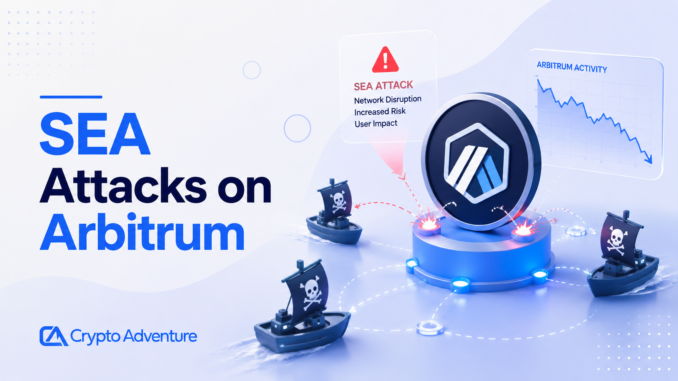


Multiple suspicious attacks involving SEA on Arbitrum have been flagged after onchain activity reportedly drained about $153,000 from affected transactions.
The alert tied the activity to multiple suspicious SEA attacks on Arbitrum, with the monitor estimating losses at roughly $153,000. One flagged Arbitrum transaction was shared as part of the incident set.

The case is still developing, and the technical root cause has not been confirmed. At publication time, the clearest public information points to suspicious onchain activity involving SEA on Arbitrum, but not to a verified postmortem explaining whether the loss came from token logic, contract permissions, approval abuse, liquidity-pool manipulation, compromised keys, or another exploit path.
Small Exploits Still Matter In A Busy Security Cycle
The estimated $153,000 loss is smaller than the largest bridge and DeFi incidents of 2026, but it still fits a wider pattern of attackers targeting narrow onchain weaknesses. Smaller attacks can move quickly, fragment across wallets, and expose contract assumptions that may not be obvious until funds are already gone.
Arbitrum has already been a focus in several recent DeFi security cases. The Aurellion Labs exploit showed how proxy and initialization controls can create real losses when ownership paths are not locked correctly. Larger Arbitrum-linked incidents have also placed emergency powers, freezes, and recovery coordination under pressure after exploited funds moved through Layer 2 infrastructure.
The SEA alert also shows why automated monitoring is becoming more important for smaller protocols and token communities. By the time a transaction becomes visible to users, the attacker may already have routed assets through swaps, bridges, or new wallets. Early detection helps teams pause contracts, revoke risky permissions, warn users, contact exchanges, and preserve transaction evidence before the trail becomes harder to follow.
What To Watch Next
The next useful updates should come from the SEA team, affected contracts, wallet labels, attacker addresses, transaction paths, and any remediation guidance for users. If token approvals are involved, users may need clear instructions on whether any approvals should be revoked. If the issue is contract-side, the key questions become whether contracts are paused, patched, migrated, or replaced.
The recovery path will depend on where the funds moved after the suspicious transactions. Assets that remain on Arbitrum may be easier to trace in real time, while funds routed through bridges, mixers, or centralized exchanges require faster coordination between security teams, infrastructure providers, and trading platforms.



Be the first to comment