

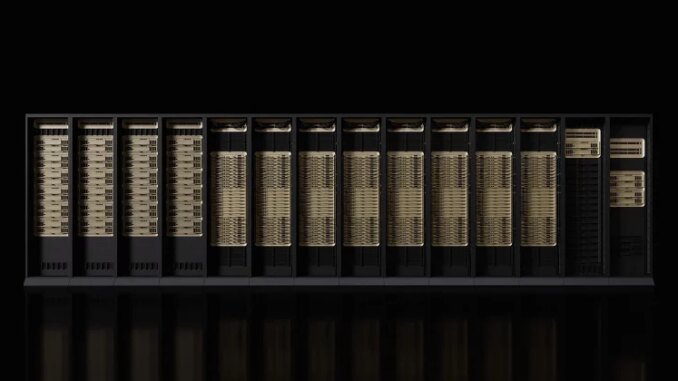

Nvidia’s Vera Rubin platform, the successor to its already dominant Blackwell architecture, is set to begin ramping AI server demand in the second half of 2026.
The company’s fiscal 2026 revenue hit $215.9B, a 65% year-over-year increase driven almost entirely by AI GPU demand. Rubin is the product line engineered to make sure that growth trajectory doesn’t flatten out.
What Rubin actually brings to the table
Nvidia claims the Rubin platform will deliver 10x lower inference token costs compared to Blackwell. On the training side, Rubin is projected to require 4x fewer GPUs for training mixture-of-experts models compared to Blackwell. Performance-per-watt improves by as much as 50x over the current Blackwell generation.
CEO Jensen Huang has positioned Rubin as a third-generation NVLink AI supercomputer, framing it as a core contributor to what he describes as a $3-4 trillion global AI factory build-out.

Production and deployment timeline
Rubin GPUs are currently under production at TSMC, with six new chips targeted for mass production in the second half of 2026.
AWS, Google Cloud, and Microsoft Azure are all preparing to integrate Rubin-based instances into their platforms during the same H2 2026 window. Microsoft, in particular, is reportedly planning to deploy hundreds of thousands of Rubin-based systems.
What this means for investors
The Rubin platform’s H2 2026 ramp has direct implications for several corners of the market beyond Nvidia itself. TSMC’s advanced packaging and manufacturing capacity will face another demand surge, which could tighten supply for other chip designers competing for the same production slots.
AMD’s MI series and custom silicon from Google (TPUs) and Amazon (Trainium) are all chasing the same workloads. But Nvidia’s software ecosystem, CUDA, remains the moat that competitors haven’t breached.
The risk to watch is execution. Six new chips entering mass production simultaneously is ambitious. Any delay at TSMC, any yield issues, any hiccup in the NVLink interconnect supply chain could push timelines into 2027 and open a window for competitors.


Be the first to comment