



Minnesota-based banking institutions and credit unions are set to offer some crypto custody services beginning in August.
On Friday, Governor Tim Walz signed House File (HF) 3709 into law, permitting “certain virtual-currency custody services to be offered and performed” by financial institutions in the US state.
One of the original sponsors in the Minnesota House of Representatives, Bernie Perryman, said in March that the bill was intended to ensure that “Minnesota-based financial institutions are allowed to evolve alongside their customers and members rather than forcing Minnesotans to rely on unregulated, out-of-state or offshore providers for services.”
The new law authorizes banks and credit unions to provide virtual-currency custody services in a nonfiduciary capacity from Aug. 1. The law amended Minnesota’s statutes to allow the financial institutions to engage “third-party service providers or subcustodians to facilitate virtual-currency custody services,” provided the funds were “legally and operationally segregated” from the bank’s or credit union’s assets and not treated as its property.

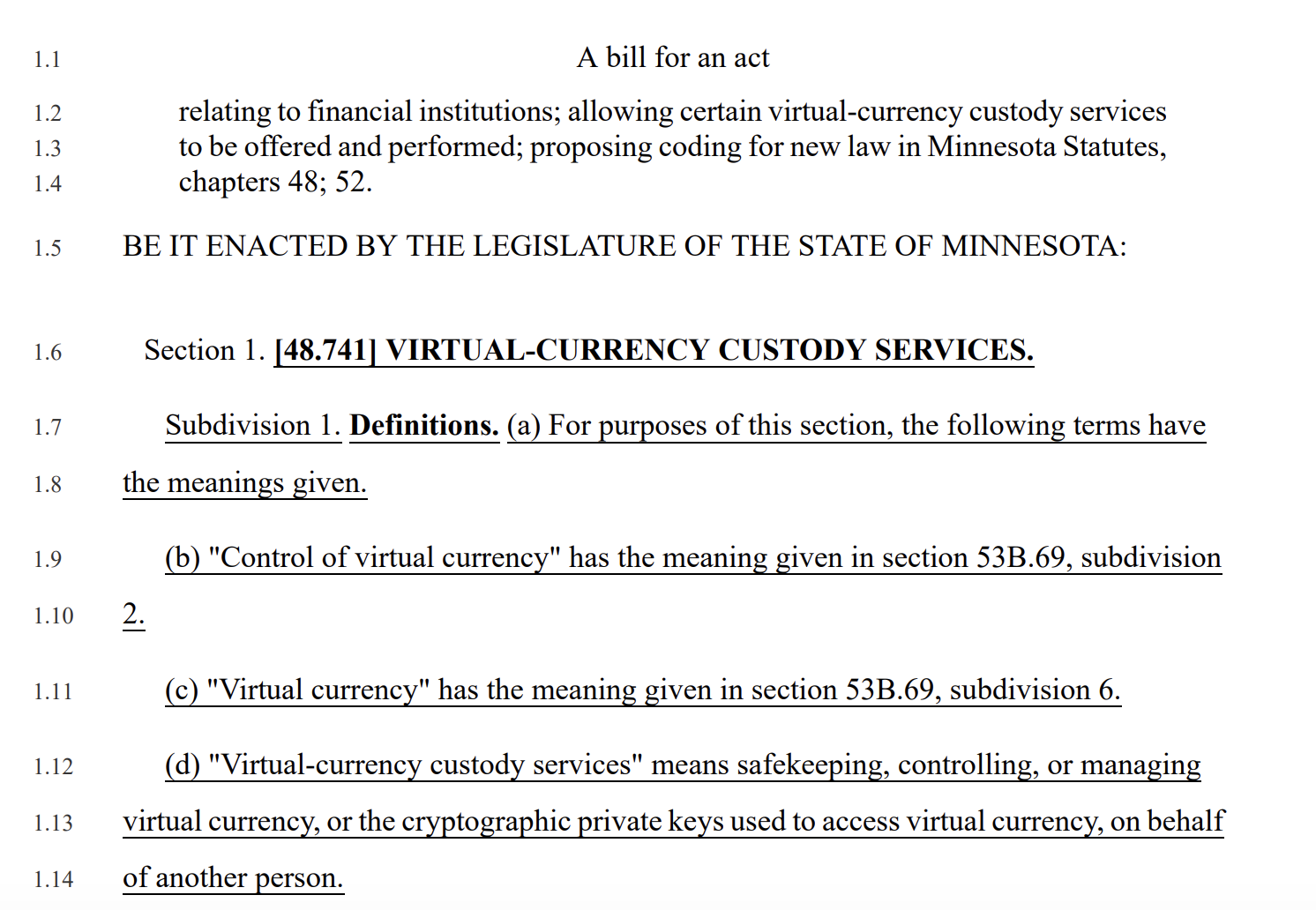
Source: Minnesota legislature
The crypto custody law could potentially affect operations at all the financial institutions in the state.
The state’s government information portal shows that, as of May 2025, there were 240 commercial insured banks operating in Minnesota, with about $128 billion in assets, and 82 member-owned credit unions under the Minnesota Credit Union Network. The country’s seventh-largest bank by total assets, U.S. Bancorp, is based in Minneapolis.
Related: Bitcoin Depot stock crashes 71% premarket after Chapter 11 filing
In addition to the crypto custody law, Minnesota lawmakers advanced a bill to ban digital asset kiosks and ATMs across the state in response to incidents of residents being scammed.
Crypto companies look to federal regulators for banking, custody services
Earlier in this month, Payward, the parent company of cryptocurrency exchange Kraken, said it had filed with the US Office of the Comptroller of the Currency (OCC) for a national trust company charter. According to the company, it planned to establish Payward National Trust Company with “fiduciary custody and other services primarily for digital assets” if approved.
Payward’s move was one of many by crypto-related companies attempting to secure federal approval under the Trump administration. The OCC approved or conditionally approved similar charter applications for Ripple Labs, BitGo, Circle, Fidelity Digital Assets and Paxos in December, and is considering a charter for World Liberty Financial, the company co-founded by US President Donald Trump and his sons.
Magazine: Bitcoin ETFs bleed $1B, Aave’s $71M ETH unfreeze bid delayed: Hodler’s Digest, May 10 – 16



Be the first to comment