




TLDR
- An a16z-linked wallet bought $90.87M worth of HYPE tokens over roughly one month.
- HYPE’s chart shows a cup-and-handle pattern, with a potential 55% rally toward $71–$72.
- HYPE gained ~7% in 24 hours while BTC and ETH posted losses.
- Hyperliquid struck a deal with Coinbase and Circle to capture up to 90% of USDC reserve income.
- Bitwise announced it will use 10% of management fees from its BHYP ETF to buy and hold HYPE.
Hyperliquid’s native token, HYPE, has been one of the better-performing crypto assets in recent weeks. On-chain data, institutional moves, and a fresh stablecoin deal have all combined to push it into the spotlight.
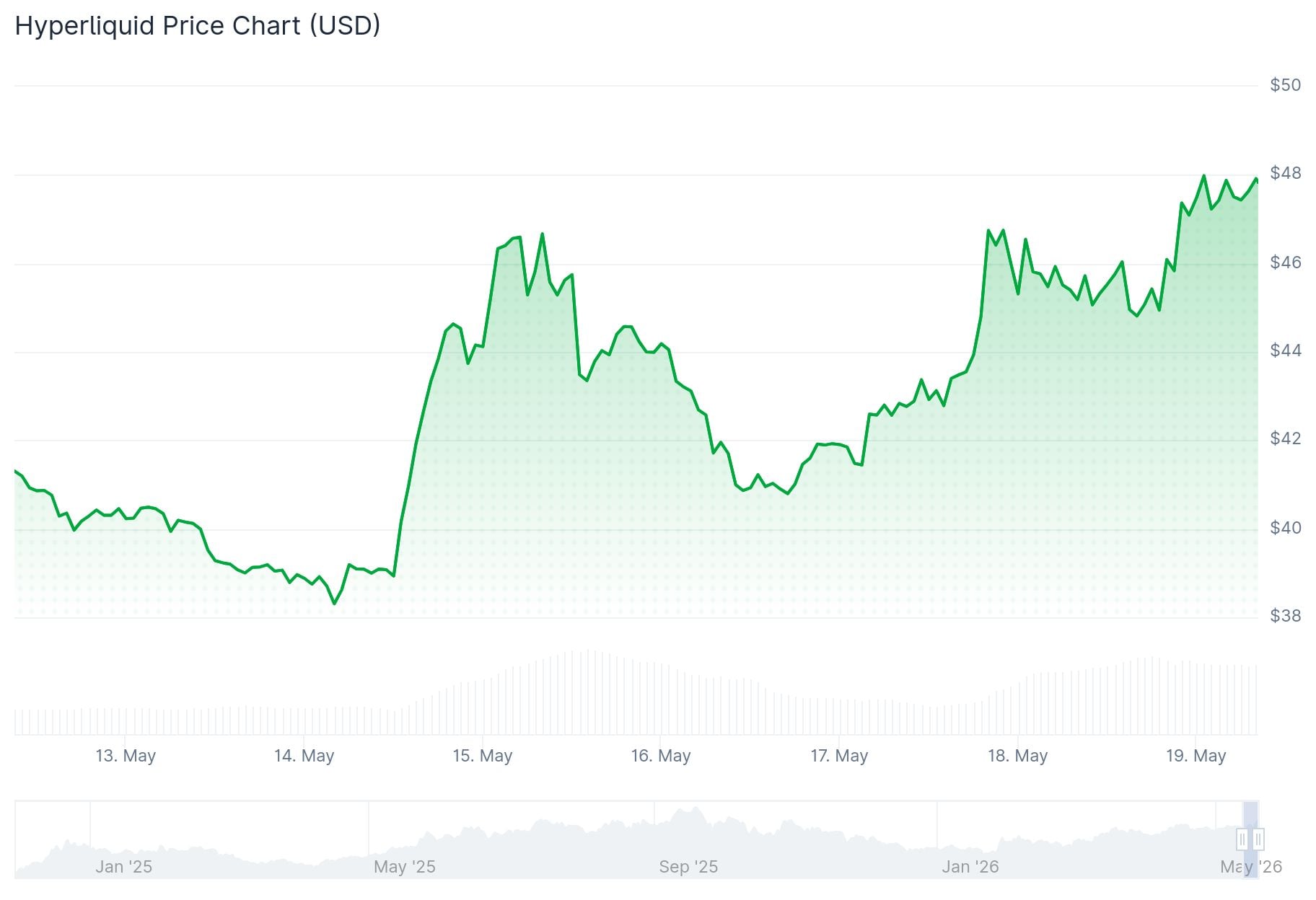
A wallet linked to venture capital firm Andreessen Horowitz (a16z) purchased 372,000 HYPE tokens — worth around $16.91 million — in just three hours on Monday. That purchase brought the wallet’s total accumulation since April 14 to 2.11 million HYPE, valued at roughly $90.87 million, according to on-chain tracking platform Lookonchain and Arkham Intelligence data.
HYPE gained about 7% in 24 hours during this period. For comparison, Bitcoin dropped 1.22% and Ether fell 2.22% over the same timeframe. Year-to-date, HYPE is up 80%, while BTC and ETH are down roughly 12.5% and 28.3% respectively.
Technical Setup Points to $71 Target
HYPE’s three-day price chart is showing what traders call a cup-and-handle pattern. This is a bullish continuation setup where price forms a rounded recovery before pausing near resistance, then breaks higher.
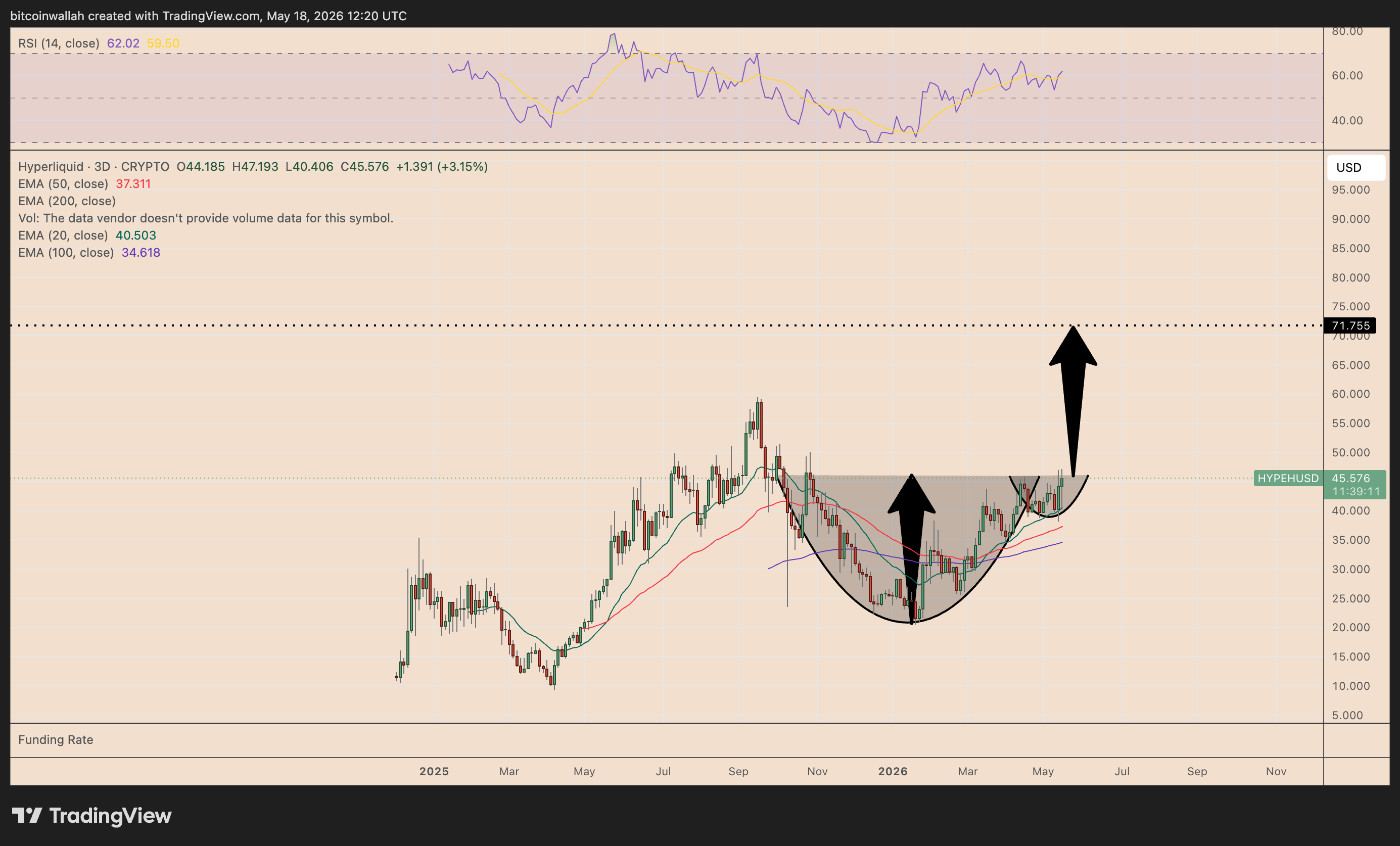
In HYPE’s case, the cup formed after the token fell from around $46 to $21, then recovered back toward the $45–$47 range. That zone now acts as the pattern’s neckline. As of Monday, the token was consolidating in a slight downward drift, forming the “handle” portion of the pattern.
If HYPE breaks above the $45–$47 neckline, the measured target based on the cup’s depth points to the $71–$72 range. That would be a new all-time high for the token, about 55% above current prices.
Trader Pentoshi commented that if the US CLARITY Act passes and allows hedge funds, prop desks, and asset managers to trade on Hyperliquid, the platform’s revenue could “grow 5x–10x.”

USDC Deal Could Redirect $160M in Annual Revenue
Hyperliquid last Thursday announced that Circle’s USDC would become the official “Aligned Quote Asset” on its exchange. Coinbase will act as treasury deployer for most USDC on the network, while Circle handles minting and cross-chain infrastructure.
Coinbase has announced its plan to activate AQAv2 on USDC as the treasury deployer, with Circle serving as the technical deployer responsible for CCTP and native cross-chain infrastructure. Both Coinbase and Circle have committed to stake HYPE to activate AQAv2. As part of this…
— Hyperliquid (@HyperliquidX) May 14, 2026
The key detail: Hyperliquid is set to receive up to 90% of the reserve income generated by USDC deposits on the platform — income that previously flowed to Circle and Coinbase. Syncracy Capital co-founder Ryan Watkins called it “Hyperliquid’s biggest announcement all year.”
With over $5 billion in USDC on the platform, analysts estimate the deal could channel $135–$160 million annually into Hyperliquid’s ecosystem through yield sharing. Compass Point analysts estimate the deal could remove $60–$80 million in annual EBITDA from Circle and Coinbase combined.
🔥HUGE: Bitwise says it will use 10% of management fees from its BHYP Hyperliquid ETF to buy and hold $HYPE on its balance sheet.
“99% of the blockchain’s revenue is used to buy back and burn HYPE tokens.” pic.twitter.com/SrBT95CGXc
— Coin Bureau (@coinbureau) May 18, 2026
Coin Bureau noted on X that Bitwise plans to allocate 10% of management fees from its BHYP ETF to buy and hold HYPE. Bitwise also highlighted that 99% of Hyperliquid’s blockchain revenue is used to buy back and burn HYPE tokens — a detail that may add further buying pressure over time.
A US spot HYPE ETF launched last week, opening a regulated access point for traditional investors.
Compass Point also warned that other DeFi protocols, including Polymarket and Jupiter, may now push for similar revenue-sharing terms with stablecoin issuers.



Be the first to comment