

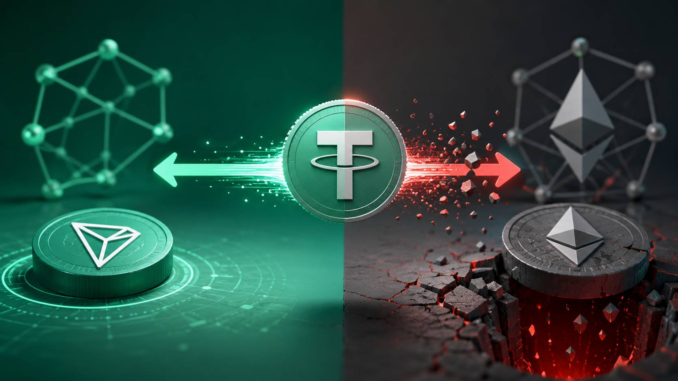


USDT is the same token across TRC-20 and ERC-20: a dollar-pegged stablecoin issued by Tether, redeemable 1:1 against the company’s reserves.
Below the token sit two completely different networks. USDT TRC-20 lives on the Tron blockchain. USDT ERC-20 lives on Ethereum.
Sending USDT to the wrong network typically results in permanent loss of funds. Wallets like IronWallet that support both networks make the distinction visible at every step, but the sender carries the responsibility to match the network to the recipient.

A wrong choice carries enough cost that the question deserves a direct answer: same token, different networks, and the wrong choice loses the money.
The Short Answer: Same Token, Different Networks
Yes and no, depending on what “same” means. The TRC-20 ERC-20 same token question has a simple answer: yes, the token is the same dollar value, but the blockchain underneath is not.
Tether issues USDT on multiple blockchains. USDT launched on the Omni layer (Bitcoin) in 2014, expanded to Ethereum as USDT ERC-20 in 2017, and to Tron as USDT TRC-20 in 2019. Solana, BNB Chain, Polygon, Avalanche, and other networks followed.
Each version represents the same underlying claim on Tether’s reserves and trades at the same dollar value. A USDT Tron Ethereum decision is a choice of which blockchain to use for the transfer, not a choice between different assets.
Architecturally, the networks are distinct. Tron uses delegated proof-of-stake with 27 super representatives processing blocks every three seconds. Ethereum uses proof-of-stake with thousands of validators and roughly 12-second block times.
Two separate ledgers, two separate address spaces, no shared transaction history.
Why TRC-20 and ERC-20 USDT Aren’t Interchangeable
Address-level differences make the distinction visible immediately. A TRC-20 wallet address starts with the letter “T” and runs 34 characters long, using base58check encoding. An ERC-20 wallet address starts with “0x” and runs 42 characters long, using hexadecimal format.
An Ethereum node has no way to read a Tron address. A Tron node has no way to read an Ethereum address. The two networks don’t share state, don’t communicate natively, and don’t recognize each other’s addresses as valid.
When IronWallet generates addresses for USDT on Tron and USDT on Ethereum, the app produces two entirely separate addresses. Each address ties to its own network, with the prefix and length differences immediately visible to the user.
Cross-chain bridges exist for moving USDT between networks, but a bridge transfer is an explicit conversion: the user burns USDT on one network and mints (or unlocks) the equivalent on the other through a separate protocol.
That process is fundamentally different from sending. A regular send transaction has no bridge logic and no fallback. If the destination network doesn’t match the address, the transaction either fails at the wallet level (best case) or completes on the wrong network with no recipient on the other side (worst case).
What Happens When USDT Goes to the Wrong Network
USDT network confusion at the send stage is the single most expensive mistake stablecoin users make.
Here is a common scenario: a sender holds USDT on Tron, selects “send” in their wallet, pastes an Ethereum address that a recipient gave them, and approves the transaction. The wallet processes the send on Tron because that’s where the USDT balance sits.
Within seconds, the transaction confirms on the Tron blockchain. Funds leave the sender’s address. The receiving Ethereum address, however, exists on Ethereum, not on Tron.
On Tron, that string of characters is not a valid recipient. The funds are effectively lost in the sense that no one controls them at the destination.
Recovery depends on the recipient type. Centralized exchanges sometimes recover funds if the exchange operates wallets on both networks and the address technically maps to one of their accounts. The process typically requires a support ticket, a fee, and weeks of waiting, with no guarantee.
Non-custodial wallet recipients face harder odds. Recovery requires the recipient to control the private keys for that same address on the other network, which most wallets don’t generate from the same seed phrase unless they were designed for multi-chain coverage.
Addressing poisoning attacks compounds the risk. Scammers seed wallet transaction histories with addresses that look similar to legitimate ones, hoping users copy the wrong address by mistake. When that mistake combines with a network mismatch, the loss is doubled: wrong recipient, wrong network, no recovery path.
When to Use TRC-20 vs ERC-20 USDT
Practical choice depends on the transfer purpose and what the recipient can accept:
-
TRC-20 for cost efficiency: TRC-20 USDT transfers typically cost under $1, and often closer to a cent or less when the sender stakes TRX for energy. Ethereum gas fees for ERC-20 USDT transfers range from $3 to $15 during normal conditions and can exceed $30 during peak congestion.
-
TRC-20 for remittances and high-frequency transfers: Tron settles transactions in roughly 3 seconds with consistent throughput. Low cost combined with fast settlement makes Tron the default for cross-border stablecoin transfers, payroll, and any use case involving multiple sends per day.
-
ERC-20 for DeFi participation: Ethereum’s DeFi ecosystem (Aave, Compound, Curve, Uniswap, MakerDAO) is built on ERC-20 token standards. Lending, borrowing, liquidity provision, and yield generation in major protocols all require ERC-20 USDT.
-
ERC-20 for institutional contexts: Ethereum’s audit infrastructure, on-chain analytics tooling, and integration with traditional finance systems make ERC-20 USDT the preferred choice for institutional treasurers, custody providers, and compliance-focused operations.
-
Match what the recipient expects: The sender doesn’t choose unilaterally. The recipient’s wallet, exchange, or platform supports specific networks. The transfer must use the network that the recipient can actually receive on.
IronWallet supports both TRC-20 and ERC-20 USDT, with gasless transfer mechanics that let users send on either network without holding TRX or ETH separately for fees.
How to Avoid the Wrong-Network Mistake
A small set of habits reduces the risk to near zero.
Verify the address format matches the network at a glance: a “T” prefix means Tron, a “0x” prefix means Ethereum (and most other EVM-compatible networks).
Confirm the network selection in the wallet send screen matches what the recipient gave you, especially when the recipient sent the address by message and the network as a separate note.
Choose a wallet that surfaces network selection clearly. IronWallet’s send flow shows the network as a distinct selection step, with the token and network labeled separately and the address format validated before the transaction can proceed.
This combination prevents the most common mistakes: selecting USDT generically without picking a network, or pasting a Tron address while the wallet defaults to Ethereum.
Send a small test transaction for first-time recipients. A $1 test on a $0.20 Tron transfer fee is the cheapest insurance available against a six-figure mistake.
Double-check exchange withdrawal screens carefully: the network selection at withdrawal is where the most expensive errors happen. Exchanges process the transaction exactly as instructed without checking whether the destination address actually exists on the chosen network.
Bottom Line
USDT on TRC-20 and USDT on ERC-20 are the same dollar-pegged token on two different blockchains. The networks are not interchangeable. A send to the wrong one typically loses the funds.
Between them, the decision is practical: TRC-20 for cost-efficient transfers, ERC-20 for DeFi and institutional use, always matched to what the recipient can receive.
Wallets like IronWallet that support both networks with clear UI cues make the correct choice obvious, but the sender still has to look. The cost of looking is a few seconds. The cost of not looking is the entire transaction.
Disclaimer: This article is provided for informational purposes only. It is not offered or intended to be used as legal, tax, investment, financial, or other advice.


Be the first to comment