

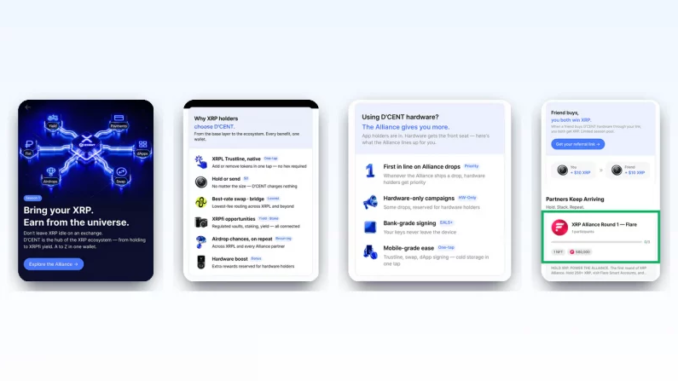

Flare’s integration with D’CENT hardware wallets connects directly to Flare-based XRP yield vaults, requiring no separate Flare wallet and no gas token to get started.
The move is paired with Flare’s announcement of an “XRP Alliance,” a coalition aimed at rallying ecosystem participants around expanding XRP’s role in decentralized finance.
What the D’CENT integration actually does
D’CENT users can now access Flare’s yield vaults directly, depositing FXRP (Flare’s wrapped version of XRP) to earn yield that auto-compounds back into XRP. No bridging to an unfamiliar chain. No buying a gas token. No downloading a third wallet app.
The yield vaults themselves were built in collaboration with Upshift and Clearstar. Strategies inside the vaults include XRP staking and liquidity provision, which generate the returns that get auto-compounded for depositors.
The earnXRP vault’s early traction
The Flare XRPFi vault hit its deposit cap of 25 million XRP, roughly $33.9 million, in just one week after launch. The vault offered a 3.4% APY, with fees waived for the first month.
Flare reported that over 5,400 participants used the Flare XRPFi Yield integration through the Xaman wallet, and the majority of them were first-time DeFi users.
The Xaman integration (previously known as XUMM) lets users access yield products directly from the XRP Ledger while maintaining self-custody.
The XRP Alliance and what it signals
The “XRP Alliance” is Flare’s attempt to formalize this strategy into something broader. The initiative aims to bring together ecosystem participants, from wallet providers to DeFi protocols, around the shared goal of making XRP more useful in decentralized finance.
The earnXRP vault structure, where FXRP deposits generate yield that compounds back into XRP, abstracts away the underlying strategies so users don’t need to understand the mechanics.
What this means for investors
The 3.4% APY on the XRPFi vault is modest, but the deposit cap filled in one week. One risk to note: the yield strategies rely on staking and liquidity provision, which carry smart contract and impermanent loss risks. Auto-compounding simplifies the user experience but does not eliminate the underlying exposure.



Be the first to comment