



Pi Network price remained under intense pressure on Monday as rising token unlock concerns, worsening technical indicators, and persistent selling from early miners continued dragging the token toward fresh multi-month lows.
Summary
- Pi Network price fell toward the $0.15 level as traders braced for over 195 million PI tokens scheduled to unlock over the next 30 days.
- PiScan data showed average daily unlocks of 6.52 million PI, with the largest single-day release of 18.22 million tokens expected on May 27.
- PI remained under technical pressure after breaking below key support near $0.164, while weak exchange liquidity and ongoing miner selling continued weighing on sentiment.
According to data from crypto.news, Pi Network (PI) price traded near $0.149 at press time on May 19 after briefly falling below the key $0.15 psychological support level earlier in the session. The token has now erased most of its post-mainnet rally gains and is down sharply from its March peak near $0.30.

The latest decline comes as traders brace for another major wave of supply expansion. Data from PiScan shows approximately 195.65 million PI tokens are scheduled to unlock over the next 30 days, representing roughly 3.17% of the currently locked supply. That equates to an average of 6.52 million PI entering circulation daily, with the largest single-day unlock expected on May 27 when over 18.22 million PI tokens are set to become available.
At current prices, the upcoming unlocks represent nearly $29.3 million worth of potential new supply entering the market. Investors increasingly fear that demand may struggle to absorb that influx, especially as liquidity on exchanges remains relatively thin compared to larger cryptocurrencies.
One of the core problems facing PI is that many early adopters acquired their holdings through mobile mining over several years at effectively zero cost. As tokens gradually migrate to the open mainnet and become transferable to centralized exchanges, many holders appear willing to sell aggressively to secure profits.
Recent on-chain activity suggests that the process is already accelerating. PiScan data indicated exchange outflows exceeding 2.55 million tokens this week alone as migration activity intensified following the latest protocol upgrade.
The growing imbalance between unlock-driven supply and still-limited buy-side liquidity has continued weighing heavily on sentiment across the PI market.
Pi Network’s broader ecosystem transition also introduced additional uncertainty this week. On May 18, the project activated its long-awaited Protocol 23 upgrade, migrating its backend architecture to Stellar Consensus Protocol v23 while introducing native smart contracts and parallel processing features.
The upgrade represented one of the largest technical milestones in Pi Network’s history, but it also coincided with elevated volatility and operational adjustments. Due to database optimization requirements tied to the migration, the Pi Core Team extended the node migration deadline from May 15 to May 19 to allow operators additional time to update their systems safely.
At the same time, developers expanded Pi App Studio with a new “vibe coding” infrastructure intended to help creators use artificial intelligence tools to rapidly build applications for the network’s user base.
In its April 2026 ecosystem update, the Pi Core Team stated that the network had surpassed 18.1 million fully KYC-verified users and over 16.72 million mainnet migrations.
“Over 100,000 Pioneers have been KYC’d and over 30,000 migrated to Mainnet,” Pi Network said in a May 11 post shared by the official PiCoreTeam account on X.
While those metrics demonstrate continued ecosystem expansion, traders increasingly view them as a double-edged sword because every successful migration potentially introduces additional transferable supply into the market.
Why are Pi Network token unlocks becoming a major concern?
The upcoming unlock schedule has emerged as one of the largest bearish catalysts currently facing PI.
Unlike many established cryptocurrencies that benefit from deep institutional liquidity and broad exchange support, PI still trades primarily on mid-tier platforms such as OKX, Bitget, and Gate.io. The token remains absent from larger exchanges, including Binance and Coinbase, limiting its ability to absorb heavy sell-side pressure efficiently.
Thin liquidity conditions can amplify volatility significantly whenever large holders decide to exit positions. Analysts note that even moderate sell waves can overwhelm existing buy orders because order books remain relatively shallow compared to more mature crypto assets.
That structural weakness appears increasingly visible as unlock volumes continue rising.
Over the next month alone, daily unlocks averaging over 6.5 million PI could steadily increase circulating supply pressure. The May 27 unlock event may become especially important because more than 18 million tokens are scheduled to enter circulation in a single day.
Such events often trigger defensive positioning from traders anticipating near-term downside volatility.
Additional concerns have emerged around scam activity and ecosystem trust issues following the open-network transition. As more users move tokens to external wallets and exchanges, scammers have increasingly targeted inexperienced holders through fake migration tools, phishing links, and fraudulent wallet verification schemes.
Those risks have further complicated investor confidence at a time when the market is already struggling with heavy supply expansion.
Does the technical chart signal another breakdown toward $0.12?
The daily chart suggests bearish momentum continues dominating the short-term structure.
PI recently broke below the key historical support zone near $0.164, which previously acted as a critical stabilization level throughout April and early May. The token is now trading beneath both its 50-day and 100-day moving averages, reinforcing the broader downtrend structure.
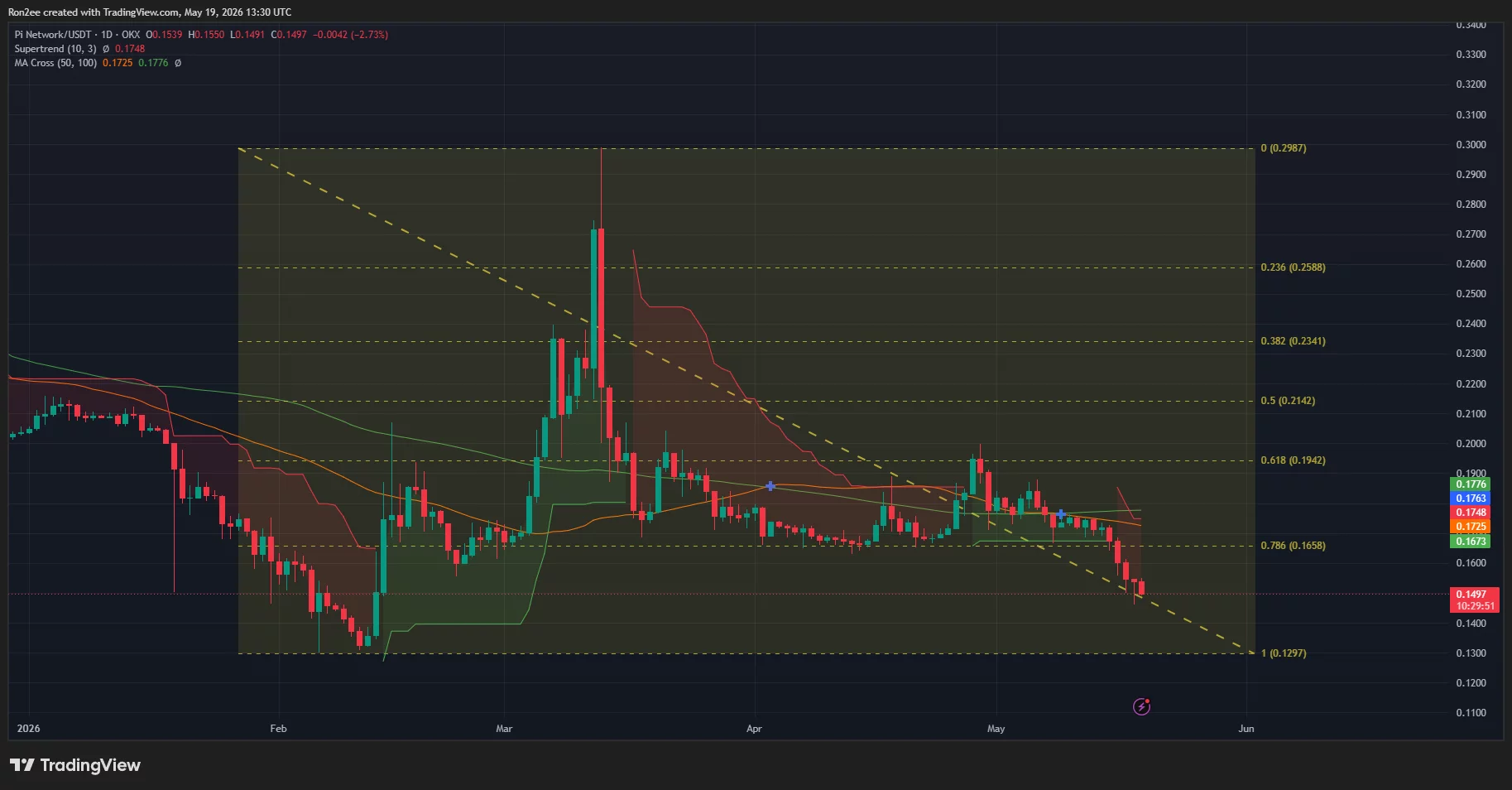
PI price action has also continued forming a series of lower highs since the March peak near $0.30, reflecting persistent seller control across multiple recovery attempts.
The chart additionally shows PI trading near the lower boundary of a broader Fibonacci retracement range. The token has already fallen below the 0.786 Fibonacci retracement level around $0.1658, leaving the final major retracement support near the 1.0 level around $0.1297.
That area now represents a critical downside target if current selling pressure continues accelerating.
Technical analysts have also warned that PI may be forming a broader double-top reversal structure after repeatedly failing to sustain rallies above the $0.19 to $0.20 region earlier this quarter.
According to analysts, PI coin’s current price action resembles a potential “dead cat bounce” scenario near the $0.15 area. Analysts warned that failure to stabilize above this zone could expose the token to a deeper decline toward its historical lows.
Momentum indicators similarly continue to favor bears. The Supertrend indicator remains firmly bearish, with resistance now sitting near the $0.175 region. PI also remains below its major moving average cluster, which continues sloping downward.
As long as PI price remains beneath those resistance levels, bulls may struggle to regain control of the trend.
The recent breakdown below the descending trendline visible on the daily chart further strengthened bearish sentiment because it invalidated the consolidation range that had supported PI throughout much of April.
If sellers maintain control, PI could revisit the major support region near $0.13 in the coming weeks, which aligns closely with the projected Fibonacci extension target and the token’s previous all-time low zone.
On the upside, bulls would likely need to reclaim the $0.165 to $0.175 resistance range to weaken the current bearish setup. A stronger recovery above the 50-day moving average near $0.172 could potentially reopen the path toward the $0.19 region.
However, unless demand begins absorbing the upcoming unlock supply more effectively, traders may continue treating short-term rebounds as temporary relief rallies rather than the beginning of a sustained recovery trend.
Disclosure: This article does not represent investment advice. The content and materials featured on this page are for educational purposes only.



Be the first to comment