

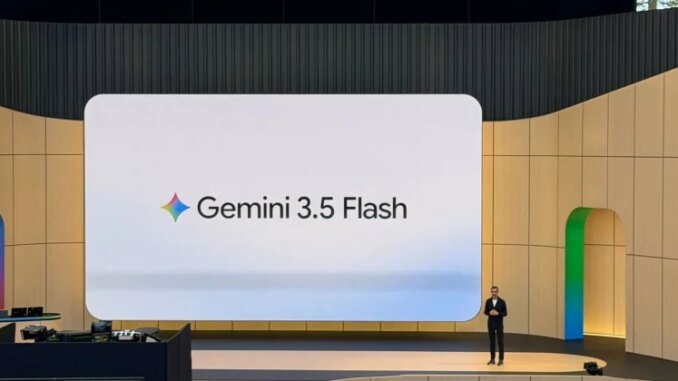

Google just unveiled Gemini 3.5 Flash at its annual developer conference, calling it the company’s most powerful coding and agentic AI model to date. The model can autonomously execute complex tasks and build software from scratch.
For the crypto industry, the implications are pointed. Decentralized AI projects have spent the last two years pitching themselves as the open, permissionless alternative to Big Tech’s walled gardens.
What Gemini 3.5 Flash actually does
The model is optimized for three things: coding, reasoning, and what Google calls “agentic workflows.” In English: it can take a high-level instruction, break it into steps, write the code, call external APIs, and execute the whole thing without a human babysitting each stage.
It supports multimodal inputs, meaning it can process text, images, and other data types in a single conversation. The context window stretches to 1 million tokens, which is roughly the equivalent of feeding it an entire codebase or a few hundred pages of documentation and asking it to work with all of it at once.

On the performance side, Google claims Gemini 3.5 Flash runs 3x faster than Gemini 2.5 Pro. API pricing comes in at $0.50 per 1 million input tokens and $3 per 1 million output tokens. That pricing structure matters because it puts sophisticated AI capabilities within reach of small development teams and individual builders, not just well-funded enterprises.
The model is rolling out across Google’s ecosystem, including the Gemini App and AI Mode in Search, with a clear focus on developers and enterprise customers.
Why crypto should be paying attention
Gemini 3.5 Flash’s agentic capabilities are directly relevant to crypto use cases. Autonomous agents that can write code, interact with APIs, and execute multi-step workflows are exactly the kind of tools that on-chain trading systems, DAO governance frameworks, and DeFi protocols have been trying to build.
At $0.50 per million input tokens, Google is essentially commoditizing the inference layer. Decentralized AI networks that charge for compute on a per-token or per-task basis now have to justify their premium against Google’s pricing and infrastructure.
The broader AI arms race
Google’s announcement lands in the middle of an intensifying competition among tech giants. OpenAI, Anthropic, Meta, and now Google are all shipping increasingly capable models at lower price points and faster speeds.
The projects most likely to weather this pressure are the ones solving problems that centralized providers genuinely cannot or will not address. Verifiable inference, where you can cryptographically prove that a model produced a specific output, is one example. Privacy-preserving computation is another. These are areas where blockchain architecture provides structural advantages, not just ideological ones.



Be the first to comment