

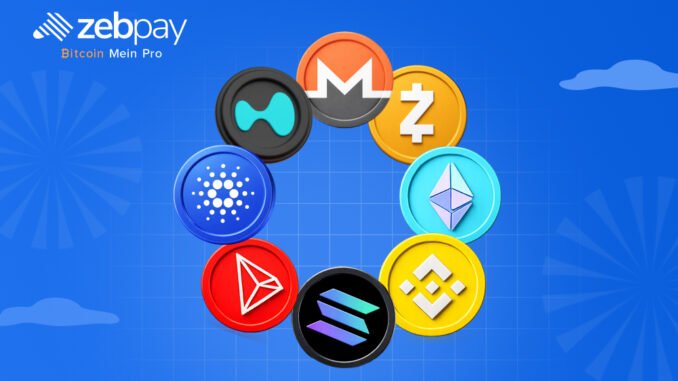

Bitcoin changed finance. But it also left gaps, slow transactions, limited programmability, and high energy consumption. Altcoins were built to fill those gaps. Since Litecoin launched in 2011 as one of the first alternatives to Bitcoin, the altcoin market has grown into a multi-trillion-dollar ecosystem powering everything from decentralised finance (DeFi) to gaming and identity systems.
For Indian investors, understanding altcoins isn’t optional anymore, it’s foundational. Whether you’re exploring ZebPay’s crypto offerings or building a long-term portfolio, understanding how altcoins work, which ones matter, and the risks they pose will directly affect your outcomes.
Key Takeaways
- Altcoin is defined as any crypto coin that isn’t Bitcoin
- There are 10,000+ altcoins in existence; only a fraction hold real utility or value
- Top altcoins by market cap include Ethereum, BNB, Solana, XRP, and Cardano
- Altcoins offer higher growth potential but also carry higher risk than Bitcoin
- The future of altcoins is tied to real-world adoption, regulation, and technological development
- Always research tokenomics, team, and use case before investing
What Are Altcoins, Exactly?
The word “altcoin” is short for alternative coin. It refers to every cryptocurrency launched after Bitcoin, which means the definition covers an extraordinarily wide range of assets.
Some altcoins are direct Bitcoin forks (like Litecoin or Bitcoin Cash). Others are built on entirely independent blockchains with different goals:
- Ethereum (ETH): Programmable smart contracts
- XRP: Fast, low-cost cross-border payments
- Solana (SOL): High-speed, low-fee transactions
- Cardano (ADA): Research-driven blockchain development
- Polkadot (DOT): Interoperability between blockchains
Not all altcoins are created equal. Many are speculative, illiquid, or outright fraudulent. A smaller subset has genuine utility, active developer ecosystems, and institutional backing.
Also Read: Top crypto to invest in 2026
Bitcoin vs Altcoins
| Feature | Bitcoin | Altcoins |
| Purpose | Store of value / digital gold | Varied — payments, smart contracts, DeFi, NFTs |
| Market Cap | Largest (~40–50% dominance) | Collectively large, individually smaller |
| Volatility | High, but relatively stable vs alts | Generally higher |
| Liquidity | Highest | Varies significantly |
| Use Case | Value transfer | Broad and use-case specific |
| Regulatory Clarity | Relatively clearer | More ambiguous globally |
Bitcoin is often treated as the baseline, a benchmark asset against which altcoin performance is measured. When Bitcoin rises, altcoins often follow. When Bitcoin drops, altcoins typically fall harder. This correlation matters for portfolio construction.
Benefits of Altcoins
1. Broader Utility
Bitcoin does one thing well. Altcoins were designed to do many things, from running decentralised applications to enabling stablecoins and cross-chain bridges.
2. Higher Growth Potential
Smaller market caps mean altcoins can deliver outsized returns when adoption grows. However, this works in reverse during downturns.
3. Portfolio Diversification
Holding a mix of Bitcoin and select altcoins distributes risk across different use cases and blockchain ecosystems.
4. Innovation Access
Altcoins let retail investors participate early in emerging sectors, DeFi, Web3, and AI-integrated blockchains, before those verticals mature.
5. Lower Entry Prices
Many altcoins are priced at a fraction of Bitcoin, making them accessible to investors with smaller capital.
Are Altcoins a Good Investment?
This depends on your risk tolerance, investment horizon, and research depth.
Altcoins are not inherently better or worse than Bitcoin as investments. They are different instruments with different risk profiles. A blue-chip altcoin like Ethereum behaves very differently from a low-cap token that launched six months ago.
What to check before investing in any altcoin:
- Does the whitepaper and use case solve a real problem?
- Are teams and investors credible and transparent?
- What’s the total supply? Is there an unlock schedule that could dilute value?
- Is the network actually being used?
- Can you exit without significant slippage?
The Future of Altcoins
The altcoin market is not static. It is being reshaped by three converging forces: institutional adoption, regulatory clarity, and technological maturation.
Institutional capital is moving beyond Bitcoin. Ethereum spot ETFs are now live in the US, and several institutions have begun allocating to Layer 1 and Layer 2 assets as part of diversified digital asset strategies. This signals that altcoins are no longer viewed purely as retail speculation instruments, they are becoming a recognised asset class in their own right.
Regulation will separate survivors from casualties. Projects with clear utility, transparent governance, and regulatory compliance are better positioned to endure tightening global frameworks. Altcoins that cannot demonstrate a legitimate use case will struggle under increased scrutiny, and that is not necessarily a bad outcome for the broader market. A cleaner, more accountable ecosystem benefits long-term participants.
Conclusion
Altcoins represent the expanding frontier of blockchain technology. They are not a monolith. They range from battle-tested Layer 1 protocols to highly speculative micro-cap tokens with no proven utility. Understanding the difference is what separates informed investing from speculation.
The future of altcoins looks increasingly tied to real-world infrastructure: finance, AI, identity, and supply chains. But that future will not be evenly distributed. Use credible platforms, read the whitepaper, check on-chain data, and never invest more than you can afford to lose.
In the grand scheme of things, ZebPay blogs are here to provide you with crypto wisdom. Get started today and join 6 million+ registered users to explore endless features on ZebPay!
FAQs
What are altcoins in simple terms?
Altcoins are all crypto assets other than Bitcoin. Examples include Ethereum, Solana, XRP, and thousands of others.
Which altcoin is best to invest in?
There is no universally “best” altcoin. Ethereum and Solana are considered blue-chip altcoins due to their network activity and adoption. Investment suitability depends on individual risk appetite and research.
How many altcoins exist?
As of 2025, there are over 10,000 altcoins listed across various exchanges. The majority hold negligible value or utility.
What is altcoin season?
Altcoin season refers to a market period when altcoins outperform Bitcoin, often characterised by a drop in Bitcoin dominance and rising altcoin prices across the board.
Can altcoins replace Bitcoin?
Unlikely in the near term. Bitcoin serves a distinct function as a decentralised store of value. Most altcoins serve different use cases and are not direct competitors to Bitcoin’s core proposition.
Disclaimer:
Crypto products and NFTs are unregulated and can be highly risky. There may be no regulatory recourse for any loss from such transactions. Each investor must do his/her own research or seek independent advice if necessary before initiating any transactions in crypto products and NFTs. The views, thoughts, and opinions expressed in the article belong solely to the author, and not to ZebPay or the author’s employer or other groups or individuals. ZebPay shall not be held liable for any acts or omissions, or losses incurred by the investors. ZebPay has not received any compensation in cash or kind for the above article and the article is provided “as is”, with no guarantee of completeness, accuracy, timeliness or of the results obtained from the use of this information.



Be the first to comment