

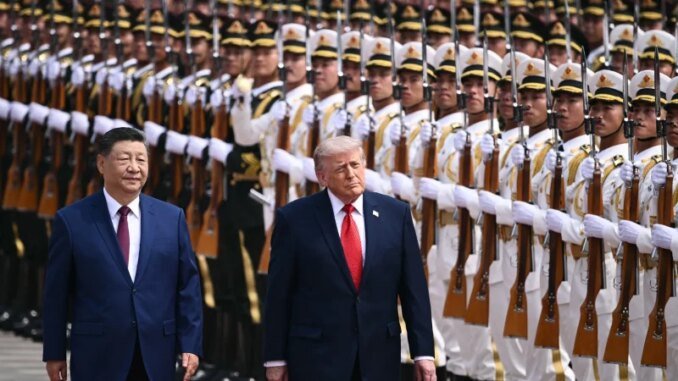

President Donald Trump is deliberating whether to greenlight a $14 billion arms package for Taiwan, what would be the largest single US weapons sale to the island in history. The decision sits at the intersection of US-China diplomacy, geopolitical brinkmanship, and the kind of high-stakes deal-making that tends to send shockwaves through global markets.
Congress pre-approved the sale back in January, so the ball is firmly in Trump’s court.
What’s in the package and why it matters
The $14 billion arms deal includes advanced air and missile defense systems, interceptor missiles for Patriot PAC-3 batteries, NASAMS short-range air defense, counter-drone assets, and medium-range munitions.
Taiwan has set aside $25 billion to cover both this new package and a previously authorized $11 billion deal.

Meanwhile, the House Foreign Affairs Committee unanimously advanced the PORCUPINE Act, legislation specifically designed to speed up arms deliveries to Taiwan.
The China variable
Trump’s deliberation is reportedly tied to his broader engagement with Chinese President Xi Jinping. The arms sale could function as a concession in exchange for Chinese movement on trade, fentanyl precursor exports, or other friction points in the US-China relationship.
For crypto markets, the Taiwan question is less abstract than it might seem. Taiwan is home to TSMC, the world’s most important semiconductor manufacturer. The company produces the vast majority of the world’s most advanced chips, the same chips that power everything from AI data centers to the specialized hardware used in Bitcoin mining operations.
Any escalation in cross-strait tensions historically triggers risk-off behavior in global markets. The March 2022 Russia-Ukraine invasion saw Bitcoin drop roughly 8% in the days surrounding the incursion.
What this means for investors
If Trump approves the sale, it reinforces the status quo. Taiwan’s deterrence posture strengthens, the semiconductor supply chain remains under a credible defense umbrella. Defense contractors with exposure to the systems in the package, particularly Patriot and NASAMS manufacturers, would be obvious beneficiaries.
For crypto-native investors, the semiconductor angle deserves close attention. Bitcoin mining’s ongoing shift toward more efficient ASIC hardware depends on continued access to advanced chip fabrication. TSMC’s dominance in this space means that anything threatening Taiwan’s stability is, by extension, a supply-side risk for mining infrastructure globally.



Be the first to comment