

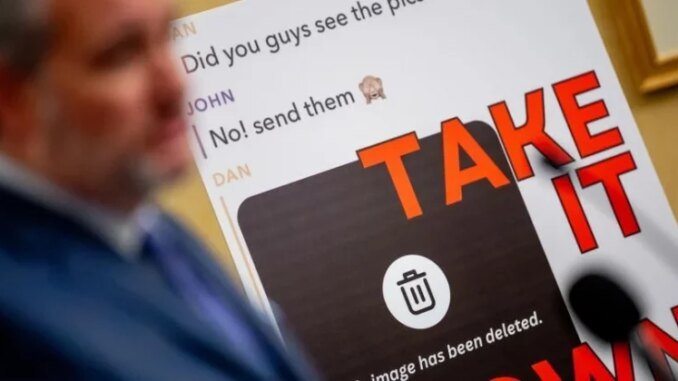

President Trump signed the TAKE IT DOWN Act into law on May 19, 2025, turning a bipartisan piece of legislation into the first federal statute specifically targeting deepfake pornography and non-consensual intimate imagery. The law passed Congress with near-unanimous support, a rare feat for any bill, let alone one regulating online content.
Any platform hosting user-generated content now has to build a notice-and-takedown system that removes flagged material within 48 hours. They have exactly one year, until May 19, 2026, to get those systems operational. Fail to comply, and the Federal Trade Commission comes knocking.
What the law actually does
The Act criminalizes publishing, or even threatening to publish, non-consensual intimate imagery. That includes AI-generated deepfakes, which the law formally labels “digital forgeries.”
Penalties scale with severity. Publishing non-consensual intimate images of adults carries up to two years in prison. Cases involving minors face harsher sentencing.

Notably, the law’s reach extends beyond sexually explicit content. Digital forgeries intended to cause harm to identifiable individuals fall under its scope even if they aren’t pornographic.
The FTC handles enforcement and can pursue civil penalties and injunctive relief under the existing FTC Act framework.
Why crypto and Web3 should be paying attention
The law applies to “covered platforms,” defined broadly as online services that host user-generated content. That language doesn’t carve out exceptions for decentralized protocols, blockchain-based social networks, or Web3 applications.
Decentralized social protocols like Lens, Farcaster, and Nostr have been growing their user bases by leaning into censorship resistance as a feature, not a bug. The TAKE IT DOWN Act essentially says that feature has legal limits when it comes to non-consensual intimate imagery.
On a traditional platform like Instagram or X, a compliance team can receive a report, review it, and remove the content within hours. On a blockchain-based platform where content is stored across distributed nodes or pinned to IPFS, “removing” something within 48 hours may not even be technically possible in the way the law envisions.
What this means for the broader digital landscape
The legislative response was introduced in June 2024, moved through Congress with unusual speed, and landed on the president’s desk less than a year later.
For smaller platforms and startups, the compliance burden is different from incumbents. Building a compliant takedown system requires dedicated resources: legal counsel, moderation staff, technical infrastructure. That raises the cost floor for launching any new social platform in the US.
The risk to watch is enforcement ambiguity. The FTC will need to issue guidance on what constitutes a “covered platform” in the decentralized context, how the 48-hour clock starts, and what qualifies as a good-faith compliance effort.



Be the first to comment