


Foreign investors are pulling money out of South Korean stocks at one of the sharpest clips of the year, turning the KOSPI’s powerful tech-led rally into a stress test for domestic demand.
A widely shared Global Markets Investor update put foreign net selling in the KOSPI at nine straight sessions, with roughly $3.4 billion of the latest outflows concentrated in technology stocks. The same update placed year-to-date foreign outflows near $55 billion, a figure that underlines how aggressively overseas funds have been reducing exposure after one of the world’s strongest equity runs.

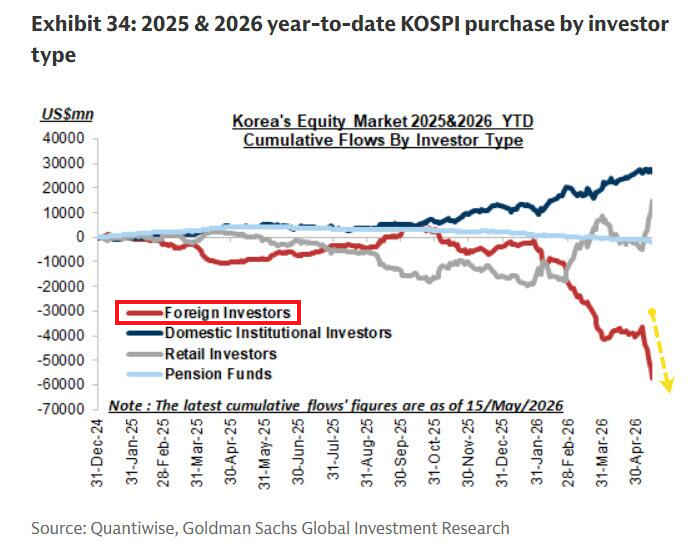
The verified regional flow data already points to serious pressure. Foreign investors have sold a net $24.75 billion of Asian equities so far in May, including a record $17.27 billion in the past week across tracked markets. South Korea absorbed the heaviest blow, with $13.14 billion in foreign outflows over that weekly window.
The selling is hitting a market that had become heavily tied to AI-linked chip momentum. Earlier Korean market data showed foreign investors selling large amounts of Samsung Electronics and SK Hynix during a five-session streak, even as the broader KOSPI was still setting record highs. The pressure is therefore less about one weak session and more about whether foreign funds are taking profits from the same semiconductor leaders that carried the index higher.
Retail Buyers Take The Other Side
Domestic retail investors appear to be absorbing much of the foreign selling, creating a sharp handoff between overseas funds taking chips off the table and local traders buying the dip. That can keep index levels supported for longer than foreign-flow data alone would suggest, but it also raises the risk of a crowded retail position if volatility expands.
The macro backdrop is not helping. Higher long-term U.S. yields have pressured growth-heavy Asian markets, especially Korea and Taiwan, where major index exposure is concentrated in a smaller group of large technology names. The same de-risking backdrop is visible across digital assets, where a recent crypto market snapshot showed Bitcoin holding near $77,000 while ETF outflows kept broader risk appetite tight.
South Korea’s equity story is now about market structure as much as performance. If retail demand keeps absorbing foreign sales, the KOSPI can stay elevated despite heavy outflows. If that domestic bid weakens, selling concentrated in Samsung, SK Hynix and other AI-linked leaders could turn a profit-taking wave into a broader correction.


Be the first to comment