


What to know:
- South Korea’s KOSPI surged 8% after Samsung’s labor agreement breakthrough.
- Samsung shares rebounded 7-8% as strike fears eased quickly.
- New bonus structure links employee rewards directly to company performance.
- Crypto and semiconductor sectors gained relief from supply chain stability.

South Korea’s KOSPI posted a historic rally after Samsung Electronics reached a tentative labor agreement, easing fears of a major production disruption. The breakthrough boosted investor confidence, strengthened semiconductor market sentiment, and reduced concerns surrounding crypto-related supply chains and broader financial market volatility.
South Korea’s KOSPI Jumps After Samsung Deal
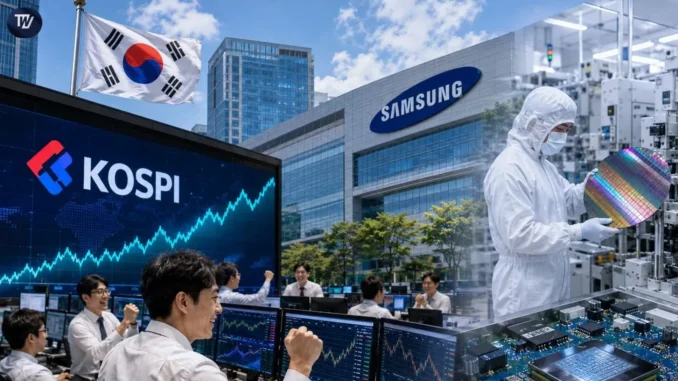
South Korea’s KOSPI recorded one of the biggest rallies in its history after Samsung Electronics reached a tentative agreement with its labor union.
The benchmark index surged nearly 8% to 7,787, adding around ₩570 trillion, or nearly $410 billion, in market value during the session.
The rally was mainly driven by Samsung Electronics, which controls almost 30% of South Korea’s KOSPI by weight.
Samsung shares climbed roughly 7% to 8% after investors reacted positively to reports that the company avoided a possible 18-day production stoppage.
The stock had previously dropped around 9% to 10% during weeks of growing strike concerns. Investor confidence improved quickly after government-backed mediation helped both sides reach a temporary settlement.
Markets viewed the agreement as a major relief for South Korea’s semiconductor sector and broader financial markets.
Also Read: Crypto Crime Alert as Sinaloa Cartel Laundering Network Faces OFAC Sanctions
Profit-Sharing Plan Eases Strike Concerns
The tentative agreement replaced strike plans with a profit-sharing compensation structure. Samsung reportedly agreed to allocate around 10.5% of operating profit toward employee bonuses.
Most payouts will be made in company stock rather than in cash. It gives the employees an opportunity to benefit from the improved performance of Samsung without the risk of the company having to increase labor costs that remain fixed even during poor market conditions for memory chips.
However, the agreement requires the consent of the union members. There were global fears about the impact on the supply of semiconductors due to the possibility of the strike.
Samsung, being the top producer of DRAMs and NAND flash memory for mobile phones, laptops, artificial intelligence (AI) servers, and supercomputers, would suffer from shipment delays globally due to factory closures.
SK Hynix would be ready to capitalize on the situation, especially where high-bandwidth memory associated with Nvidia AI accelerators is concerned.
South Korea’s KOSPI Boosts Crypto Sentiment
Recovery in the KOSPI had positive impacts on the crypto mood, as the Korean stock market is among the world’s busiest crypto markets.
An abrupt fall in the KOSPI index would have triggered crypto price swings owing to investor flight from risky assets. However, the strong recovery minimized worries about financial instability. The steady hands of Samsung in manufacturing are not just for smartphones and televisions.
Samsung is responsible for the manufacture of memory chips that are used in the mining process, artificial intelligence servers, and high-performance computers connected to blockchain technology.
But with the rally, there are still concerns regarding Samsung’s strategy to earn consistent profits. In case prices for memory chips remain low, the stock incentive program could create tension between labor and management at the company.
Also Read: Solv Protocol Migrates $700M BTC Assets to Chainlink CCIP



Be the first to comment