

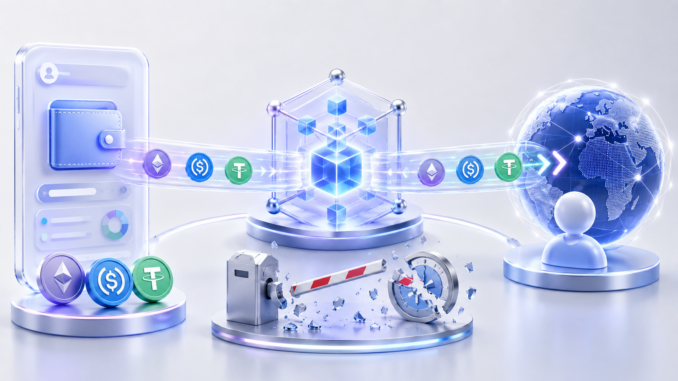
Gasless transactions are blockchain transactions where the user does not directly pay the network fee with the chain’s native gas token. The transaction still costs money to process. Validators, sequencers, or block producers still need to be paid. The difference is that a wallet, app, relayer, paymaster, marketplace, game, or sponsor handles the gas cost behind the scenes.
That distinction matters. “Gasless” does not mean the blockchain became free. It means the fee is abstracted away from the user experience. A user may sign a message, click claim, mint an NFT, make a small transfer, or use a dApp without first buying ETH, MATIC, SOL, AVAX, BNB, or another native gas asset. The app then pays the fee, recovers it elsewhere, or routes the action through account-abstraction infrastructure.

Gasless transactions became important because gas is one of crypto’s biggest onboarding barriers. A new user can receive a stablecoin, NFT, or in-game asset but still be unable to move it because the wallet has no native token for fees. That creates a broken experience: the user owns something but cannot use it without making a separate purchase. Gasless design solves that problem by letting the app sponsor or abstract the fee.
Why Gasless Transactions Matter
Gas is a technical requirement, but it feels like friction to normal users. Every on-chain action needs a fee because public blockchains must limit spam, pay network participants, and price block space. On Ethereum-style networks, gas also measures computation. More complex actions cost more than simple transfers because smart contracts use more execution resources.
That fee model works for network security, but it creates a product problem. A user may understand a bank card, mobile app, or game purchase. They may not understand why claiming a reward requires a separate token they have never bought. The result is failed onboarding, abandoned wallets, and confusion around small transactions.
Gasless transactions improve the flow for wallets, games, NFT platforms, DeFi apps, loyalty programs, marketplaces, social apps, and stablecoin payments. They let the product feel closer to a normal app while keeping the blockchain settlement layer underneath.
The broader impact is adoption. Crypto can reach more users when basic actions do not require gas-token management at every step. That does not remove the need for wallet education, but it reduces the first friction point.
The Main Gasless Transaction Models
Gasless transactions can work in several ways. The user experience may look similar, but the infrastructure behind it can differ sharply.
| Model | How It Works | Best Fit | Main Trade-Off |
|---|---|---|---|
| Meta Transactions | User signs a message, relayer submits the on-chain transaction and pays gas | Apps, games, claims, simple dApp actions | Relayer and trusted-forwarder design must be secure |
| Account Abstraction | Smart accounts use bundlers and paymasters to sponsor or abstract gas | Wallets, DeFi, payments, onboarding | More infrastructure and smart account complexity |
| Paymasters | A sponsor pays gas if the user operation meets defined rules | Freemium apps, subscriptions, token-gated actions | Sponsor must manage rules, deposits, and abuse prevention |
| Gas Paid In ERC-20 Tokens | User pays fees in USDC or another token instead of native gas | Stablecoin users and app-specific wallets | The app still needs conversion or paymaster support |
| Marketplace-Sponsored Gas | Platform covers minting, claiming, listing, or transfer costs | NFTs, gaming assets, loyalty rewards | Fees may be priced into platform economics |
| Chain-Level Fee Payer Design | A transaction allows a separate fee payer account | High-throughput app chains and some non-EVM ecosystems | App must manage payer balances and abuse controls |
| Custodial Or Off-Chain Transfers | Platform updates internal balances without on-chain settlement every time | Exchanges, apps, payment platforms | User depends on platform custody and withdrawal rules |
The cleanest way to understand them is this: the user signs intent, but someone else handles the gas payment or converts the fee into a form the user does not need to manage directly.
How Meta Transactions Work
Meta transactions let users authorize an action without sending the blockchain transaction themselves. The user signs a message off-chain. A relayer receives that signed message, packages it into a real on-chain transaction, pays the gas, and submits it to the network.
A common Ethereum pattern uses a trusted forwarder. The app’s contract accepts calls through the forwarder and still recognizes the original user as the actor. ERC-2771 standardizes this trusted-forwarder design so recipient contracts can accept meta transactions while preserving the user’s identity inside the contract call.
The flow usually looks like this:
- The user opens an app and chooses an action.
- The wallet asks the user to sign a message, not broadcast a normal transaction.
- The relayer checks the signature and action data.
- The relayer submits the transaction on-chain and pays gas.
- The forwarder or recipient contract verifies the original signer.
- The contract executes the action as if it came from the user.
This model is useful for onboarding, claims, small actions, and dApps that want to remove native token friction. It is also sensitive to implementation. The app must prevent replay attacks, forged messages, unauthorized forwarding, and relayer abuse. A badly designed meta-transaction system can create security problems even if the user experience feels smooth.
How Account Abstraction Makes Gasless UX Stronger
Account abstraction changes the wallet model. Instead of relying only on externally owned accounts controlled directly by private keys, users can interact through smart accounts with programmable rules. Those smart accounts can support batched transactions, social recovery, spending limits, session keys, custom signature schemes, sponsored fees, and gas payments in different tokens.
ERC-4337 is the best-known Ethereum account-abstraction framework. It introduces UserOperations, bundlers, an EntryPoint contract, and paymasters. The user creates a UserOperation instead of a normal transaction. Bundlers package those operations and submit them on-chain. Paymasters can sponsor gas or allow fee payment through alternative logic.
The result is a better app experience. A new user can open a smart wallet and use an app before holding ETH. A game can sponsor early player actions. A DeFi app can let users pay fees in USDC. A wallet can batch approve-and-swap into one click. A team can add spending limits or recovery rules without forcing users through the old wallet model.
Account abstraction is not only about gasless transactions. Gas sponsorship is one feature inside a broader wallet upgrade. The same model can improve security, recovery, automation, and user experience.
What Paymasters Do
Paymasters are the key gas-sponsorship component in ERC-4337-style account abstraction. A paymaster can decide whether it is willing to pay for a user operation. It can sponsor the full fee, require the user to meet certain conditions, or charge the user in another token.
A paymaster can support several business models:
- Free first transaction for a new user
- Sponsored NFT claim for a verified wallet
- Gas paid in USDC instead of ETH
- Gas covered for subscribers
- Gas covered for players inside a game
- Gas covered for loyalty or reward actions
- Gas covered only below a daily limit
- Gas covered only for whitelisted contract calls
This turns gas from a raw blockchain requirement into product logic. The app can choose which actions deserve sponsorship and which actions still require the user to pay. That makes gasless design more sustainable because the sponsor does not need to pay for everything forever.
Paymasters also need protection. If sponsorship rules are too loose, bots can drain the sponsor’s gas budget. Good paymaster design includes rate limits, allowlists, authentication, value caps, fraud checks, simulation, and monitoring.
EIP-7702 And The Next Step For Gasless UX
Ethereum’s account model is also evolving through EIP-7702, which lets existing externally owned accounts temporarily use smart-account-style code during a transaction. That matters because many users already have normal wallets, and moving everyone to new smart accounts is difficult.
EIP-7702 can support smoother wallet features such as batching, sponsored transactions, session-style permissions, and smart-account behavior without forcing users to abandon existing addresses. It does not remove the need for careful wallet security. The private key still matters because it can authorize powerful actions.
For gasless transactions, the broader direction is clear: wallets are becoming more programmable, and apps are gaining better tools to hide gas complexity from users while preserving on-chain settlement.
Gasless Transactions In NFTs
NFTs are one of the clearest gasless transaction use cases. Creators and collectors often do not want to manage gas before they know whether an asset will sell, transfer, or claim successfully.
NFT gasless minting can let creators mint or prepare NFTs without paying upfront gas directly. In some designs, the marketplace sponsors the transaction. In others, the NFT is lazily minted later when someone buys it. NFT lazy minting delays the on-chain mint until purchase or claim, which shifts the cost away from the creator’s first listing step.
This works well for creator onboarding. An artist can list work without first buying ETH. A game can distribute items to players without forcing every player to fund a wallet. A loyalty program can issue NFT passes without making customers learn gas settings.
The trade-off is contract and platform dependence. Users should still check when the NFT becomes on-chain, who pays the fee, where metadata is stored, whether the NFT can be transferred freely, and which marketplace or smart contract controls the minting flow.
Gasless Transactions In DeFi And Payments
Gasless design can also improve DeFi and stablecoin payments. A user holding USDC should not always need ETH first just to move or swap the USDC. A smart account with paymaster support can let the user pay fees in USDC or have the app sponsor the fee for specific actions.
For DeFi, the best gasless flows often combine several actions. Instead of approving a token, waiting, then swapping, then staking, a smart account can batch actions into one user-facing confirmation. That reduces failed steps and makes complex smart contract interactions easier to understand.
For payments, gasless transactions can make stablecoins feel more like normal digital money. A user can send a dollar-linked token without thinking about the chain’s native gas asset. This is especially useful for wallets, payroll apps, games, remittances, and consumer payment tools. For example, Sui recently added gasless transactions for 7 stablecoins giving users and businesses the possibility to use stablecoins on their Sui Network without paying the chain fees.
The economics still need to work. Someone pays the fee. The sponsor may recover it through spreads, subscriptions, merchant fees, token incentives, premium plans, or app revenue. A product that sponsors every transaction without controls can become expensive or vulnerable to spam.
Gasless Does Not Mean Risk-Free
Gasless transactions reduce friction, but they can also hide what is happening. A user may sign a message without understanding that the action will move tokens, approve spending, claim an asset, or interact with a contract. The absence of a visible gas fee can make the action feel safer than it is.
The biggest risks are:
| Risk | What It Means |
|---|---|
| Signature Confusion | Users may sign messages without understanding the on-chain action behind them |
| Malicious Relayers | A bad relay setup can route or censor actions incorrectly |
| Replay Attacks | A signature may be reused if the system lacks proper nonces, expiry, and chain checks |
| Hidden Fees | Gas may be recovered through spreads, prices, platform fees, or worse exchange rates |
| Sponsor Limits | Gasless support can stop when budgets, campaigns, or conditions change |
| Smart Contract Risk | The transaction may still interact with vulnerable or malicious contracts |
| Phishing | Fake gasless claims can trick users into signing dangerous approvals |
| Centralization | Relayers, paymasters, or sponsored flows can become chokepoints |
The user still needs to read wallet prompts. A gasless signature can be harmless, but it can also authorize something important. If the app hides too much detail, the UX may become easier and riskier at the same time.
How To Use Gasless Transactions Safely
The safest approach is to treat a gasless action like any other wallet approval. The user should check the app, domain, contract, action, asset, network, and wallet prompt before signing. No fee does not mean no consequence.
A practical safety routine looks like this:
- Use the official app link, not a social-media reply or ad.
- Check which wallet is connected.
- Read the action before signing.
- Avoid unlimited approvals unless they are clearly needed and trusted.
- Use a separate wallet for claims, games, experiments, and airdrops.
- Keep long-term assets away from high-risk gasless interactions.
- Revoke unnecessary approvals when possible.
- Be suspicious of urgent “free claim” pages.
Gasless phishing is attractive because the offer feels harmless. A fake app can say “no gas required,” then ask for a signature that grants access to valuable assets. Strong crypto scam prevention still applies, especially around claims, mints, rewards, and game items.
Wallet security also remains essential. Sponsored fees do not protect a compromised wallet. If a seed phrase is exposed, an attacker can restore the wallet and move assets regardless of who pays gas. Long-term funds need careful private-key and seed phrase storage.
How Developers Should Think About Gasless Design
Gasless transactions are a product decision, not only a technical feature. Developers should decide which actions deserve sponsorship and why. A game may sponsor early actions but not every marketplace sale. A wallet may sponsor onboarding but not large transfers. A DeFi app may sponsor claims but not complex trades. A merchant app may sponsor payments because the merchant recovers the cost through business revenue.
Good gasless design should include:
- Clear user prompts
- Rate limits
- Transaction simulation
- Contract allowlists
- Per-user spending caps
- Anti-bot controls
- Paymaster balance monitoring
- Relayer redundancy
- Replay protection
- Analytics for failed and abused transactions
- Transparent fee recovery where fees are priced elsewhere
Developers should avoid hiding risk in the name of convenience. A smooth transaction flow should still show the user what they are approving, which asset is affected, and whether any permission will remain after the action.
When Gasless Transactions Make Sense
Gasless transactions are strongest for onboarding, claims, low-value actions, games, loyalty rewards, NFT minting, simple transfers, and consumer apps where native gas tokens create unnecessary friction.
They are less ideal for every action by default. High-value DeFi trades, complex contract interactions, and privileged account operations may deserve more explicit transaction friction because the user should slow down and review the action carefully.
The best gasless experience does not make crypto invisible. It makes the annoying part invisible while keeping the important parts visible: asset, amount, network, permission, and consequence.
Conclusion
Gasless transactions let users interact with blockchain apps without directly holding or spending the native gas token. The fee is still paid, but it is sponsored, shifted, delayed, abstracted, or bundled into the app’s economics. Meta transactions use relayers and trusted forwarders. Account abstraction uses smart accounts, bundlers, and paymasters. NFT platforms may sponsor or delay minting costs. Apps may also let users pay fees in stablecoins or another supported token.
The benefit is better usability. Gasless transactions make wallets, games, NFTs, stablecoin payments, DeFi apps, and consumer crypto products easier to use. The risk is that smoother UX can hide important approval details. Users should still read signatures, verify apps, protect wallets, and understand that no visible gas fee does not mean no risk.
Gasless design is one of the clearest paths toward mainstream crypto use. It turns gas from a user obstacle into an application-level design choice. The strongest products will use it carefully: sponsor the right actions, expose the right information, protect against abuse, and make blockchain interactions feel simple without making them careless.



Be the first to comment