


Your finance team wants to settle a supplier invoice on-chain, in euros, by 5 p.m. today. The fastest option seems to be a euro stablecoin. Yet your relationship bank is steering you toward a new blockchain-based payment rail it’s piloting with dozens of peers.
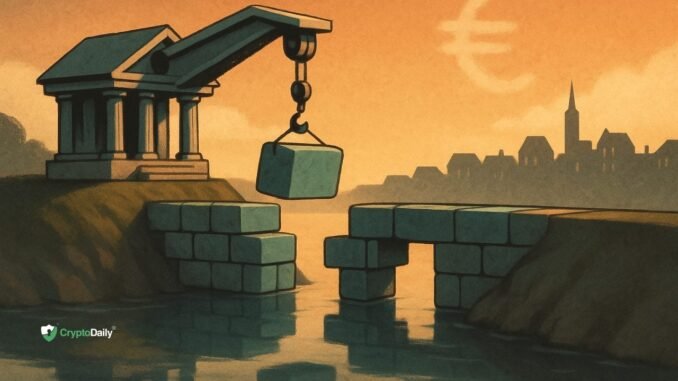
That tension—between open, bearer-like stablecoins and bank-built on-chain money—is reshaping Europe’s payment landscape. With the EU’s MiCA stablecoin regime live and a digital euro in preparation, banks are moving to keep euro-denominated money native to the internet without ceding ground to non-bank issuers.
Across Europe, reports and pilots point to a large consortium—around 37 banks—working on a blockchain payment alternative. Here’s why they’re doing it, what it could look like, and how it compares to euro stablecoins you can use today.

The Big Picture
Euro payments are going real-time and programmable. Merchants, fintechs, and treasurers want instant settlement, lower fees, and composable workflows that plug directly into finance apps and supply-chain systems. Stablecoins already offer this on open networks. Banks, meanwhile, need to deliver similar speed and programmability—under the bank-deposit model, with compliance controls and central-bank settlement access.
What looks like a stablecoin versus bank contest is really a race to make euros internet-native while preserving trust, safety, and the deposit funding model that underpins credit in the real economy.
Three forces converge now: MiCA creates clear rules for fiat-referenced tokens, the ECB advances the digital euro design phase, and European payments policy leans into instant settlement. In that context, a multi-bank blockchain rail is less about hype and more about market structure: who issues money on-chain, who controls settlement risk, and how Europe maintains payment sovereignty.
What counts as a euro stablecoin in Europe?
Under the EU’s Markets in Crypto-Assets Regulation (MiCA), “e-money tokens” (EMTs) reference a single fiat currency and function like on-chain e-money, redeemable at par by the issuer. Only credit institutions (banks) and electronic money institutions (EMIs) can issue EMTs. “Asset-referenced tokens” (ARTs) reference baskets of assets; they face different obligations and are generally not meant for large-scale payments in the EU.
Regulatory anchors that matter
– MiCA’s stablecoin rules entered into effect in mid-2024, with supervisory roles for national regulators and EU authorities. See MiCA text via the Official Journal of the EU and guidance from the European Banking Authority (EBA) for up-to-date obligations and transition timelines.
– The regulatory framing means a compliant euro stablecoin in Europe is typically an EMT: redeemable euro-for-euro, with safeguarding of reserves and disclosure standards. ARTs are treated more restrictively for payments.
Who issues euro stablecoins today?
– Circle’s EURC is positioned to operate under MiCA via its French entity, following announcements in 2024 about aligning both USDC and EURC with EU rules. Details are on Circle’s official site: circle.com.
– Monerium issues EURe as on-chain e-money under EU e-money regulation, operating across multiple networks. Company information: monerium.com.
– Tether’s EURt exists on several blockchains but must conform to MiCA when offered in the EU for payment services; market access and features may evolve as supervision tightens.
– Société Générale–FORGE launched EUR CoinVertible (EURCV), a euro-denominated token aimed at institutions and capital markets use. See SG‑FORGE: sgforge.com.
Importantly, a bank-issued token or a regulated EMI-issued token may look similar on-chain, yet the legal claim differs. Euro stablecoins are typically a claim on the issuer’s safeguarded funds; they are not bank deposits unless the issuer is a bank and treats them as such under applicable rules.
Inside the bank-built alternative: tokenized euros, not just stablecoins
When banks describe a blockchain “payment alternative,” they usually don’t mean an open, bearer-style stablecoin used in permissionless DeFi. They’re building rails where tokens represent regulated liabilities—often tokenized deposits—or settlement assets backed by central bank money. The aim is atomic settlement, programmability, and compliance within a framework supervisors recognize.
Tokenized deposits
Tokenized deposits are on-chain representations of customer deposits. They keep funds within the banking system while enabling 24/7 programmable transfers and potential cross-bank atomic settlement. Designs vary: some use permissioned ledgers, others connect permissioned subnets to public chains via compliant gateways.
Shared settlement assets
Banks are also exploring shared settlement assets designed for wholesale use. Models include utility settlement assets backed by central bank reserves in omnibus accounts, and proofs-of-concept for wholesale CBDC. These aim to reduce intraday liquidity needs and enable delivery-versus-payment (DvP) for tokenized securities.
Interoperability layers
Multiple cross-border and cross-network experiments—from SWIFT’s work on tokenized asset interoperability and CBDC interlinking (swift.com) to BIS Innovation Hub pilots (bis.org)—focus on connecting heterogeneous ledgers. Bank consortia want any on-chain euro money to interoperate with tokenized capital markets and existing payment messaging standards.
In practice, a 37‑bank-scale project signals industry alignment on governance, technical standards, and legal treatment of the tokens. That’s critical to avoid fragmentation: a dozen incompatible euro tokens would defeat the purpose.
Why a 37‑bank scale matters
Payment networks are about reach. A large consortium can establish de facto standards for identity, KYC, settlement finality, and developer tooling. It also improves the odds of merchant and platform integrations, from ERP plug-ins to e-commerce gateways.
Network effects beyond hype
With dozens of banks involved, treasurers can expect consistent onboarding, unified APIs, and clearer legal opinions around tokenized money and smart contracts. For regulators, a single governance framework is easier to supervise than many small experiments.
How a consortium payment might flow
- Your company’s bank converts part of your euro balance into a tokenized deposit or approved on-chain euro instrument within a permissioned environment.
- The payment instruction references an invoice and triggers a smart contract with rules (escrow, milestones, or time locks).
- Atomic settlement occurs when conditions are met: the supplier receives tokenized euros while title to goods or a service receipt is logged on-chain.
- The recipient can redeem to a bank account, keep the tokens for onward payments, or pledge them in a financing workflow—subject to network rules.
- Compliance, reporting, and reconciliation data are produced in real time, mapped to existing ISO 20022 messages.

Comparing on-chain euro payment models
Stablecoins, tokenized deposits, and wholesale settlement assets can all move euros on-chain, but they carry different rights, risks, and reach. Here’s a side-by-side view to help teams choose the right tool for the job.
| Model | Issuer | Legal claim | Settlement scope | Programmability | Access | Primary regulation (EU) |
|---|---|---|---|---|---|---|
| Euro stablecoin (EMT) | EMI or bank | Claim on safeguarded funds at issuer | Retail & merchant payments; DeFi integrations vary | High on public chains; depends on network | Broad, subject to platform policies | MiCA (EMTs), e-money rules, AML |
| Tokenized deposit | Bank | Bank deposit (on-chain representation) | Retail/wholesale within networked banks | High within permissioned and bridged setups | Customers of participating banks | Banking law, AML, prudential oversight |
| Wholesale settlement asset | Consortium / central bank nexus | Backed by central bank money/reserves (design-specific) | Institutional DvP/PvP | High for institutional workflows | Financial institutions | Payment system oversight; potential CBDC frameworks |
| Digital euro (retail CBDC) – proposed | Eurosystem | Direct claim on central bank | Retail payments, subject to policy limits | Programmable via intermediaries’ services | Public via intermediaries | Eurosystem legal framework (in design) |
Where things stand between 2024 and 2026
Europe is threading multiple needles at once—stablecoin supervision, instant payments policy, and CBDC design—while banks industrialize tokenization. A few anchor milestones help frame expectations.
MiCA supervision of euro-referenced tokens
MiCA’s provisions for EMTs and ARTs came into force in 2024. Issuers marketing stablecoins in the EU must meet requirements on authorization, reserve safeguarding, disclosures, and governance. The EBA has published guidance and consultations to clarify supervisory expectations; see official materials at eba.europa.eu and EU law portals for the MiCA text.
Instant payments as the new floor
The EU’s Instant Payments Regulation—adopted in 2024—pushes euro transfers toward 24/7/365 availability at domestic cost parity. That makes programmable, instant settlement less optional and more a baseline. Bank-built blockchain rails are being designed to complement SEPA Instant and TARGET services with on-chain finality and conditional settlement.
Digital euro: preparation, not production (yet)
The ECB is in a preparation phase for a potential digital euro, running experiments and engaging intermediaries on architecture and privacy. Public materials and timelines are available at ecb.europa.eu. Even if launched, a retail CBDC will likely coexist with bank deposits and e-money; banks still need programmable, on-chain deposit money for broad commercial use cases.
Tokenized capital markets pull payments along
As more euro-denominated securities are issued and settled on-chain, payment legs must keep pace. Banks are piloting DvP with tokenized money to reduce fails, free collateral faster, and standardize corporate actions. That gravity could pull merchant payments and treasury operations into the same rails over time.
What this could unlock for merchants and treasurers
Beyond speed, programmable euros enable conditional logic: escrow releases on delivery confirmation, automatic early-payment discounts, and embedded compliance. The business case sharpens when these features reduce working-capital friction or dispute losses.
For merchants
– Faster settlement with instant availability can improve cash conversion cycles.
– Payment rules (refund windows, chargeback alternatives, loyalty triggers) can run at the ledger level.
– Cross-border acceptance improves when banks coordinate on KYC and settlement guarantees.
For corporate treasurers
– A single set of APIs for on-chain euros across many banks reduces integration overhead.
– Real-time, on-ledger reconciliation collapses month-end processes.
– Liquidity savings via atomic DvP/PvP could lower intraday credit lines and associated costs.
Risks & What Could Go Wrong
- Fragmentation: Multiple euro tokens and rails may not interoperate, splitting liquidity and developer mindshare.
- Smart contract and integration risk: Bugs in ledger code, wallets, or bank adapters could halt payments or expose funds.
- Governance drift: A large consortium can move slowly; misaligned incentives may stall upgrades or cross-chain connectivity.
- Regulatory friction: Divergent national interpretations of MiCA or data-protection rules could limit cross-border operation.
- AML/privacy trade-offs: Fine-grained traceability may clash with customers’ privacy expectations; over-collection raises compliance risk.
- Operational resilience: 24/7 rails need robust failover, key management, and incident response across all member banks.
- Depeg/redemption risk for stablecoins: For EMTs, issuer failures or reserve mishandling can impair par redemption; banks may face run dynamics if tokenized deposits are too portable without safeguards.
- Bridge risk: If public–permissioned bridges are used, compromised bridges can lead to loss events or frozen assets.
No blockchain payment rail is risk-free: the trade-off shifts from card chargebacks to code correctness, operational resilience, and governance clarity.
For ongoing coverage of European stablecoins, tokenized deposits, and CBDC pilots, Crypto Daily tracks policy moves and market builds across the region: cryptodaily.co.uk.
Frequently Asked Questions
Is a euro stablecoin the same as a tokenized bank deposit?
No. A euro stablecoin structured as an EMT is a claim on safeguarded funds held by an issuer (an EMI or bank). A tokenized deposit is an on-chain representation of a bank deposit, with rights and protections governed by banking law. They may look similar on-chain but differ in legal claim, prudential treatment, and access to central bank settlement.
Can EU residents still use euro stablecoins under MiCA?
Yes, provided the stablecoin is issued and offered in compliance with MiCA and other applicable EU laws (e.g., AML/CTF). Some tokens may be geofenced or restricted if they do not meet EU requirements. Always review the issuer’s disclosures and your platform’s terms.
How do fees and speed compare with cards and SEPA?
Stablecoins on public chains can be very fast and low-cost, but network congestion or bridge fees apply. Bank-built rails aim for instant settlement with predictable fees integrated into existing banking contracts. Exact costs depend on your bank, network design, and volume tier—avoid assuming uniform “near-zero” costs.
What’s the difference between wholesale CBDC and these bank tokens?
Wholesale CBDC would be central bank money native to a ledger, intended for interbank and capital markets settlement. Bank tokens (tokenized deposits or shared assets) are commercial bank liabilities or consortium instruments. Both target atomic settlement, but liability, governance, and access differ.
When might merchants see this at checkout?
Timelines vary by country and consortium. Some pilots already support business-to-business settlement and wallet payouts. Broad retail availability typically follows once banks finalize governance, merchant tools, dispute processes, and regulatory approvals. A prudent planning horizon is measured in phases over the next 12–24 months, not weeks.
Will these bank rails connect to DeFi?
Some designs foresee permissioned bridges to public chains, enabling interactions with compliant smart contracts. Others may remain walled gardens. Expect strict identity controls, allowlists, and transaction screening; open, anonymous DeFi access is unlikely for bank-issued money.
How should a treasury team evaluate issuer risk?
Ask who the legal issuer is, what the token represents (EMT, deposit, or other), how reserves or backing are safeguarded, redemption terms, outage procedures, audit cadence, and whether there is central bank settlement backing. Map these answers to your risk policy and regulatory obligations before integrating any on-chain euro instrument.
Disclaimer: This article is provided for informational purposes only. It is not offered or intended to be used as legal, tax, investment, financial, or other advice.




Be the first to comment