


USDC supply on Hyperliquid has climbed above $4.11 billion, giving the network one of the largest stablecoin bases in onchain trading and strengthening the liquidity story behind HYPE.
The latest split shows about $2.39 billion in CCTP-native USDC on HyperEVM and about $1.72 billion in Arbitrum-bridged spot USDC on HyperCore. HyperEVM gives builders an EVM-compatible smart-contract environment, while HyperCore handles the network’s fully onchain perpetual futures and spot order books. Together, they place USDC at the center of collateral, settlement, market quoting and capital movement across the ecosystem.

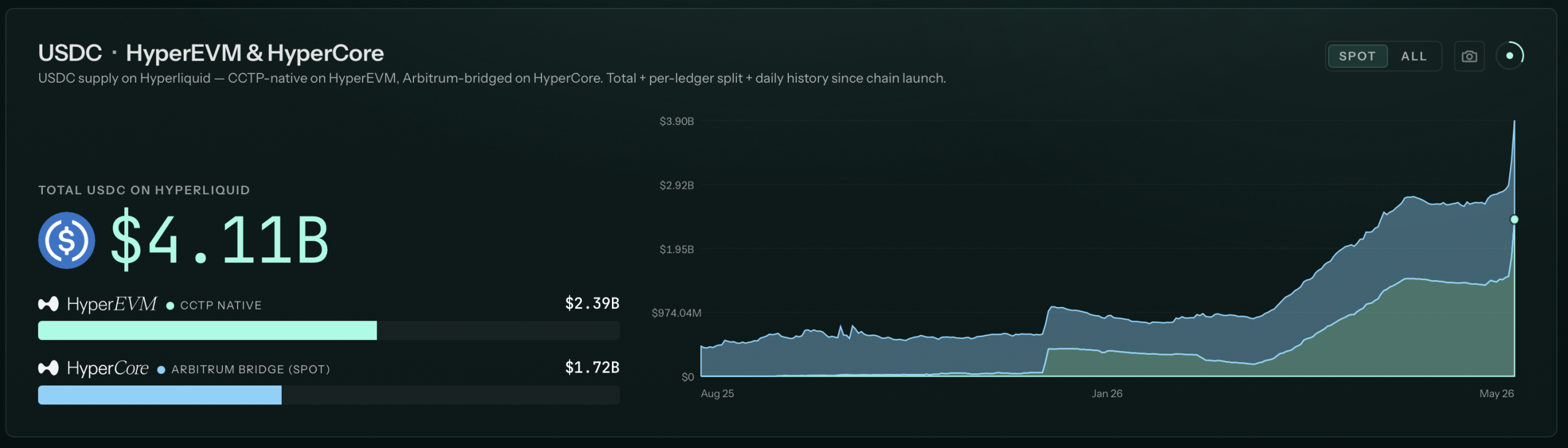
The milestone matters because stablecoin depth is the working capital of an exchange-like ecosystem. Deeper USDC balances can support larger positions, tighter markets, faster collateral movement and more confidence for market makers deploying capital across spot, perpetuals and newer Hyperliquid market structures. For traders, the headline is not just that more USDC sits on the network. It is that more dollar liquidity is now available inside the same system where HYPE incentives, trading fees and builder activity are already concentrated.
Hyperliquid’s growth has increasingly depended on whether it can turn user deposits into real market depth, not only token speculation. USDC crossing $4 billion gives that thesis a stronger base because collateral, quote liquidity and order-book activity now sit closer together inside the same network economy.
Circle’s Role Makes USDC More Than A Balance Sheet Asset
USDC’s role expanded after Circle moved to become the technical deployer of USDC as an Aligned Quote Asset on Hyperliquid. Under that structure, USDC continues as the primary collateral asset across HIP-1, HIP-2, HIP-3 and HIP-4 markets, covering spot assets, liquidity strategies, builder-deployed perpetuals and newer outcome-style markets.
That gives USDC a deeper role than simply sitting in user wallets. It becomes part of the system’s market design. HIP-2 liquidity currently runs on spot pairs quoted against USDC, while HIP-3 builder-deployed perpetual markets can use quote assets as collateral and carry direct fee and market-design implications. HIP-4 extends the same stablecoin conversation into new market types, keeping USDC tied to the next layer of Hyperliquid’s expansion.
The Circle structure also strengthens the native side of the network. CCTP-native USDC on HyperEVM gives users and applications a cleaner path for moving dollar liquidity through Circle’s burn-and-mint infrastructure instead of relying only on wrapped or bridged liquidity. That matters for settlement quality, user confidence and the long-term shift from fragmented stablecoin balances toward more direct issuance and redemption rails.
The broader market had already been watching Hyperliquid after Coinbase became the official USDC treasury deployer in a move that deepened the relationship between USDC infrastructure and Hyperliquid’s market design. The latest supply milestone now gives that relationship a measurable liquidity figure rather than just a strategic announcement.
HYPE Gains A Stronger Liquidity Argument
HYPE is trading near $58, keeping the token close to recent highs even as parts of the wider crypto market remain under pressure. Fund-linked demand has already helped the narrative after Bitwise and 21Shares added HYPE exposure, but the USDC supply milestone gives the rally a more durable market-structure angle.
For HYPE, the important question is whether Hyperliquid can keep converting liquidity into activity. Stablecoin balances create the base, but trading volume, fees, builder deployment, staking demand and user retention decide whether that base becomes lasting value. A large USDC pool can make the network more attractive to market makers and traders, while deeper activity can feed back into the token’s broader economic story.
The split between HyperEVM and HyperCore will now be one of the clearest signals to watch. Rising native USDC on HyperEVM would point to more smart-contract and app-side demand. Persistent bridged USDC on HyperCore would show that traders are keeping collateral inside the core order-book environment. A healthy balance between both sides would support the view that Hyperliquid is growing as a full trading network rather than a single-product perp platform.
USDC crossing $4 billion gives Hyperliquid a stronger liquidity base at a sensitive moment for HYPE. The next confirmation will come from whether the stablecoin balance keeps holding above the $4 billion mark, whether native USDC continues to grow on HyperEVM, and whether deeper collateral turns into sustained trading volume, fees and market creation across HIP-1 through HIP-4.



Be the first to comment