

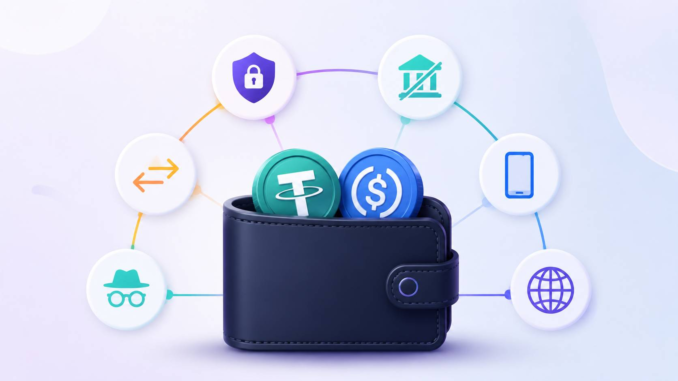


Stablecoin holders moving USDT and USDC in 2026 face a clear choice. Custodial platforms require identity verification at signup. Non-custodial wallets don’t ask for ID at any stage.
Five no-KYC crypto wallets stand out for USDT and USDC transfers in 2026: IronWallet, Trust Wallet, Exodus, Zengo, and Atomic Wallet.
Each takes a different approach to keeping users anonymous through signup, holding, and transfer workflows. None require government-issued ID, phone numbers attached to verification services, or KYC documentation to start using the wallet.
Sections ahead cover each wallet’s specific approach to privacy, stablecoin coverage, and transfer mechanics.
What “No-KYC” Actually Means for Stablecoin Transfers
KYC (Know Your Customer) is the identity verification process that exchanges and regulated platforms use to comply with anti-money-laundering rules.
Submitting a passport, driver’s license, or proof of address creates a permanent link between the user’s identity and every transaction made through that platform.
A no-KYC wallet breaks that link. Private keys are generated and stored locally on the user’s device. No company verifies who the user is, and no transaction is tied to a verified identity through the wallet itself.
A wallet qualifies as no-KYC when it meets four conditions:
-
No government-issued ID required at any point during signup, holding, or transfer workflows
-
No identity verification through third-party services like Jumio, Onfido, or similar KYC vendors
-
Private keys generated and stored locally on the user’s device, not on company servers
-
No mandatory linking of wallet addresses to verified identities through onboarding flows
For stablecoin holders specifically, no-KYC matters because USDT and USDC see frequent peer-to-peer transfers, cross-border payments, and remittances.
Users in regions with banking restrictions, capital controls, or surveillance-heavy environments rely on no-KYC wallets to maintain financial privacy.
The five wallets profiled below all meet this standard.
How the Five Wallets Compare on No-KYC Standards
A direct comparison across the four most relevant privacy criteria for stablecoin transfers:
|
Wallet
|
Email at Signup
|
Phone Required
|
Base Wallet KYC
|
Gasless Stablecoin Transfers
|
|
IronWallet
|
No
|
No
|
No
|
Yes (USDT on Tron, USDC on Ethereum)
|
|
Trust Wallet
|
No
|
No
|
No
|
No
|
|
Exodus
|
No
|
No
|
No
|
No
|
|
Zengo
|
Yes (recovery only)
|
No
|
No
|
No
|
|
Atomic Wallet
|
No
|
No
|
No
|
No
|
All five meet the no-KYC standard at the wallet level. IronWallet adds gasless transfer capability that the other four don’t currently match.
1. IronWallet: Multi-Chain Wallet With Gasless Stablecoin Transfers and No KYC
IronWallet is a non-custodial multi-chain wallet with no KYC, 10,000+ supported assets, gasless stablecoin transfers, and WalletConnect Pay integration. Installation requires no email, no phone number, and no identity documents. A user downloads the app and starts sending stablecoins within minutes.
Stablecoin support inside IronWallet covers both USDT and USDC across the major networks where they circulate: ERC-20 USDC and USDT on Ethereum, TRC-20 USDT on Tron, BEP-20 USDT and USDC on BNB Chain, SPL stablecoins on Solana, and native USDC on Base.
IronWallet’s gasless transfer mechanic removes a common friction point for anonymous USDT transfer workflows. Standard TRC-20 USDT sends require TRX for gas, and standard ERC-20 USDC sends require ETH. IronWallet abstracts the gas layer so the fee is deducted from the stablecoin balance itself, with no native token required.
Privacy extends past signup. The wallet’s privacy policy explicitly blocks Google Analytics and Apple Store analytics from operating inside the application. Stablecoin balances, transaction histories, and transfer habits aren’t tracked by third-party analytics services or linked to user identities through standard mobile tracking infrastructure.
2. Trust Wallet: Mobile and Browser Extension Stablecoin Wallet
Trust Wallet runs on iOS, Android, and as a Chrome browser extension, with USDT and USDC support spanning Ethereum, BNB Chain, Polygon, Tron, and additional networks. Signup involves generating a 12-word seed phrase, with no email, phone, or document verification required.
A user holding ERC-20 USDC for Ethereum DeFi and TRC-20 USDT for cheaper peer-to-peer sends can manage both inside the same interface without identity verification at any point.
DApp connectivity runs through WalletConnect, letting users link to DeFi protocols, decentralized exchanges, and lending platforms by scanning a QR code from inside the wallet. The handshake happens at the wallet level, with private keys remaining on the device throughout the connection.
One caveat worth noting: integrated swap and buy features may route through third-party providers that have their own KYC requirements for fiat on-ramps. The base wallet stays no-KYC, but specific purchase or fiat-conversion flows may add verification steps depending on the partner involved.
3. Exodus: Multi-Platform Wallet Operating Since 2015
Exodus offers mobile, desktop, and browser extension formats that all share the same recovery phrase, letting users move between devices without separate accounts. Setup ends at the 12-word phrase: no email registration, no phone number, no KYC documentation.
Asset support inside Exodus includes USDT and USDC across Ethereum, Solana, Polygon, Algorand, and additional networks. The total catalog exceeds 200 cryptocurrencies, covering the major stablecoin standards along with broader holdings.
Interface design favors users new to self-custody, with built-in swap functionality letting users convert between assets directly inside the app. Some swap providers may have their own requirements layered on top of the base wallet.
Operating since 2015, Exodus has one of the longer development histories among non-custodial wallets. The track record matters for no-KYC wallet users who want stable security practices and a continuous development team behind the product.
4. Zengo: MPC Wallet Without Traditional Seed Phrase
Zengo uses multi-party computation for key management: instead of a 12-word seed phrase, key generation is split between the user’s device and Zengo’s servers, with only the user able to authorize transactions. The architecture removes seed phrase responsibility while keeping the wallet fully self-custodial.
Recovery operates through 3FA: email verification, 3D FaceLock biometric scan, and an encrypted recovery file. The email is collected for recovery only, not used for KYC verification, identity linking, or anti-money-laundering checks. No government-issued ID is requested at any point in the signup or transfer process.
USDT and USDC support inside Zengo runs on Ethereum, with additional stablecoin coverage across the six blockchains and four Layer 2 networks the wallet supports.
Users who want to avoid seed phrase management while keeping anonymous USDT transfer capability find their match here.
As one of the wallets without identity verification offering modern recovery mechanics, Zengo trades the traditional seed phrase for a multi-factor recovery model without weakening the non-custodial guarantee.
5. Atomic Wallet: Cross-Platform Wallet Supporting 1,000+ Cryptocurrencies
Atomic Wallet spans desktop (Windows, macOS, Linux), mobile (iOS, Android), and web versions, all sharing the same recovery phrase.
Over 1,000 cryptocurrencies are supported, including USDT and USDC, across major networks. Installation and use require no KYC verification.
Network coverage for USDT spans Ethereum, Tron, BNB Chain, and additional chains, with USDC support on Ethereum and other networks. Holding, sending, and receiving both stablecoins all happen without identity verification at any stage.
A built-in exchange lets users convert between supported assets directly inside Atomic Wallet, with staking available for the networks that support it. Base wallet operations remain no-KYC, though third-party services accessed through integrated features may carry their own requirements.
Cross-platform availability matters for users who want consistent access across devices. Starting on desktop and continuing on mobile uses the same recovery phrase, with no identity check required for the transition.
The Verdict
Five wallets keep USDT and USDC transfers separate from user identity. IronWallet combines no-KYC privacy with gasless stablecoin transfers and 24/7 live support. Trust Wallet offers broad network coverage with dApp integration. Exodus delivers a clean interface across multiple platforms.
Zengo replaces the seed phrase with MPC recovery while staying non-custodial. Atomic Wallet supports 1,000+ assets across desktop, mobile, and web.
Each option qualifies as a strong no-KYC wallet or no KYC stablecoin wallet for stablecoin holders in 2026. As a crypto wallet with no ID category, all five represent a private stablecoin wallet approach where privacy holds across signup, holding, and transfer workflows.
Disclaimer: This article is provided for informational purposes only. It is not offered or intended to be used as legal, tax, investment, financial, or other advice.




Be the first to comment