

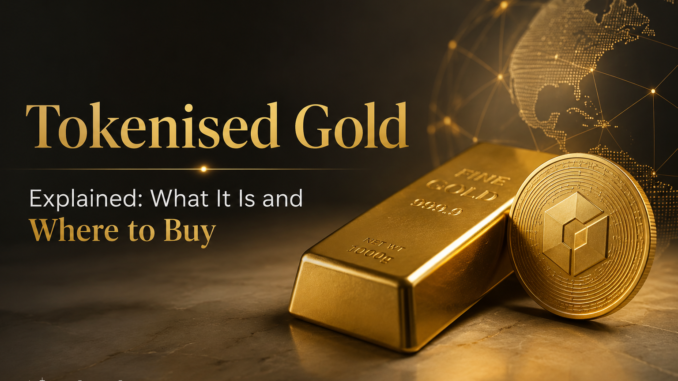

Five thousand years of monetary history, now settling on-chain in under three seconds. Here’s everything traders need to know about gold-backed tokens in 2026.
Gold has been a trusted store of value across every empire, currency regime, and market cycle in recorded history. Blockchain is younger, but in 2026, the two are converging fast. Tokenised gold is now a $4.4 billion asset class, and its trading volume surged 1,550% in 2025 alone. For traders, the question is no longer whether to pay attention; it’s how to participate intelligently.
This guide breaks down the mechanics, the leading platforms, the risks and the questions every gold trader and digital-asset investor is asking right now.
What Is Tokenised Gold?
Tokenised gold is a blockchain-based digital asset that represents direct ownership of physical gold stored in a secure, audited vault. Each token corresponds to a specific quantity of real bullion, most commonly one troy ounce (31.1 g) or one gram and is redeemable against that underlying metal by the issuing institution.
Think of it as a digitally native warehouse receipt: the gold never moves, but proof of ownership does, instantly, globally, and without a clearing house in the middle.
“Tokenised gold is physical gold ownership wrapped in blockchain technology not a derivative, not a synthetic, not a promise. The metal exists, it’s audited, and it’s yours.”
Unlike gold ETFs, tokenised gold tokens can be transferred peer-to-peer, used as DeFi collateral, fractionalised to as little as one millionth of a troy ounce, and traded around the clock on both centralised and decentralised exchanges. That liquidity profile is fundamentally different from anything traditional precious-metals markets have offered before.
How Does Tokenised Gold Work?

Step-by-step: from vault to wallet
The process begins when an issuer purchases and deposits physical gold, typically London Good Delivery bars or Swiss vault-grade bullion, with a regulated custodian. An equivalent number of tokens are then minted on a public blockchain (most commonly Ethereum). Each token’s existence, and the corresponding reserve, is tracked on-chain in real time and verified by independent auditors on a regular cycle.
When a token holder wishes to redeem, they send their tokens back to the issuing smart contract, which burns them and initiates a physical delivery or cash settlement process, subject to minimum redemption thresholds that vary by issuer.
Which blockchains are used?
The majority of tokenised gold lives on Ethereum as ERC-20 tokens, benefiting from the widest DeFi ecosystem and deepest on-chain liquidity. Tether Gold (XAUT) is also available on the Tron network (TRC-20). Newer entrants are exploring layer-2 solutions and alternative layer-1 chains to reduce gas costs for smaller retail transactions.
The Leading Tokenised Gold Tokens in 2026

| Token | Issuer | Peg | Custody | Status |
|---|---|---|---|---|
| XAUT | Tether | 1 troy oz | Swiss vault | Largest by cap |
| PAXG | Paxos | 1 troy oz | London vaults (LBMA) | Regulated (NYDFS) |
| KAU | Kinesis Money | 1 gram | Global insured vaults | Yield-bearing |
| VRO | VeraOne | 1 gram | French certified vault | EU-focused |
| DGX | Digix Global | 1 gram | Singapore vault | Pioneer / reduced activity |
Tether Gold’s XAUT is the dominant player by market capitalisation, over $806 million as of Q1 2025 per BDO audit reports — while Paxos Gold (PAXG) is the most regulated, operating under a New York Department of Financial Services trust charter. Each PAXG token is backed by one troy ounce of London Good Delivery gold held in professional vaults, and token holders have a claim to a specific, identifiable bar.
Tokenised Gold vs. Physical Gold vs. Gold ETFs
| Factor | Tokenized Gold | Physical Bullion | Gold ETF |
|---|---|---|---|
| Trading hours | 24/7/365 | Dealer hours | Exchange hours |
| Settlement | Near-instant (on-chain) | Physical delivery | T+1 / T+2 |
| Fractionalisation | To 0.000001 oz | Minimum 1 coin/bar | 1 share minimum |
| Direct ownership | Yes (redeemable) | Yes | No |
| Storage cost | Embedded in fee | User’s cost | Management fee |
| DeFi utility | Yes (collateral, yield) | No | No |
| Regulatory clarity | Evolving | Established | Established |
Key Benefits for Traders and Investors
- Round-the-clock liquidity. Trade gold exposure at 2 a.m. on a Sunday, something no bullion desk or ETF market can offer.
- Fractional access. Buy $50 worth of gold instead of committing to a full troy ounce. This dramatically lowers the barrier for retail participants and portfolio rebalancing.
- Programmable and composable. Use tokenised gold as collateral in DeFi lending protocols, deploy it in yield strategies, or integrate it into multi-asset smart contract portfolios.
- Transparent audit trail. Every token, every reserve transaction, and every redemption is recorded immutably on-chain and verified by third-party auditors.
- Cross-border transferability. Send gold value across jurisdictions in seconds, without customs risk or wire-transfer delays.
- Inflation hedge, upgraded. The classic safe-haven case for gold applies in full — now with the convenience and programmability of a digital asset.
Risks Traders Must Understand
- Counterparty and custody risk. The token is only as good as the issuer’s reserve management. Verify audit reports and custodian credentials before allocating.
- Smart contract vulnerability. Code can have bugs. Review whether the protocol has undergone reputable third-party security audits.
- Regulatory uncertainty. Commodity tokenisation rules vary significantly by jurisdiction and continue to evolve rapidly, particularly in the EU and Asia-Pacific.
- Redemption thresholds. Physical delivery of the underlying gold often requires holding a minimum amount – sometimes 400 oz – making direct redemption impractical for retail-sized positions.
- Liquidity depth. Outside of XAUT and PAXG, on-chain order books can be thin. Slippage may be significant for large block trades.
Where to Buy Tokenised Gold in 2026
Centralised exchanges (CEX)
The simplest on-ramp for most traders. Tether Gold (XAUT) is listed on Binance, Bybit, OKX, Bitget, and MEXC. Paxos Gold (PAXG) trades on Kraken, Gemini, and several other regulated venues. CEX custody means you rely on the exchange to hold your tokens, but the fiat on-ramp and KYC process are familiar to anyone who has traded crypto before.
Decentralised exchanges (DEX)
For traders who prefer self-custody, both XAUT and PAXG are available on Uniswap and other Ethereum-native DEXs. You will need an Ethereum-compatible wallet (MetaMask, Ledger) and ETH for gas. Liquidity is deepest in the PAXG/USDC and XAUT/USDT pairs.
Dedicated platforms
Kinesis Money operates its own exchange for KAU, offering a yield mechanism where transaction fees are distributed back to token holders — an unusual structure that gives tokenised gold a modest income component alongside its price exposure. VeraOne targets European investors through its own platform with euro-denominated pricing.
DeFi protocols
Advanced users can deploy PAXG or XAUT as collateral on Aave, Maker, and similar lending protocols to borrow stablecoins, effectively leveraging gold exposure without selling it. This strategy carries liquidation risk and should only be used by experienced DeFi participants.
Market Context: Why Tokenised Gold Is Surging in 2026
The macro backdrop has been exceptionally favourable. Persistent inflationary pressures, continued geopolitical restructuring, and growing institutional interest in real-world asset (RWA) tokenisation have all converged. tokenised precious metals now represent roughly 80% of the entire $7 billion tokenised commodities market, with gold alone accounting for over $5 billion in on-chain value.
First-time precious metals buyers grew 309% in December 2025 alone – a cohort that arrived via crypto on-ramps, not traditional bullion dealers. This demographic shift is structurally significant: it suggests tokenised gold is not cannibalising the existing bullion market so much as expanding it.
“Many high-net-worth investors are now holding both physical bullion and tokenised equivalents, using the latter for liquidity and the former for direct custody and ultimate security.”
Frequently Asked Questions
Is tokenised gold actually backed by real gold?
Yes, reputable issuers like Paxos and Tether hold physical gold in audited, insured vaults equivalent to every token in circulation. For PAXG, each token corresponds to a specific, identifiable London Good Delivery bar. Always verify that an issuer publishes regular third-party audit reports before investing.
What is the difference between XAUT and PAXG?
Both are pegged to one troy ounce of gold. XAUT (Tether Gold) is issued by the company behind USDT and stores gold in Swiss vaults; it has a larger market cap. PAXG (Paxos Gold) operates under a NYDFS trust charter, stores gold in London LBMA-approved vaults, and is generally considered the more tightly regulated of the two.
Can I redeem tokenised gold for physical metal?
Yes, but minimum thresholds apply. Tether Gold requires a minimum of 430 fine troy ounces for physical redemption; smaller holders can cash out at spot value. Paxos Gold allows redemption at any quantity in USD, with physical bar delivery available for larger holdings. Check each issuer’s redemption terms carefully.
Is tokenised gold a good hedge against inflation?
Tokenised gold retains all the macro properties of physical gold — including its historical role as an inflation hedge and store of value — while adding 24/7 liquidity and programmability. It is not risk-free (counterparty and smart contract risks apply), but for investors who want gold exposure without storage logistics, it is a compelling alternative.
How is tokenised gold taxed?
Tax treatment varies significantly by jurisdiction. In many countries, tokenised gold is treated as a commodity or financial instrument rather than a currency, potentially triggering capital gains tax on disposal. Some jurisdictions also apply VAT or sales tax. Consult a qualified tax adviser familiar with digital assets in your country of residence before investing.
Can I earn yield on tokenised gold?
Yes, through several mechanisms. Kinesis Money’s KAU token distributes a portion of platform transaction fees to holders. On DeFi platforms like Aave, PAXG can be supplied as collateral to earn interest from borrowers. These yields are modest and come with their own risks, but they represent a meaningful advantage over physical bullion, which generates no passive income.
What is the minimum investment in tokenised gold?
This varies by platform and token. XAUT can be fractionalised to 0.000001 of a troy ounce, making exposure accessible for as little as a few dollars — a stark contrast to the hundred-dollar-plus minimum for physical coins or ETF shares. Most CEXs have their own minimum order sizes; check your chosen exchange’s trading rules.
Is tokenised gold regulated?
Regulatory frameworks are evolving. Paxos Gold is the most clearly regulated product, operating under New York State trust law. In the EU, gold-backed tokens may fall under MiCA or commodity regulations depending on their structure. Many other issuers operate in jurisdictions with lighter-touch oversight. Always verify the regulatory status of any product in your home jurisdiction.




Be the first to comment