

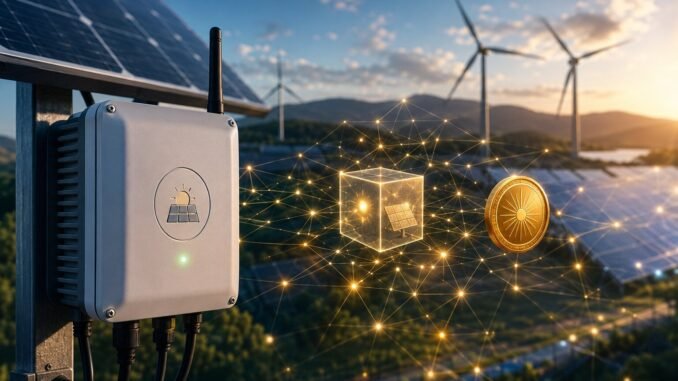

The global renewable energy market generates trillions of dollars in output each year — yet its underlying infrastructure remains stubbornly pre-digital. Renewable Energy Certificates, the primary mechanism for tracking and trading clean energy, are still issued as PDFs, circulated by email, and reconciled by hand months after the fact. The consequences are far from trivial: double-counting, opaque provenance, and outright fraud undermine the very ESG commitments that corporations and regulators are racing to honor. Blockchain has long been proposed as the natural fix — offering immutable records, programmable settlement, and borderless access — but no one has built a protocol specifically designed around the physics and compliance requirements of energy production. That gap is precisely where Solarious begins.

By connecting physical solar hardware directly to an on-chain validator network, Solarious converts raw electricity output into cryptographic proof in under four seconds. Its Solar Miner reads voltage, current, and kilowatt-hours in real time and signs that data at the chip level, feeding a hard-capped 200-node network that delivers absolute finality — not probabilistic consensus — making it fit for real-world asset settlement at institutional scale. Unlike general-purpose chains built for everything and optimized for nothing, Solarious is purpose-engineered for the energy market: every kilowatt becomes a tamper-proof, double-spend-proof record tied to a specific device, location, and timestamp. This month, that thesis crossed from whitepaper to reality: the first Solar Miner went live, producing the first genuine on-chain proof of physical energy output. For ESG funds, corporate buyers, and energy producers alike, the implications are immediate — and for the first time, the energy industry has a settlement layer built to match the scale of the transition underway.

To delve deeper into Solarious’s origins, its technical differentiators, market strategy, and long-term trajectory — straight from the architect behind this breakthrough in energy blockchain infrastructure — we present this exclusive conversation with Jack Samatov, Founder of Solarious.
Every blockchain claims to solve a real problem. What problem does Solarious actually solve that nothing else can?
Solarious is solving the disconnect between blockchain economies and real-world environmental commodities for renewable energy producers of all sizes. Built on a proprietary Layer 1 blockchain powered by its Proof of Energy protocol, Solarious is the first platform to combine live renewable energy production verification, validator consensus, environmental asset tokenization, and consumer onboarding. Existing tokenized REC and carbon systems still rely heavily on centralized registries, manual audits, and off-chain trust layers.
Solarious has built a new settlement layer for renewable energy that measures production in real time, validates it on-chain, rewards participants with cryptocurrency, and enables the tokenization of RECs and carbon-related environmental assets within a single integrated ecosystem.
Walk me through what happens from the moment a solar panel produces electricity to when $SOLAR gets minted.
We have proprietary hardware nodes called SOLAR Miners. They connect directly to inverters operating with solar panels and use integrated AI components capable of reading solar energy output in real time. Every available data point – including voltage, geo-location, weather, current, and kilowatt-hours produced is measured continuously, packaged, encrypted, and cryptographically signed at the chip level using secure hardware, ensuring the private key never leaves the device.
The signed energy proof is then transmitted to our 200-node validator network. On-chain, the data package is verified using zero-knowledge cryptography and validated through the Solarious Proof of Energy consensus protocol. Once verified, $SOLAR tokens are minted and distributed proportionally to renewable energy producers relative to their contribution to the producer network, while validators are rewarded for securing and validating the system. The rewards are delivered directly into the proprietary Solarious crypto wallet ecosystem.
The entire process – from physical energy production to on-chain settlement – occurs within a single block in approximately four seconds.
Bitcoin burns energy to secure the network. Solarious records and verifies it instead. Why does that distinction matter?
Bitcoin secures its network and creates digital scarcity by consuming massive amounts of computational energy through Proof of Work protocol.
Solarious takes a fundamentally different approach. Instead of burning energy to create scarcity, Solarious verifies real-world renewable energy production and transforms it into on-chain economic activity through its proprietary Proof of Energy protocol. This distinction matters because the underlying asset is not wasted computation — it transforms renewable energy production into an economic incentive model that encourages households and businesses to adopt, expand, and participate in renewable infrastructure.
In simple terms, Bitcoin monetizes network participation through energy consumption and computational scarcity. Solarious monetizes network participation through verified renewable energy production.
The first Solar Miner went live this month. What did that moment mean for you personally?
It was incredible. We spent years building toward that block. My team prepared the node at my house the night before, and I couldn’t sleep waiting for the sun to come out. When it finally did, watching real sunlight produce a real on-chain proof was amazing.
That was the moment the whole thesis stopped being theoretical. The physics worked. The cryptography worked. The network finalized it in four seconds.
Everything after this is scale.
Who is your actual customer — an individual solar producer or an industrial energy company?
Both, and that is the point. A rooftop in Lagos and a 500-megawatt farm anywhere in the world participate on the same terms. The protocol does not care about the size of your installation. It cares about what you produce and rewards are allocated based on each producer’s proportional share of the network’s verified renewable energy output. That has never truly existed in traditional energy markets, where meaningful economic rewards have historically been concentrated among large-scale producers.
You have 200 validator nodes, hard capped. Everyone else has thousands. Why is that the right call?
Institutional settlement cannot run on probabilistic finality. If you are clearing a real-world asset transaction worth millions, you need to know with mathematical certainty that the block is final — not that it is probably final in a few minutes. As simulations showed, the two hundred geographically distributed nodes gives us four-second absolute finality and Byzantine Fault Tolerance that holds even if a third of the network goes down simultaneously. That was a deliberate call.
Renewable Energy Certificates today are traded manually for the most part, with no on-chain verification. How does Solarious change that?
Right now, most RECs are a PDF with a serial number. The same serial number can appear on two PDFs. Nobody catches it until an audit months later. On Solarious, every REC is a cryptographic proof tied to a specific device, location, and timestamp. It gets verified before it is issued. Double-spending is mathematically impossible. That changes the entire compliance picture for ESG funds and corporate buyers.
What does the energy market look like on-chain in 2030?
Solar production is measurable, programmable, and increasingly financialized. By 2030 the question will not be whether energy settles on-chain – it will be which chain. Every megawatt-hour will carry a cryptographic provenance record. Carbon accounting will be automated. Energy trading will clear in seconds. The companies that built the infrastructure early will own the market.
Why build this now?
Because the infrastructure always lags the market by a decade. The internet had no payment layer for its first ten years. We built Solarious now because the energy transition is happening now – and the settlement layer needs to exist before the market gets too big to retrofit.
Strategic Imperative: Position for the Solar Blockchain Shift
Solarious advances beyond prototype with operational hardware and robust architecture, poised to monetize renewable output at global scale. For energy producers, ESG funds, and blockchain investors: integration offers verified $SOLAR yields and market primacy. My vision is clear – with live proof in hand, Solarious doesn’t just participate in the energy blockchain race; it is purpose-built for a market evolution that is already becoming inevitable.
Disclaimer: This article is provided for informational purposes only. It is not offered or intended to be used as legal, tax, investment, financial, or other advice.



Be the first to comment