

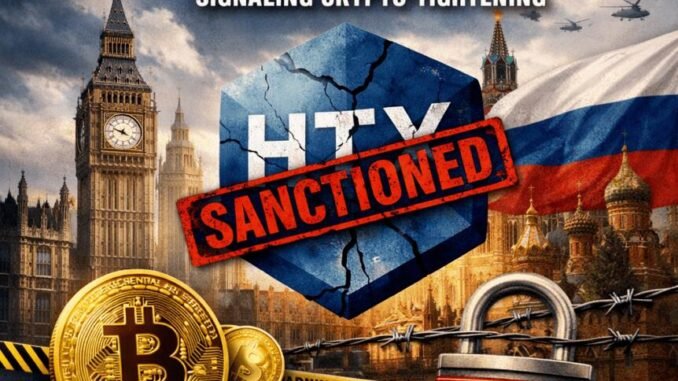

The United Kingdom has added HTX, the exchange formerly known as Huobi Global, to its sanctions list over alleged support for Russia. The designation follows a UK government assessment that there are reasonable grounds to suspect HTX has facilitated activities benefiting Moscow’s government through linked entities such as A7 Limited Liability Company and Garantex, both previously sanctioned. HTX is registered in Panama and has been singled out as part of a broader crackdown on entities the UK believes Russia relies on to bypass sanctions.
In announcing the designation, UK authorities underscored that the move targets efforts to shield Russia from Western penalties. “If the Kremlin thinks it can evade our sanctions by hiding behind crypto networks and shadow financial systems, it is gravely mistaken,” stated Foreign Secretary Yvette Cooper, emphasizing the government’s resolve to tighten controls over crypto-enabled evasion. The designation positions HTX alongside other sanctions-listed entities that the UK says have supported Russia’s government or its military actions through financial services and digital assets.
“Regulatory compliance remains our absolute top priority at HTX. We proactively monitor and strictly adhere to regulatory frameworks in all jurisdictions where we operate globally, including the UK.”
HTX’s official response to the designation, provided to Cointelegraph, centers on compliance. The exchange asserted that it maintains rigorous oversight and adheres to regulatory frameworks across its operating footprint, including the UK. The public statement reflects the ongoing push-pull between sanctions enforcement and the crypto industry’s efforts to reassure users and regulators that it can operate within strict rules.
The UK designation comes amid a wider, high-stakes regulatory moment for crypto in Europe and beyond. In April, the European Commission announced a package of crypto-related sanctions targeting stablecoins and other digital asset entities associated with Russia and Belarus. The move signals a broader intent to curb crypto channels that could be exploited to circumvent traditional financial restrictions. Regulators abroad are watching closely how sanctions regimes intersect with rapidly evolving crypto markets, particularly as exchanges and custodians expand cross-border services.

The reality of Russia’s evolving regulatory landscape also looms large. In April, Russian lawmakers advanced measures designed to curb unlicensed digital asset services, potentially imposing criminal penalties for breaches and mandating registration with the country’s central bank. The proposals sit alongside bills that would limit crypto use by retail investors and reinforce prohibitions on digital asset payments. These developments highlight a dual track: tightening controls within Russia while increasing international scrutiny on entities that may facilitate Russian access to global markets.
Key takeaways
- HTX (formerly Huobi Global) has been added to the UK sanctions list for alleged support to Russia via sanctioned entities A7 LLC and Garantex, with HTX registered in Panama.
- The designation is framed as part of a broader UK crackdown on entities the government says Russia uses to evade sanctions, underscoring the UK’s intent to police crypto-enabled flows that could bypass traditional controls.
- HTX disputes the allegations via a statement to Cointelegraph, asserting strict regulatory compliance and proactive monitoring across jurisdictions including the UK.
- Europe’s regulatory stance toward crypto-related sanctions has sharpened, with the European Commission issuing a new package targeting stablecoins and crypto actors tied to Russia and Belarus.
- Russia’s own crypto regulation is intensifying, with proposals to criminalize unregistered digital asset services and to impose stricter limits on crypto usage by retail investors and as a form of payment.
Sanctions, compliance, and the crypto ecosystem
The UK’s designation of HTX illustrates a broader trend in which authorities are increasingly treating certain crypto firms as extensions of state-centered risk. By tying enforcement to entities that facilitate cross-border finance in support of sanctioned regimes, regulators aim to close channels that might otherwise appear legitimate due to the anonymity or speed offered by digital assets. For investors and users, the move reinforces a clear expectation: crypto firms must demonstrate transparent compliance programs, robust know-your-customer and anti-money-laundering tools, and a willingness to cooperate with sanctions regimes across multiple jurisdictions.
From a market perspective, sanctions actions against exchanges can introduce volatility in the short term as counterparties reassess exposure to sanctioned entities or restricted jurisdictions. They also raise operational questions for exchanges that operate globally: how to implement and enforce sanctions lists in real time across diverse regulatory landscapes; how to handle custodial and trading flows that may be routed through complex networks; and how to communicate these controls to customers without compromising user experience. The HTX case adds to a growing list of examples where sanctions obligations intersect with the operational realities of international crypto platforms.
Critically, the EU’s sanctions move in April signals a parallel tightening across a key regional bloc. By signaling penalties and restrictions around stablecoins and other crypto instruments tied to sanctioned entities, Brussels is shaping a framework that could influence global standards. For market participants, this may translate into heightened vigilance around counterparties, quicker updates to screening and compliance workflows, and clearer mapping of sanctioned relationships in cross-border operations.
On the regulatory front inside Russia, the proposed measures would elevate penalties for unlicensed digital asset services and potentially enforce centralized oversight through the central bank. While these proposals could slow the pace of retail adoption in the near term, they reflect a longer-term trajectory toward formalizing a state-led regulatory environment for crypto activity. For international exchanges and service providers, the implications are twofold: ensuring alignment with Russian requirements if they operate there, and preparing to navigate a more complex, possibly fragmented, global compliance landscape as different jurisdictions diverge in their approach to crypto assets.
HTX’s situation also revisits the topic of past regulatory actions in the UK. The UK Financial Conduct Authority previously pursued enforcement against HTX in 2025 over alleged illegal crypto promotions conducted across social media platforms, including TikTok, X, Facebook, Instagram, and YouTube. That episode underscores a longstanding tension between aggressive marketing tactics common in the sector and the regulatory emphasis on investor protections and compliant communications. The current sanctions designation adds a new layer to the regulatory narrative surrounding HTX and similar platforms.
For market observers, the balance of power in crypto regulation remains a central question. On one hand, authorities seek to prevent evasion of sanctions and curtail Russia-linked financial channels. On the other, the industry argues that legitimate, regulated crypto activity can enhance financial integrity and transparency if properly supervised. The HTX designation contributes to that ongoing dialogue, illustrating how geopolitics, sanctions policy, and crypto compliance intersect in real time.
As policymakers, regulators, and industry participants closely monitor developments, several questions will shape the near-term landscape: Which other crypto services may be scrutinized next under sanctions regimes? How quickly will exchanges scale their compliance programs to meet evolving rules across regions? And how will customers adapt as more jurisdictions require rigorous verification, traceability, and restrictions on certain asset flows?
In the coming weeks, market players will be watching for further clarity on the UK’s designation criteria, any additional entities brought into the sanctions fold, and the practical impact on cross-border trading, liquidity, and customer onboarding. The HTX case may serve as a bellwether for how aggressively governments intend to police crypto-enabled pathways that could bypass conventional financial controls.
What remains uncertain is how closely other jurisdictions will mirror the UK’s approach and whether parallel sanctions measures will emerge in new forms, such as tighter enforcement of stablecoins or expanded restrictions on digital asset services linked to state actors. For now, investors and builders should prepare for a more integrated regulatory regime where sanctions risk and compliance costs are increasingly embedded into the operational fabric of crypto platforms.
Readers should continue to monitor official government designations and regulator statements, as well as updates from major exchanges about their sanctions screening capabilities and regional compliance rollouts. The HTX designation is a reminder that crypto firms operate in a high-stakes regulatory environment where geopolitical tensions can rapidly reshape the risk landscape and, with it, market opportunities and challenges alike.



Be the first to comment