

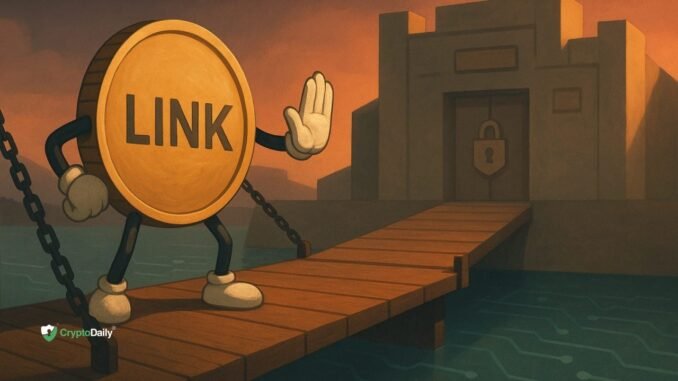

A bank demos an on-chain bond that prices to the second and settles in minutes. The UI is slick—until the data feed stutters. Spreads go stale, redemption logic freezes, and the pilot grinds to a halt. Everyone in the room learns the same lesson: tokenization is only as good as its oracle.
Over the past two years, tokenized treasuries, money-market funds, and structured products have grown from niche tests to serious pilots. Yet the invisible plumbing—the data, messages, and off-chain attestations that keep these assets accurate—remains the make-or-break factor. That’s where Chainlink’s “data moat” shows up.
This is not about hype. It’s about how real-world finance translates into cryptographic guarantees, and why carefully designed, well-governed oracles still matter.
The Big Picture
Tokenized finance is moving from experiments to early production. Custodians, asset managers, and fintechs are putting yields, collateral, and settlement rails on public and permissioned chains. The common thread: each instrument depends on data that blockchains can’t produce on their own—prices, rates, reserves, corporate actions, and cross-chain state changes.
Blockchains secure state transitions; markets secure truth. Oracles are the negotiation layer between the two.
Chainlink, the most widely integrated oracle network in DeFi, has evolved from price feeds into a suite that includes Proof of Reserve, cross-chain messaging (CCIP), low-latency market data, and off-chain computation. Competing approaches—first-party publisher networks, optimistic oracles, or in-house bank oracles—offer meaningful alternatives. But the trade-offs are non-trivial, and tokenized finance amplifies them.
Why Off-Chain Reality Can’t Self-Verify On-Chain
Smart contracts are deterministic. The “real world” is not. When a tokenized asset needs an FX rate, a T-bill price, or a proof that a custodian holds collateral, it must import that fact from outside the chain. This introduces trust assumptions that cannot be eliminated entirely—only minimized, diversified, and made auditable.
Pricing and benchmarks
Most tokenized products reference benchmarks: sovereign yields, credit spreads, indices, or VWAPs. These are constructed from off-chain venues and methodologies. An oracle must source data from reputable providers, aggregate it, and publish updates on deviation thresholds and heartbeats that balance cost, latency, and liveness.
Events and reserves
Lifecycle events (maturities, coupons, redemptions) and custodial reserves (fiat, securities, commodities) require attestations. A Proof of Reserve feed can reduce reliance on periodic PDFs or manual reconciliations by providing a cryptographically signed view of holdings, ideally with independent auditors or API access to custodial systems.
Cross-chain state
Tokenized finance is multi-chain. Assets may be created on one chain, used as collateral on another, and settled elsewhere. Secure cross-chain messaging is required to synchronize state and prevent replay or double-mint scenarios. This is why generalized messaging protocols, such as Chainlink’s CCIP, matter: they provide routing and risk controls over arbitrary payloads.
Inside Chainlink’s Data Moat
Calling it a “moat” isn’t about invincibility; it’s about accumulated advantages that are hard to replicate quickly: distribution across major DeFi apps, a deep bench of professional node operators, premium data partnerships, and a product suite aligned to institutional requirements.
Who runs the network and why it matters
Chainlink’s oracle networks are operated by independent node operators, including infrastructure firms and enterprises. Some well-known organizations have publicly stated they operate Chainlink nodes, contributing reputation and operational rigor. This diversity reduces single-operator risk and improves liveness under stress.
Product components institutions actually use
- Data Feeds: Aggregated price feeds for assets, FX, and indices with on-chain publication and off-chain reporting for efficiency. Documentation: docs.chain.link/data-feeds.
- Proof of Reserve (PoR): On-chain proof that off-chain collateral exists, via auditor attestations or automated API checks. Documentation: docs.chain.link/proof-of-reserve.
- CCIP: Cross-Chain Interoperability Protocol for secure messaging and token transfers with built-in risk controls. Overview: chain.link/ccip.
- Data Streams: Low-latency market data with pull-based validation for derivatives and high-frequency use cases.
- Functions and Automation: Off-chain compute and verifiable triggers (e.g., scheduled actions) that reduce manual interventions.
Economics and risk management
Oracle reports cost gas. Networks minimize this via off-chain aggregation and by publishing only when thresholds are met. For security, Chainlink employs decentralized committees and supports staking-based commitments by node operators. The result is an economic incentive structure where reliability is paramount and misbehavior is economically disincentivized. While no system is perfect, the combination of reputation, cryptography, and incentives has helped Chainlink avoid the most common oracle-failure patterns seen in DeFi.
| Oracle approach | Data sourcing | Update model | Strengths | Key considerations |
|---|---|---|---|---|
| Chainlink (DONs) | Aggregated from multiple premium providers via independent node operators | Push-based with deviation thresholds + heartbeats; cross-chain messaging via CCIP | Battle-tested in DeFi; broad chain/app coverage; PoR and CCIP suite | Fees tied to gas and update cadence; governance and vendor selection still matter |
| Pyth Network | First-party publishers (exchanges, market makers) sign price updates | Pull-based updates by consumers; low-latency focus | Fast market data; direct publisher attestations | Consumer must request/commit prices; coverage depends on participating publishers |
| RedStone | Modular: off-chain signers; app-specific delivery | Pull or custom delivery; optimized for gas savings | Flexible integration; cost-efficient | Integration pattern differs from legacy push feeds; assess signer set |
| UMA (Optimistic Oracle) | Dispute-based truth resolution with economic guarantees | Optimistic; values final if undisputed in window | Generalizable to exotic data/events | Not instant finality; requires dispute watchers and economic parameters |
| Internal bank oracle | Institution-controlled feeds and attestations | Custom SLAs; private or permissioned networks | Data licensing clarity; internal accountability | Single point of failure; limited decentralization; harder public DeFi integration |
How Tokenized Assets Actually Use Oracles Day-to-Day
From issuance to redemption, oracles touch almost every function. A practical flow often looks like this:
- Onboarding: Define data needs—benchmarks, FX pairs, NAV snapshots, coupon schedules, and reserve attestations. Select providers and update cadences.
- Deployment: Integrate price feeds and PoR into smart contracts; configure deviation thresholds and heartbeats; set failover logic for multiple sources.
- Lifecycle automation: Use Automation/keepers to schedule coupons, rebases, or interest accrual; log events on-chain for auditability.
- Collateralization: Feed prices into risk engines to compute LTVs and liquidation buffers. For wrapped or custodial assets, add PoR to gate mint/burn.
- Cross-chain use: When enabling secondary markets on other chains, use CCIP or comparable messaging to reflect mints/burns and prevent inconsistencies.
- Monitoring and alerts: Track freshness, variance vs. reference sources, and oracle liveness. Alert on anomalies; switch to circuit-breaker modes if needed.
Design choices that reduce operational risk
- Multi-oracle redundancy for critical feeds, with deterministic fallback ordering.
- Explicit circuit breakers that pause actions on stale or extreme data.
- Segregation between pricing oracles and administrative attestations (reserves, corporate actions).
- Clear SLAs and incident playbooks with providers and node operators.

Adoption Markers and What They Signal
Several signals suggest oracles are maturing alongside tokenization:
- Interoperability pilots by major financial messaging networks have tested blockchain connectivity with Chainlink for secure, standardized messaging between traditional systems and multiple blockchains.
- DeFi-native protocols have relied on Chainlink price feeds for years across major EVM chains, providing a hardening effect and operational familiarity.
- Proof of Reserve has been adopted for on-chain verification of off-chain collateral in stablecoin and wrapped-asset contexts, addressing an auditability gap.
- RWA tokenization has accelerated, with trackers showing rising issuance of on-chain treasuries and funds. For many of these, reliable benchmarks and attestations are essential. See category data: defillama.com/categories/RWA.
Institutional implications
These markers point to a practical norm: oracles are no longer optional glue; they are part of the core stack. Procurement teams should evaluate them like any critical vendor—security, uptime, data licensing, and compliance—while architects design with redundancy and observability from day one.
Build, Buy, or Partner: Choosing Your Oracle Strategy
The most consequential decision is not “which brand,” but “which trust model fits the product and jurisdiction.” Here’s a pragmatic framework.
When to adopt a network like Chainlink
- You need broad chain coverage and DeFi composability.
- You require a mix of price feeds, PoR, and cross-chain messaging under one operational roof.
- You want decentralized operator diversity rather than a single internal feed.
When a first-party publisher network fits
- Your instruments require ultra-low-latency updates from specific venues.
- You can accommodate pull-based consumption patterns in contracts.
- You value direct exchange or market-maker attestations.
When an optimistic oracle makes sense
- Your data involves subjective events (e.g., custom indices, off-market conditions) that benefit from dispute windows.
- You accept slower finality in exchange for flexible, game-theoretic guarantees.
When to run an internal oracle
- You are operating in a permissioned environment with strict data-licensing constraints.
- You can tolerate a single-operator model and offset it with governance and audits.
- You need tight integration with proprietary systems and SLAs.
Due diligence checklist
- Data lineage: Who publishes data? How is it aggregated and verified?
- Operator set: How many independent operators? What are their credentials?
- Security model: Thresholds, signatures, dispute processes, and staking commitments.
- Latency and cost: Update frequency vs. gas costs; pull vs. push trade-offs.
- Failure modes: Fallbacks, circuit breakers, and historical incident response.
- Compliance: Data licenses, jurisdictional constraints, and audit support.
Risks & What Could Go Wrong
- Oracle manipulation: Thin-liquidity venues can be exploited to move a price feed if sources are not diversified or if deviation logic is weak.
- Staleness and liveness failures: Network congestion or operator outages can freeze updates, halting contract logic.
- Cross-chain message risk: Relaying incorrect or replayed messages can cause double-mints or lost funds without strict verification and rate limits.
- Data licensing and IP: Using proprietary benchmarks without clear licenses can create legal exposure.
- Custodial misreporting: PoR is only as good as data access. If custodians or auditors are compromised, feeds can mislead.
- Governance centralization: Small committees can introduce capture or censorship risk if not transparently managed.
- Regulatory change: New rules on benchmarks, data sharing, or stablecoin reserves can force redesigns.
No oracle eliminates trust—robust designs distribute, minimize, and monitor it. Treat oracle risk like counterparty risk: quantify, diversify, and plan for failure.
None of this is investment advice. Tokenized finance, like DeFi, is volatile and experimental. Manage exposures accordingly.
For ongoing coverage of tokenization, oracle security, and cross-chain infrastructure, Crypto Daily tracks the space with news and explainers you can share with risk, legal, and engineering. Visit Crypto Daily.
Frequently Asked Questions
Why can’t blockchains fetch prices or rates by themselves?
Blockchains intentionally avoid external calls to keep consensus deterministic. Any off-chain fact—prices, FX, reserves—must be imported through an oracle mechanism with explicit trust assumptions and verification logic.
What makes Chainlink’s approach attractive for tokenized finance?
Distribution, data-provider breadth, and a suite that spans price feeds, Proof of Reserve, and cross-chain messaging. The combination reduces integration overhead and concentrates operational accountability while keeping operator sets decentralized.
Isn’t “trusted oracle” a contradiction if crypto aims for trustlessness?
For off-chain facts, absolute trustlessness is impossible. The practical goal is trust minimization: multiple independent providers, cryptographic attestations, economic incentives, transparent processes, and strong fallback plans.
How does CCIP differ from a bridge?
CCIP is a generalized messaging protocol that can move tokens and arbitrary data with risk controls such as rate limits and commit/verify flows. It emphasizes secure messaging rather than solely lock-and-mint bridging semantics.
Do I need multiple oracles for a single product?
Often yes, especially for critical price feeds or administrative attestations. Multi-oracle designs with deterministic fallbacks and circuit breakers materially reduce tail risk compared to single-provider setups.
What about low-latency use cases like perps?
First-party publisher networks and low-latency streams can be a better fit for high-frequency products. Many teams combine fast pull-based updates for trading with aggregated push-based feeds for risk management and settlements.
How should we evaluate Proof of Reserve?
Scrutinize data access (API vs. auditor attestations), frequency of checks, independence of providers, and how the smart contract responds to anomalies. PoR is a control, not a guarantee—design around failures.
Disclaimer: This article is provided for informational purposes only. It is not offered or intended to be used as legal, tax, investment, financial, or other advice.





Be the first to comment