

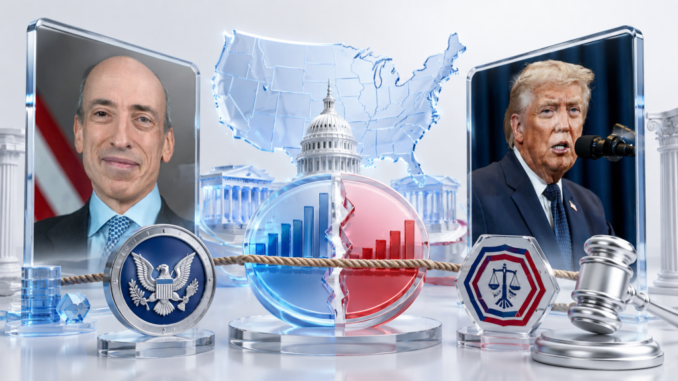

Former SEC and CFTC Chair Gary Gensler has challenged President Donald Trump’s push to keep prediction markets under the Commodity Futures Trading Commission, arguing that many of these products should remain under state authority instead.
The dispute has become one of the most important regulatory fights around Kalshi, Polymarket, Crypto.com, Robinhood and other platforms offering event-based contracts. Trump recently backed the CFTC’s claim to exclusive authority over prediction markets, placing the sector inside his broader pro-crypto policy agenda and arguing that the U.S. should protect a fast-growing financial market.

Gensler’s objection cuts directly into that position. His view is that the CFTC’s post-Dodd-Frank authority was not designed to turn sports betting or similar event markets into federally supervised derivatives. That argument puts him closer to state gambling regulators and attorneys general who say sports-linked prediction markets can function like online betting products, even when platforms describe them as financial contracts.
The Fight Is About Who Controls Event Contracts
Prediction markets let users trade on the outcome of future events, including elections, sports results, economic data, corporate milestones and public-policy decisions. Platforms such as Kalshi frame these products as event contracts that belong inside federal commodities regulation. State regulators argue that some contracts cross into gambling and should be handled under state gaming laws, licensing rules and consumer-protection systems.
That conflict has already moved into court. The CFTC has argued that federally regulated event-contract markets sit under its exclusive jurisdiction, while several states have tried to block or restrict sports-related prediction markets. The agency has also moved deeper into rulemaking after opening a prediction-market consultation in March.
The latest Trump-Gensler clash raises the stakes because it turns a technical derivatives dispute into a national policy fight. Trump’s approach favors a single federal pathway for prediction markets. Gensler’s position leaves more room for state-by-state oversight, especially when contracts resemble sports betting or gambling products.
CryptoAdventure recently covered how Trump tied prediction markets to America’s crypto-capital agenda, framing the CFTC fight as part of a wider push to keep financial innovation inside U.S. markets. Gensler’s criticism shows that the regulatory debate is far from settled, even among former officials who have led the same agency.
Kalshi And Polymarket Sit At The Center
Kalshi and Polymarket remain the two clearest examples of why the fight matters. Kalshi operates as a CFTC-regulated exchange in the U.S., while Polymarket has grown into one of the best-known crypto-native prediction platforms. Both have benefited from rising demand for event-based trading, but the legal treatment of sports, politics and other high-stakes markets remains unsettled.
The industry’s growth has also pulled prediction markets closer to crypto market structure. Crypto traders now use platforms such as Polymarket to price private-company outcomes, AI listings, elections and regulatory decisions. Recent activity around OpenAI IPO odds on Polymarket showed how quickly event markets can turn private-market speculation into tradable sentiment.
That growth also creates harder oversight questions. Regulators must decide how platforms should handle KYC, geographic restrictions, suspicious trading, market manipulation, insider information and consumer losses. Those issues become sharper when a market involves sports results, government actions or private-company events where some traders may have better information than the public.
State Regulators See A Gambling Loophole
State officials are pushing back because prediction markets can compete directly with licensed gambling and sports-betting operators. If a sports outcome contract is treated as a federally regulated derivative, platforms may avoid state gambling licenses, local tax systems and responsible-gaming rules that apply to sportsbooks.
That is the core concern behind Gensler’s position. A broad CFTC shield could let prediction-market platforms offer products across state lines while bypassing the systems states built for gambling oversight. Supporters of federal regulation argue that prediction markets are financial instruments, not sportsbooks, and that fragmented state enforcement would push innovation offshore.
The question now is whether courts and regulators treat event contracts as derivatives, gambling products, or a hybrid category that needs a new framework. A federal-only model would give platforms cleaner national access. A state-led model would keep sports and gambling-like markets closer to traditional gaming oversight. A split model could allow economic and political event contracts under federal rules while leaving sports and casino-like products to states.
The Supreme Court Risk Is Growing
Gensler’s pushback adds pressure to a dispute that could eventually reach the Supreme Court. Conflicting court decisions, state enforcement actions and CFTC rulemaking all point toward a larger test of federal preemption. The outcome could determine whether prediction markets become a mainstream U.S. financial product or remain trapped in a patchwork of state-by-state legal fights.
For crypto, the decision matters beyond Kalshi and Polymarket. Prediction markets are increasingly tied to tokenized assets, pre-IPO speculation, AI valuation bets, political markets and onchain trading behavior. A clean federal route could accelerate product growth, while stronger state authority could limit sports-linked markets and force platforms to redesign access controls.
The next concrete signals are the CFTC’s proposed rule, the White House review process, active state litigation and any new court rulings on whether sports-event contracts are federally protected derivatives or gambling products subject to state law.


Be the first to comment