

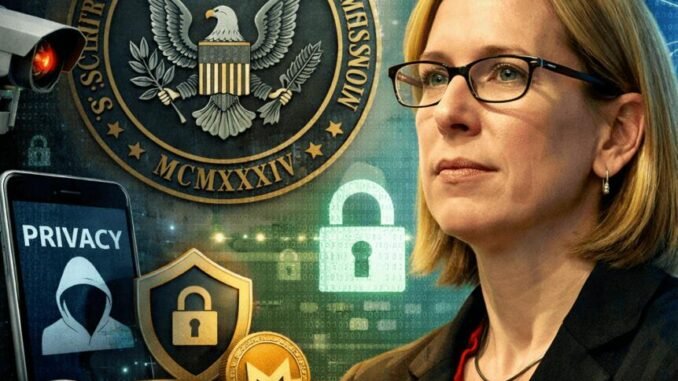

U.S. Securities and Exchange Commission Commissioner Hester Peirce warned this week that financial privacy is increasingly undervalued in U.S. regulation, urging a more balanced view of privacy-preserving technology as part of the nation’s financial infrastructure.
Speaking on Wednesday at Georgetown Law, Peirce framed cryptographic tools and privacy-enhancing technologies as legitimate components of modern markets, not merely the province of illicit actors.
“Empowering government to identify, pursue, and punish the bad guys is important to the security of the nation and its people, but so too is empowering people to protect information about their lives, including their financial lives,” she said, according to the transcript published on the SEC’s website.
Peirce added that privacy technologies can help individuals protect themselves from hackers, scammers and other malicious actors, and should not be viewed as “an opportunity for the government to watch more of what its citizens do.”

She encouraged developers building privacy-enhancing technologies to engage with the SEC’s Crypto Task Force, particularly on tools that could support Know Your Customer (KYC) and Anti-Money Laundering (AML) compliance requirements.
Key takeaways
- Privacy-enhancing technologies are legitimate components of financial infrastructure, not solely tools for illicit activity.
- Financial privacy can coexist with national security objectives and may reduce information exposure for individuals.
- Developers of privacy-focused tools should collaborate with the SEC’s Crypto Task Force on potential KYC/AML compliance considerations.
- Regulatory conversations in the European Union point to 2027 AML rule changes that could restrict anonymous accounts and privacy-preserving tokens.
- Privacy-focused crypto innovation remains active in the market, with practical applications and ongoing investor interest in assets and use cases that prioritize on-chain privacy.
Privacy returns to crypto spotlight
Privacy and privacy-preserving technologies have long been a core use case for crypto, with projects like Monero and Zcash designed to shield transaction data and user identities. The current regulatory dialogue has revived debate over the role these tools should play in the ecosystem. Advocates argue that privacy protections help users defend against surveillance, data exploitation, and targeted scams, while critics warn they could enable illicit finance if not properly regulated.
The regulatory conversation has also spilled into Europe, where authorities are weighing new AML rules slated to take effect in 2027. The framework would constrain anonymous accounts and access to privacy-preserving cryptocurrencies by banks and crypto service providers, underscoring the tension between privacy and oversight across borders.
Legal experts tracking the space have described maintaining access to privacy-focused digital assets as a “constant battle” between industry participants and regulators. Anja Blaj, a legal consultant at the European Crypto Initiative, has highlighted how regulatory friction can shape the pace and direction of privacy innovations in the sector.
As the privacy discourse persists, market observers have noted measurable interest in privacy-focused assets. Zcash, in particular, has seen renewed attention and price momentum over the past year, a signal of investors valuing privacy-centric capabilities amid shifting regulatory expectations. (Source: CoinMarketCap)
From policy to on-chain practice
Policy debates aside, the industry continues to translate privacy concepts into on-chain tools and products. Aptos has introduced a privacy-focused coin intended to prevent wallet profiling and protect treasury movements from competitor insight, illustrating how privacy tech can be embedded into corporate and network-level transactions.
Meanwhile, Polygon has rolled out private stablecoin payments for institutions, positioning privacy as a facilitator of broader on-chain adoption by enabling discreet settlement and treasury operations. These developments reflect a broader push to reconcile privacy with practical business and regulatory requirements in real-world deployments.
Looking ahead, investors and builders should watch how privacy-centric tools align with evolving KYC/AML frameworks and the regulatory guidance that will emerge from the SEC Crypto Task Force and European authorities. The path forward will likely combine tighter oversight with clearer, standards-based privacy implementations that support legitimate use while limiting misuse.



Be the first to comment