

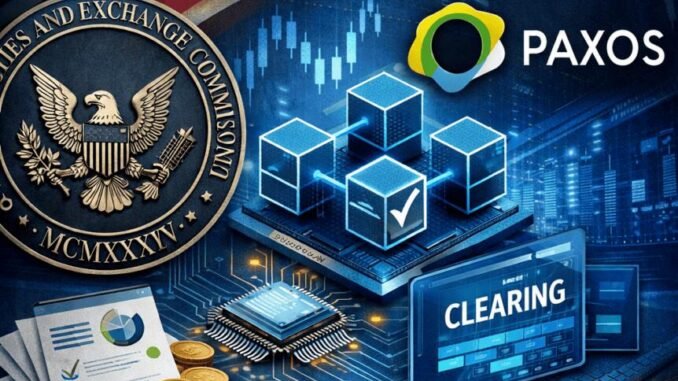

Paxos has reached a landmark milestone by obtaining U.S. regulatory clearance to operate as a clearing agency, making Paxos Securities Settlement Company the first blockchain-native firm approved to provide central securities depository services in the United States. The decision underscores a broader shift as traditional markets increasingly integrate blockchain-based post-trade infrastructure within a regulated framework.
Paxos emphasized that the registration marks the company’s entry into the core plumbing of financial markets—clearing and settlement—where trades are verified, matched, and the transfer of cash and securities is finalized. In this framework, a registered clearing agency can streamline workflows for banks and brokerages looking to build crypto-enabled market infrastructure with formal oversight.
“Paxos’ clearing agency registration is the result of seven years of work with the SEC, beginning with our No-Action Letter in 2019 and the settlement pilot we operated with some of the world’s largest and most sophisticated financial institutions,” said Charles Cascarilla, Paxos co-founder and CEO. The company notes that the pilot demonstrated blockchain-based post-trade infrastructure could deliver same-day settlement, cut costs, and improve operational efficiency within a fully regulated environment.
As a reminder of Paxos’ broader footprint, the firm remains a major issuer of digital assets and stablecoins, including PayPal USD (PYUSD), Global Dollar (USDG), and Pax Gold (PAXG). The SEC action sits within a complex regulatory narrative that Paxos has navigated for years, including a high-profile review of its Binance USD (BUSD) stablecoin issuance and related enforcement considerations.

Key takeaways
- Paxos Securities Settlement Company becomes the first blockchain-native firm registered as a clearing agency by the U.S. Securities and Exchange Commission, positioning Paxos as a central securities depository within the U.S. market infrastructure.
- The approval signals a tangible pathway for regulated, blockchain-based post-trade settlement and custody services to operate at scale alongside traditional market infrastructure.
- Paxos’ regulatory journey spans years, including a 2019 SEC no-action letter and a 2020 pilot for U.S. equities settlement, with subsequent regulatory actions shaping the current milestone.
- The company’s governance history includes a Wells Notice in 2023 over BUSD and a 2024 SEC investigation closure, followed by a 2025 NYDFS settlement tied to stablecoin compliance issues.
- Paxos remains a notable issuer of stablecoins and digital assets, a factor that intertwines its regulatory trajectory with broader questions about regulated crypto-native financial services.
Blockchain-native clearing and a new layer of market infrastructure
The function of clearing agencies is a cornerstone of orderly markets. They ensure that trades are matched, settled, and reconciled between buyers and sellers, mitigating counterparty risk and reducing settlement failures. By earning SEC clearance as a blockchain-enabled clearing entity, Paxos positions itself as a bridge between regulated traditional markets and the growing ecosystem of digital assets and crypto-native products.
Industry observers see the development as a concrete step toward modernizing post-trade infrastructure without abandoning the guardrails demanded by U.S. market participants and regulators. Paxos’ own experiences with blockchain-backed settlement, including a previously conducted same-day settlement pilot, are cited as proof points that distributed-ledger technologies can coexist with established risk controls and licensing regimes.
Cascarilla framed the milestone as the culmination of years of engagement with the SEC, highlighting how the firm’s approach blends innovation with a disciplined regulatory posture. The press materials accompany the news with a reminder that the SEC’s decision was not a purely theoretical endorsement: it enables a regulated pathway for banks and brokerages to build out crypto-related settlement capacity with a recognized custodian and clearinghouse behind the scenes.
Regulatory arc: from no-action letters to formal clearance
Paxos’ regulator journey dates back to 2019, when the SEC issued a no-action letter allowing the firm to pilot a blockchain-based settlement service for U.S. equities. The pilot, launched in February 2020, was designed to test whether blockchain could deliver faster, cheaper post-trade processing while operating under a comprehensive regulatory framework. The results highlighted potential efficiency gains, including same-day settlement in a regulated environment, which informed Paxos’ ongoing dialogue with regulators.
However, the path has not been without tension. In 2023, Paxos faced a Wells Notice from the SEC regarding the Binance USD (BUSD) stablecoin, with the agency considering enforcement actions related to its issuance. Around the same period, the New York Department of Financial Services (NYDFS) ordered Paxos to halt the minting of new BUSD. The regulatory review culminated in 2024 with the SEC closing its investigation and issuing a formal termination notice. Later, Paxos reached a settlement with NYDFS in August 2025 amounting to $48.5 million over compliance issues related to BUSD.
These episodes illustrate the evolving and sometimes contentious regulatory environment surrounding stablecoins and crypto-native financial infrastructure. The SEC’s eventual clearance for Paxos’ clearing agency activities reflects a potential path forward for other regulated crypto interfaces, provided they align with U.S. securities and commodities laws and the appropriate risk controls demanded by traditional market participants.
Implications for markets, banks, and users
The arrival of a registered blockchain clearing agency signals a growing appetite among market participants to blend crypto-native capabilities with familiar regulatory guardrails. Banks and brokerages seeking to offer crypto-based settlement services can now point to a recognized clearing authority that operates within the U.S. legal framework. This reduces some of the regulatory and operational uncertainty that previously deterred institutions from embracing blockchain-enabled post-trade workflows.
For users and investors, the development could translate into more resilient settlement pipelines, potentially lower operational costs, and a broader suite of regulated crypto-enabled products. Yet the broader regulatory landscape remains a moving target. Paxos’ experience—ranging from pioneering no-action relief to high-profile enforcement considerations and eventual settlement—serves as a reminder that innovation in crypto markets often travels alongside careful, ongoing oversight.
Industry watchers will be watching how Paxos leverages this clearance in the coming quarters: the degree to which banks and brokerages adopt blockchain-backed settlement at scale, how other blockchain-native players respond, and whether further regulatory clarity emerges around other asset classes and settlement models.
The SEC’s decision, paired with Paxos’ ongoing compliance and product ambitions, underscores a broader narrative: regulated post-trade infrastructure built on blockchain is moving from experimental pilots to a structured component of mainstream financial markets. The outcome could influence the pace at which similar initiatives expand across asset classes, and it may shape the design of future regulatory frameworks that govern digital assets in traditional market ecosystems.
Readers should keep an eye on how Paxos expands its role as a clearing agency, how market participants integrate the new framework, and whether more U.S. regulators formalize similar pathways for blockchain-enabled infrastructure in 2026 and beyond.



Be the first to comment