


Speculation can carry a game token a long way, but shipping builds is what carries a game. In GameFi, the names that endure aren’t those with the loudest candles; they are the teams that show up every week with patches, balance changes, and player‑first economies.
This article proposes a survivorship test for GameFi: filter tokens through builder activity, live‑ops discipline, and on‑chain traction instead of price spikes alone. We’ll outline signals to track, traps to avoid, and practical steps to size risk in a volatile genre.
We also ground the discussion with data points: an academic link between TVL and ETH, a real unlock schedule from a known title, and a recent pump in a newly launched gaming token—illustrating why narrative can detach from delivery.
| Point | Details |
|---|---|
| Builders outlast pumps | Consistent releases, public roadmaps, and live‑ops metrics predict staying power better than short‑term price action. |
| Token pumps can be product‑agnostic | New listings can rally before any game loop gains traction; the PITCH token’s ~176% surge in May 2026 is a fresh reminder (WEEX (coverage of PITCH)). |
| Supply mechanics matter | Unlock calendars introduce predictable sell‑pressure. Example: GODS unlock on 10 June 2026 (≈2.6M tokens, ~0.52% total) per CoinGecko (GODS page). |
| On‑chain signals > narratives | Track active wallets, retention, marketplace GMV, and protocol TVL links; capital intensity affects majors—an ECM study finds TVL strongly impacts ETH in the short run (Frontiers in Blockchain (Mohammad et al.)). |
| Risk framing is essential | Size positions against unlocks, runway, and development cadence; treat token rallies as optionality, not validation. |
How to Run a Survivorship Test on GameFi Projects
Editor’s note: In Q1–Q2 2026 I spent a lot of time inside Web3 game Discords and patch channels, mapping release cadence against token moves. The most durable names weren’t the ones trending on Telegram; they were the teams pushing weekly builds, pruning inflated rewards, and fixing exploits fast. Unlock calendars shaped order books more than most narratives admitted, and a few launches that ripped out of the gate saw liquidity evaporate as patches stalled. I now watch builder signals first—changelogs, seasonal beats, and economy sinks—while treating pumps and listings as, at best, a starting point for deeper due diligence. — Sophia Bennett
A survivorship test checks whether a GameFi project’s fundamentals can support the token when speculation cools. Think of it as a triage you can apply in under an hour. It won’t deliver perfect certainty, but it will prevent most avoidable mistakes.
Step 1: Confirm a shippable loop
Identify a playable core loop—e.g., matches, raids, or crafting—that resets daily or weekly and creates predictable engagement. Verify that the loop exists today, not in concept art. Watch gameplay videos, boot a live build, and read recent patch notes.
Step 2: Inspect live‑ops discipline
Healthy games live or die by cadence: patches, balance changes, limited‑time events. Note the average days between updates and whether the team publishes post‑mortems. A weekly or bi‑weekly rhythm signals operational maturity.
Step 3: Validate on‑chain traction
Cross‑check unique active wallets, in‑game transaction counts, and marketplace volume. Patterns—like steady or improving retention—are far more important than absolute peaks. We’ll detail which metrics matter most below.
Step 4: Map token supply risks
Catalog the next six months of unlocks, emissions, and market‑maker agreements. Some sell‑pressure is mechanical; pre‑empt it in position sizing. Use concrete examples, such as the upcoming GODS unlock on 10 June 2026 (CoinGecko (GODS page)), to anchor your analysis.
A Builder‑First Signal Checklist
Shift your focus from candles to commits. Here’s a practical checklist of builder signals that correlate with staying power.
- Release notes: Public, timestamped patches at a predictable cadence (weekly/bi‑weekly). Changelogs with bug IDs and balance rationales are stronger than generic “optimizations.”
- Roadmap truthfulness: Fewer promises, more delivered milestones. Look for evidence of cut scope and reprioritization—hallmarks of real production.
- Playtest loops: Open test servers, seasonal ladders, or beta opt‑ins with feedback forms; community playtest data integrated into patches.
- Economy stewardship: Clear currency sinks, caps on reward inflation, and time‑gated progression. Economic design docs > memetic tokenomics.
- Creator tooling: SDKs, UGC pipelines, or mod support—leverage the community as content multipliers.
- Security posture: Dedicated bug bounty, audits for core contracts, and rollback plans for marketplace exploits.
Pro tip: When repos are private, use proxies: launcher version hashes, asset bundle timestamps, event calendars, and in‑client news banners. Shipping leaves observable trails even without GitHub access.
Token Pumps vs. Product Progress
Price action can be thrilling—and misleading. Early in a cycle, tokens moon on anticipation rather than usage. The newly launched PITCH token reportedly surged about 176% from a recent low within days of its late‑May debut (WEEX (coverage of PITCH)). That speed says more about flows and listings than about whether players are returning day 7 or day 30.
Contrast that with a studio quietly shipping server optimizations, matchmaking fixes, and fair monetization. Over months, the latter earns DAU stability, marketplace turnover, and partner integrations. Price can catch up; without those fundamentals, it rarely stays up.
| Driver | Pump‑Led Projects | Builder‑Led Projects |
|---|---|---|
| Narrative | Listings, influencers, airdrop hype | Changelogs, seasons, feature unlocks |
| Liquidity quality | Thin books, volatile spreads | Deeper books over time; market‑maker stability |
| User metrics | One‑off spikes | Improving retention and session length |
| Economy | Inflationary rewards | Balanced sinks and caps; sustainable loops |
| Longevity | Short half‑life | Compounding network effects |
Speculation can start a fire; builders keep it from burning out.

On‑Chain Metrics That Matter for Games
On‑chain data isn’t a scoreboard; it’s a dashboard. Prioritise persistence over peaks and triangulate across sources.
Engagement and retention
- Unique active wallets (UAW): Track 7‑ and 30‑day trends to see if new cohorts stick.
- Transactions per user: Rising tx/user with stable fees can indicate deepening play patterns rather than mere claim bots.
- Economy churn: Measure in‑game token mints vs burns; aim for a corridor rather than aggressive expansion.
Marketplace vitality
- NFT GMV and velocity: Look for consistent secondary sales and tighter bid‑ask spreads on core items.
- Holder distribution: Beware concentrated treasuries and whales that dominate price discovery.
Capital intensity and TVL context
Total Value Locked is often framed as “DeFi only,” but it captures capital willingness to sit in crypto systems. An Error‑Correction Model study using bi‑weekly data (Aug 2021–Sep 2025) finds TVL exhibits the strongest short‑run effect on ETH price, with an adjusted R² of 0.879 and a 12.3% error‑correction speed per bi‑weekly period (Frontiers in Blockchain (Mohammad et al.)). While this is market‑wide, it reminds us that capital flows shape incentives—and GameFi economies compete for that capital via liquidity rewards, staking, and marketplaces.
For a game token, connect the dots: if liquidity incentives fade and TVL migrates elsewhere, does gameplay alone keep users engaged? Projects that survive answer “yes” through content cadence, not APRs.
Case Snapshots: Release Calendars, TVL Links, and Token Risks
Gods Unchained (GODS) and predictable supply events
According to a late‑May 2026 snapshot, GODS shows a circulating supply around 394,027,780 and a market cap near $14.2M, with an unlock of roughly 2.6M GODS (about 0.52% of total supply) scheduled for 10 June 2026 (CoinGecko (GODS page)). Whether you are a player or holder, this is actionable information: unlocks are mechanical sell‑pressure that don’t care about narratives.
- Update your float math the moment an unlock posts.
- Re‑check market‑maker depth and slippage two weeks before and after the event.
- Watch for offsetting catalysts—a new season, a card set, or a marketplace feature drop.
Speculative launches versus delivery timelines
The PITCH token’s ~176% rally soon after launch (report dated 22 May 2026) illustrates how sentiment can surge before games are battle‑tested (WEEX (coverage of PITCH)). Early momentum is not invalid, but a survivorship lens asks whether build cadence and player retention can catch up to the price. If not, gravity returns.
Pro tip: After a pump, monitor the next three patch windows. If patch notes shrink, community mod teams go quiet, and marketplace velocity drops, consider it a failed handoff from narrative to product.
A Due‑Diligence Playbook for Players and Holders
- Audit the build feed: Read the last eight patch notes. Count days between releases and note whether fixes match community complaints.
- Check the unlock calendar: Log every event in the next 180 days by size, destination, and vesting logic. Treat >1% float events as high‑impact.
- Score the economy: Identify main sinks, faucet caps, and whether rewards are tied to skill (MMR, win‑rate) or grindable loops.
- Validate users, not just wallets: Track cohorts by install date if you can; otherwise proxy via unique active wallets and session timing.
- Model liquidity: Measure order‑book depth at 1% and 2% slippage across major venues and stable pairs.
- Threat map: List top 3 failure modes: exploit risk, content drought, and sell‑pressure from treasury/market makers.
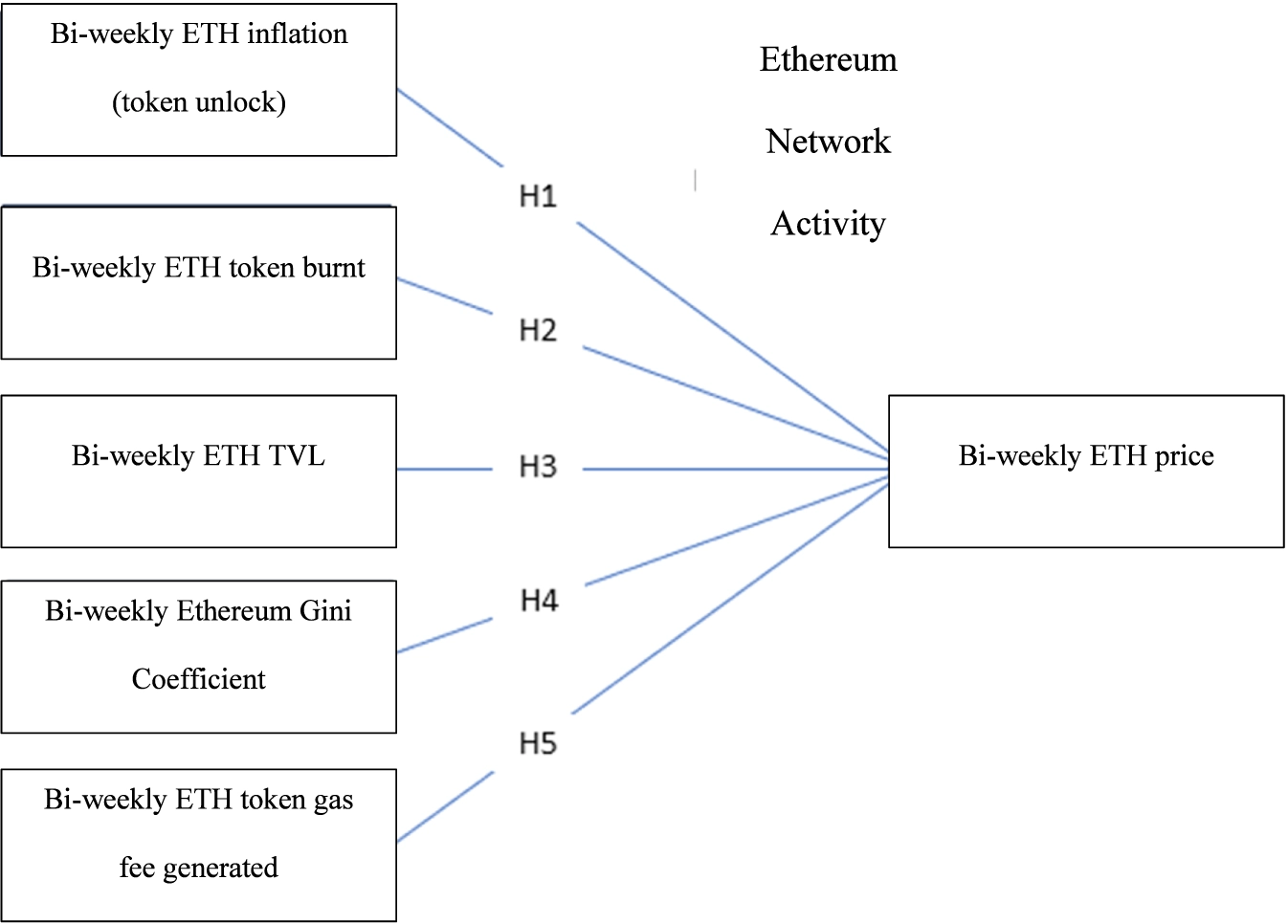
Figure 3 from the Frontiers paper showing the tokenomics predictors model (TVL, burns, unlocks, Gini, gas fees) linked to bi‑weekly ETH price — visualizes why on‑chain utility (TVL) matters more for sustained value than short token pumps. — Source: Frontiers in Blockchain
Red Flags Unique to Game Tokens
- Event‑only DAUs: Users spike only during airdrops or tournaments, then vanish. Real games show weekday baselines.
- Inflation disguised as “rewards”: Emissions with few sinks erode item value and token confidence.
- Art over architecture: Shiny trailers with no server scaling plan or anti‑cheat roadmap.
- Roadmap roulette: Deliverables keep “moving right” every month; the only constant is marketing.
- Opaque unlock beneficiaries: Foundation or advisor wallets unlabeled; governance votes rushed near unlocks.
- Marketplace wash: Sudden GMV spikes with repetitive buyer/seller pairs; beware manufactured “traction.”
Position Sizing for a Volatile Genre
Because GameFi combines product risk with market risk, treat position sizing as a product‑launch bet—not a blue‑chip allocation. A practical heuristic is to scale entry size to builder confidence and supply overhang:
- Builder score high, overhang low: Consider laddering in across multiple patches to confirm momentum.
- Builder score mixed, overhang mid/high: Keep exposure small or wait for unlock digestion and a content drop.
- Pure narrative, thin books: If you participate, treat it as short‑dated optionality with predefined exits; never confuse a listing pump with validation.
Remember that broader liquidity regimes matter. As the ECM result suggests, TVL shifts can ripple into majors like ETH (Frontiers in Blockchain (Mohammad et al.)), and risk appetites flow down to long‑tail assets. When that tide recedes, teams with active builders and sticky loops are the ones left standing.
If you’re a studio, reverse this framework: over‑communicate your cadence, document economy changes, and align token supply with content beats. The market will still speculate—but you’ll give it a foundation.
For ongoing coverage and field reports from Web3 gaming teams, Crypto Daily follows release cadences, unlock calendars, and on‑chain traction without the hype. Visit Crypto Daily for updates.
Frequently Asked Questions
Do token pumps predict future gameplay quality?
No. Short‑term rallies often reflect listings and speculative flows rather than tested gameplay. The PITCH surge in May 2026 underscores how price can move ahead of delivery (WEEX (coverage of PITCH)).
Which on‑chain metrics best reflect real adoption for a game?
Blend unique active wallets with retention windows (D7, D30), transactions per user, and marketplace GMV. Triangulate across sources and look for consistency rather than one‑day spikes.
How should I treat scheduled unlocks like the GODS event?
As mechanical supply expansions. For GODS, CoinGecko lists a 10 June 2026 unlock of about 2.6M tokens (~0.52% of total) with a circulating supply around 394M (CoinGecko (GODS page)). Adjust position sizing and monitor liquidity around the date.
Is TVL relevant to GameFi tokens or just DeFi?
TVL primarily measures DeFi capital, but it signals market‑wide risk appetite. Research using an Error‑Correction Model suggests TVL has a strong short‑run effect on ETH, highlighting how capital flows can set the backdrop for risk assets, including GameFi (Frontiers in Blockchain (Mohammad et al.)).
What if a team keeps repos private—how can I still assess builders?
Track release cadence through client version hashes, patch notes, event calendars, and in‑game announcements. Consistent, specific changelogs are a strong proxy for real output.
Are NFTs or fungible tokens better exposure to a game?
They express different risks: NFTs capture item scarcity and player status; tokens capture economy‑wide exposure and liquidity. Many players diversify: core NFTs for utility, smaller token positions for liquidity.
How do I avoid wash‑traded marketplace volume?
Compare GMV with unique buyer counts, hold time between trades, and price dispersion. Repeated address pairs and instant round‑trips are common wash patterns.
Disclaimer: This article is provided for informational purposes only. It is not offered or intended to be used as legal, tax, investment, financial, or other advice.




Be the first to comment