


What to know:
- The Indian stock market crash deepened as the MSCI rejig triggered late selling on Friday.
- MSCI changes drove estimated ₹8,000 crore outflows from Indian equities in May trade.
- Crude risks, foreign selling, and U.S.-Iran uncertainty weighed on large-cap stocks.

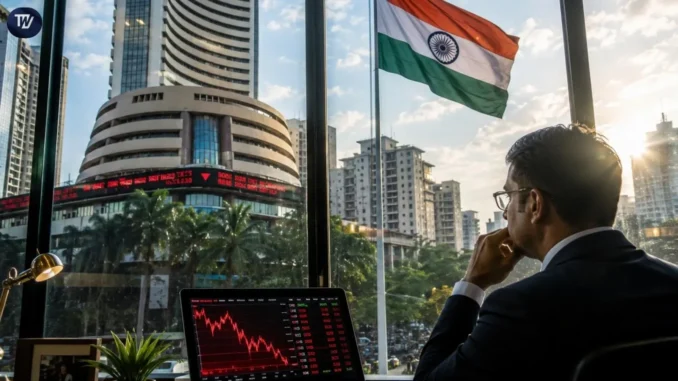
Indian equity benchmarks closed lower on Friday after early gains faded into a late selloff. The Indian stock market crash was driven by MSCI’s rebalancing in May, foreign investor caution, and uncertainty on a U.S.-Iran peace deal. Traders took profits following April’s rally.
The Nifty 50 fell 1.5% to 23,547.75. The BSE Sensex shed 1.44% to 74,775.74. The impact of the fall pushed their losses to 1.9% and 2.8% in May, respectively.
Also Read: FalconX IPO Confidential Filing with SEC Signals Late 2026 Listing Outlook

MSCI Rebalancing Triggers Late Selling Pressure
As Reuters reported, Indian equities moved deeper into negative territory in the final half hour of trade. MSCI’s May index rejig took effect on Friday. Passive funds adjusted positions near the close.
Federal Bank, MCX, National Aluminium, and Indian Bank were added to the Global Standard Index by MSCI. It removed Hyundai Motor India, Jubilant Foodworks, Kalyan Jewellers, and RVNL. Moneycontrol estimated outflows due to rebalancing at approximately ₹8,000 crore.
The MSCI Emerging Markets weight has increased from 2020 to 2024 in India. It reached about 20% in July 2024. IIFL Capital expects it to fall to 11.2% after the latest rebalancing.
The Indian stock market crash followed a turbulent three-month period. The Nifty was down 11.3% for the month of March. It had a recovery of 7.5% in April, but it again fell in May.
Indian shares are unlikely to move in a sustained uptrend until the U.S.-Iran uncertainty settles, said Arun Malhotra of CapGrow Capital. His comment reflected the market’s focus on geopolitical risk. The price of oil remained a major concern for India.
Foreign Selling Hits Large-Cap Stocks in May
In May, the price of Brent crude futures dropped 19%. Still, they remained 27.3% above levels seen before the Iran War. India is the third largest crude importer in the world.
Analysts said elevated crude prices and limited exposure to the AI trade kept India out of favor with foreign investors. Those pressures were mirrored in the Indian stock market crash. Selling pressure in the large-cap stocks was compounded by foreign selling.
Ten of the 16 major sectors posted monthly losses. Broader markets outperformed benchmarks. Small-cap and mid-cap stocks were up 0.7% and 3.2%, respectively, on earnings optimism.
During the month, heavy-weight financial stocks fell by 1.2%. IT shares declined 0.9%. Benchmark indices were under pressure as Reliance Industries tumbled 7.7%.
Indian Stock Market Crash Hits Large-Cap Stocks
ONGC dropped 11.4% as investors booked profits. The stock had risen over the previous four months in value by 25%. The company was weighed down by concerns over production delays at key projects.
ITC fell 8.9% during the month. Analysts said recent price hikes could affect cigarette volumes in June. This put further pressure on the Indian stock market crash.
Some counters still ended higher in May. Adani Enterprises ended up 22% higher following the U.S. decision to drop fraud charges against Gautam Adani. Hindalco and National Aluminium gained 8.6% and 6.3%, helped by stronger metal prices.
The Indian stock market crash concluded the month of May under pressure on large-cap stocks. The decline was led by MSCI flows, foreign selling, crude risks, and U.S.-Iran uncertainty. Headline indices finished the month weaker as broader markets were stronger.
Also Read: Crypto Risk Classification Signals New Scrutiny in India 2026



Be the first to comment