


Key Takeaways
- The SPACEX-USDH contract on Hyperliquid plunged 45% on May 28, dropping from $2,277 to $1,254.
- Thin liquidity triggered $1.51 million in liquidations across 1,393 positions held by 405 users.
- The flash crash once again exposed the risks of onchain price discovery ahead of SpaceX’s June public IPO.
Onchain Data Shows Severe Liquidity Vacuum in Pre-Market Contract
SPACEX-USDH, a synthetic pre-market asset, plunged from an opening price of $2,277 down to a low of $1,254 within a 30-minute window, representing a nearly 45% collapse. The contract eventually recovered to trade near $2,157, but the brief liquidity vacuum triggered cascading liquidations across the decentralized trading platform’s order books.

The sharp drawdown wiped out 1,393 leveraged positions across 405 individual users, resulting in a total notional loss of exactly $1.51 million. Market analysts noted that the median margin of the liquidated positions was only $31, indicating that the market was heavily skewed toward high- leverage retail participants.

The SPACEX-USDH contract behaves as a synthetic perpetual tied to the implied market valuation of the aerospace company SpaceX. Because SpaceX remains a private entity with an initial public offering expected around June 11, there is no publicly available price benchmark for the asset.
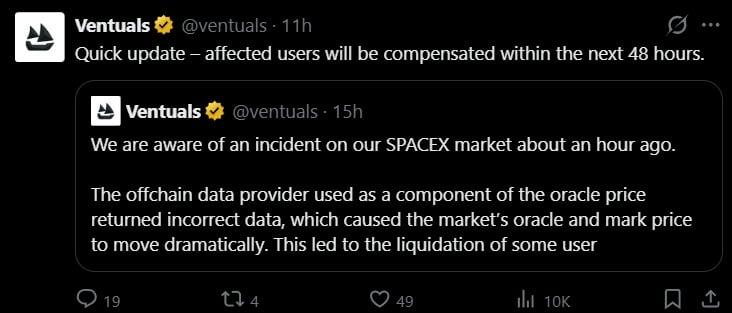
The market was built using Hyperliquid’s HIP-3 architecture by a venue called Ventuals, which allows independent builders to construct pre-markets for private equities using the exchange’s core matching engine. In fact, following the incident, the firm pledged to compensate users within 48 hours.
Before Thursday’s collapse, speculative trading had pushed SpaceX’s implied valuation to above $2.5 trillion, significantly higher than the reported $1.75 trillion to $2 trillion valuation range the company is targeting for its U.S. equity market debut.
Also, even though HYPE (the native token of the Hyperliquid ecosystem) has seen significant growth recently, piercing into the top tier of crypto assets by market capitalization and hitting all-time highs, the extreme volatility in its peripheral pre-IPO markets has once again brought out the risks of thinly traded synthetics.
This is because these assets are not anchored to any transparent spot market, resulting in traders being forced to rely on fragmented private secondary market data to determine the contract’s fair value.






Be the first to comment