




Author
Ahmed Barakat
Author

Share


The Ethereum Foundation is facing its most concentrated wave of internal criticism in years, eight high-profile departures since January 2026, a contested public mandate, and an open debate over whether the Switzerland-based nonprofit still serves a coherent purpose inside the ecosystem it helped build. The conflict is no longer a background murmur.
It is now a front-page governance crisis for the network securing trillions of dollars in on-chain assets.
What makes this moment distinct is not the departures alone. It is the collision of competing visions for what the Ethereum Foundation is supposed to be, and, by extension, what Ethereum itself is supposed to become.
Ethereum Foundation: What’s Behind the Governance Conflict
The immediate flashpoint was the foundation’s March 13, 2026 “Mandate” publication, described internally as “part constitution, part manifesto, and part guide”, which explicitly reframed the EF as a steward rather than Ethereum’s “parent, ruler, or final authority.”
The document sharpened an old fault line: should the foundation stay narrowly focused on public-goods research, or evolve into a more execution-oriented institution capable of competing in an increasingly commercial blockchain landscape?
The departures accelerated criticism that had been building for months. Zak Cole, a longtime Ethereum contributor, delivered the sharpest public verdict on Laura Shin’s Unchained podcast: “The EF is completely out of touch.
They’re funding hippos in Asia and doing a bunch of stuff nobody in the world gives a s*** about other than Vitalik and his little cabal.” Cole framed the stakes plainly: “Ethereum is no longer a startup. It’s a mature and robust ecosystem. There’s billions, trillions of dollars on the line. Livelihoods are dependent on that.”
Former EF researcher Dankrad Feist went further, publicly floating the idea of a separate $1 billion ETH-aligned organization to improve execution and value capture, a direct challenge to the foundation’s public-goods model.
The foundation’s internal agenda has also been shifting: new protocol team leadership has been tasked with raising the gas limit to 200 million, advancing proposer-builder split work, and pushing mainnet-grade zkEVMs toward 128-bit provable security.
Vitalik Buterin pushed back last week in a lengthy post, arguing critics misread the EF’s intended role. “EF is not a ‘center of Ethereum,’” Buterin wrote. “Rather EF is ‘one node, with a defined purpose, alongside other nodes.’”
He framed the foundation’s current narrowing around its core values – censorship resistance, openness, privacy and security, internally labeled “CROPS”, as a deliberate strategic choice: “The EF is choosing to use its remaining resources to pursue longevity over breadth.”
Discover: The Best Crypto to Diversify Your Portfolio
Why Ethereum Foundation Governance Affects ETH Investors
The transmission mechanism from foundation-level conflict to market impact is indirect but real. Developer sentiment drives protocol credibility; protocol credibility drives institutional confidence; institutional confidence shapes ETH’s positioning as both a financial asset and an infrastructure bet.
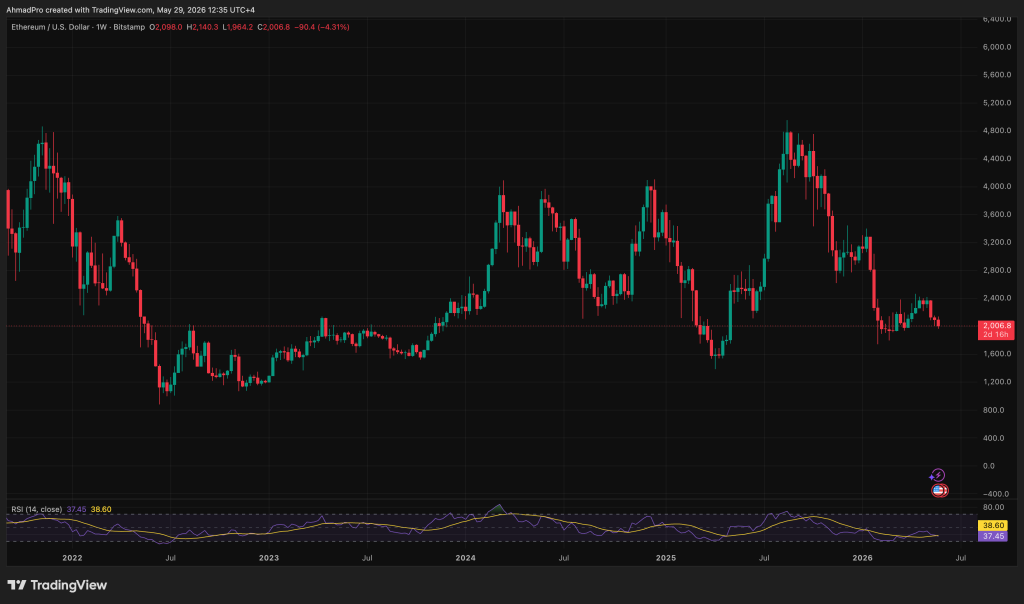
ETH has already been under price pressure, and governance uncertainty adds a credibility drag that is difficult to quantify but easy to feel in ecosystem momentum.
Chris Buolos, president of Dromos Labs, the main developer firm behind decentralized exchange Aerodrome on Ethereum layer-2 network Base, acknowledged the valid criticism while defending the foundation’s residual value: “The substantive critique, that direction has been unclear and wasteful and that the app layer has been a secondary concern, is fair.
The EF has tried to be many things to many constituencies at once.” His defense of the EF centers on its neutrality: “Having a neutral party in the room when otherwise-competing teams need to align on best practices is worth more than it sometimes gets credit for.”
This is not a directly tradeable development in the way an ETF approval or enforcement action would be. But sustained governance uncertainty at the foundation level does matter for a network where coordination on upgrades, roadmap credibility, and developer retention are competitive advantages, particularly as rival L1s aggressively court Ethereum’s developer base.
Discover: The Best Token Presales



Be the first to comment