



USDT’s market cap has fallen by roughly $1.2 billion from recent intraday levels, pulling fresh attention back to the stablecoin liquidity layer that supports much of crypto trading. The move does not look like a depeg. USDT is still trading close to $1, with live market data placing Tether’s market cap around $188.2 billion and 24-hour trading volume near $33 billion.
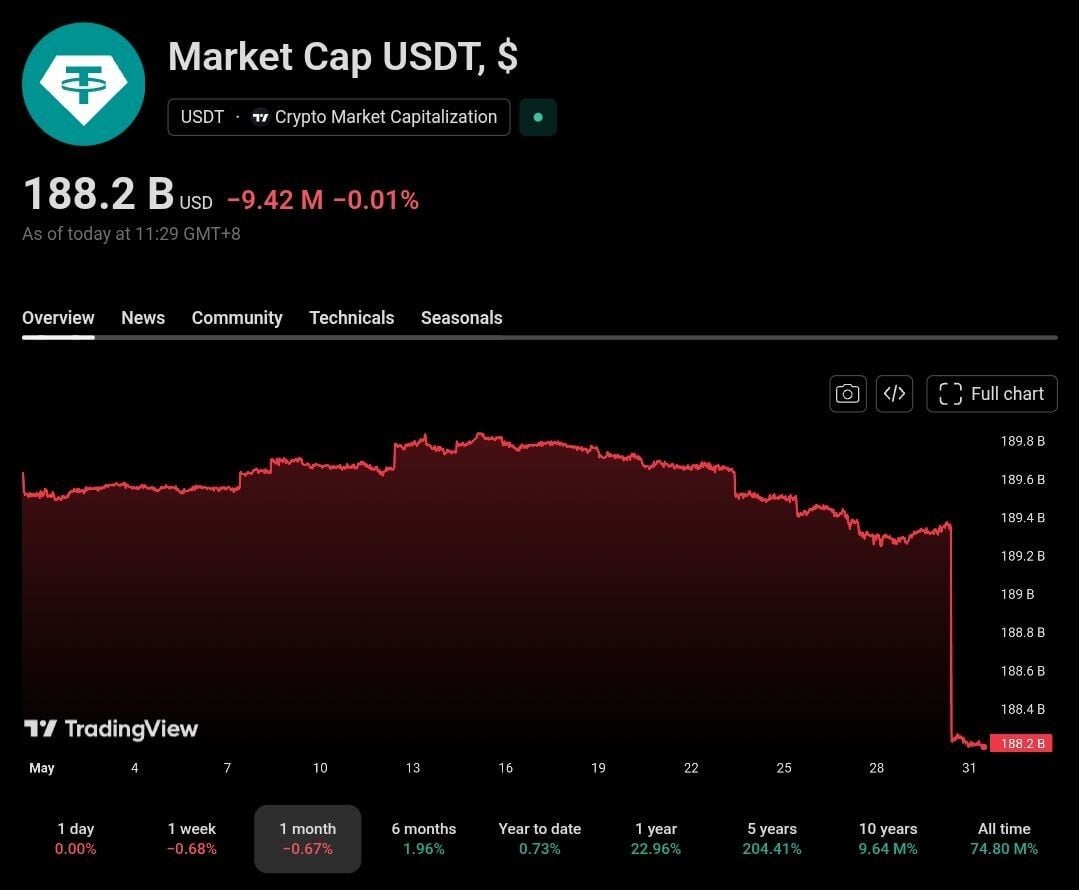
The sharper issue is supply. Stablecoins act as crypto’s settlement cash, collateral base and exchange quote currency. When USDT expands, traders often read it as fresh dollar liquidity entering the system. When it contracts, the market starts asking whether capital is being redeemed, parked elsewhere, moved off exchanges, or simply waiting through a risk-off patch.

The broader stablecoin stack is still enormous. Stablecoin supply dashboards place the total market near $320 billion, with USDT dominance around 58.8%. That gives Tether the largest influence over exchange liquidity, especially on offshore trading pairs where USDT remains the default dollar substitute.
Why Traders Are Watching The Drop
A $1.2 billion USDT contraction is not large enough to break the market on its own, but it lands at an awkward point. Bitcoin has already been dealing with softer whale accumulation, with large BTC holder balances flattening after months of weaker on-chain demand. A smaller stablecoin base can make that setup more fragile because fewer idle dollars are immediately available to absorb sell pressure or chase rebounds.
The market reaction depends on where the liquidity went. A redemption-driven drop can point to capital leaving crypto rails. A rotation into USDC, USDS, tokenized cash products, or exchange balances would tell a different story. A temporary tracker adjustment or chain-level supply movement would be less serious, especially because Tether’s own issuance model separates issued tokens, redeemed tokens, destroyed tokens and chain swaps. Redeemed USDT is no longer counted in market cap, while chain swaps are designed to keep total issuance neutral across networks.
Stablecoins Are Becoming The Market’s Stress Gauge
The timing also keeps stablecoin centralization in focus. Recent CryptoAdventure coverage of Tether’s burn-and-remint recovery process and the Circle-related Zama cUSDC freeze shows how deeply issuer controls now sit inside market structure. Stablecoins are no longer just trading tokens. They are liquidity rails, compliance instruments, recovery tools and DeFi collateral.
That makes USDT supply changes worth watching beyond the headline number. The latest drop is not a clean panic signal, and USDT has not lost its peg. It is a liquidity warning at a time when Bitcoin demand is already less aggressive and altcoin momentum remains uneven. If USDT climbs back above the recent $189 billion area, the move may fade into ordinary supply noise. If the contraction spreads across major stablecoins, the market will be dealing with less dry powder just as volatility is trying to rebuild.



Be the first to comment