

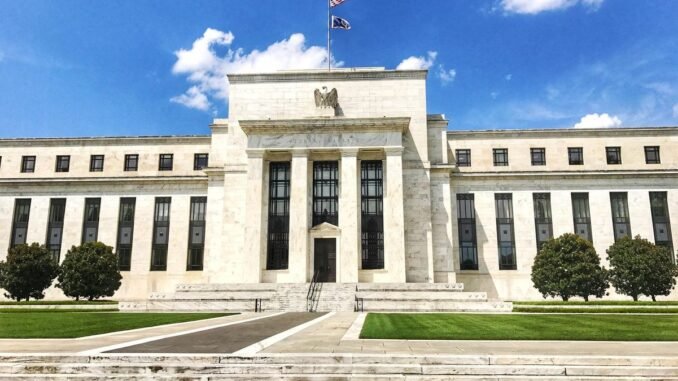


Facade of the Marriner S Eccles building of the United States Federal Reserve, the agency of the Federal Government responsible for setting the monetary policy of the United States, as well as determining interest rates, Washington, DC, July 24, 2017. (Photo via Smith Collection/Gado/Getty Images).
Getty Images
Governments have no resources. They can only consume insofar as they have taxable access to private sector production.
If you were to say the above at the libertarian Cato Institute, the libertarian leaning Mises Institute, the conservative American Enterprise and Hoover Institutions, and even at the increasingly populist Heritage Foundation, the audience and scholars at all five institutes of thought would nod along in agreement.
Which is why it’s puzzling that those same centers of right-leaning thought have created a policy “out” for themselves. The Federal Reserve has become some kind of other to which absolute truths don’t apply.
According to right-leaning economists, the Fed and other central banks enable government growth. They do no such thing. Governments have no resources, period.

To pretend that a creation of government could enable that same government’s growth is not just shockingly obtuse on its face. It also violates Say’s Law, among other things, for presuming that consumptive power can be created out of thin air. All consumption is preceded by production, and since governments produce nothing (another certain applause line at Cato, Mises, AEI, Hoover, and Heritage), the innocent are reduced to asking if the Fed gets its consumptive power from Pluto?
In response to the above, Miseans will quote Austrian School legend Guido Hulsmann, and his famous line about how “…fiat money allows the government to take out loans to an unlimited extent because fiat money by definition can be produced without limitation.” Hulsmann was incorrect.
He implied that money is wealth. No, real money that circulates among producers, lenders, and borrowers is an effect of wealth creation. Circulating exchange media are as natural as production, as though an “invisible hand” put them into circulation. As Mises himself once correctly observed, “No individual and no nation need fear at any time to have less money than it needs.” Yes, precisely. Money is an effect, never an instigator of economic activity. It’s where production is, always and everywhere.
Sadly, however, it’s not just the Mises Institute promoting central bank fictions. At the Cato Institute, and in a piece bemoaning the Fed’s alleged role in the U.S.’s growing national debt, Norbert Michel recently wrote that “one of the reasons governments started creating central banks in the first place was to help them finance their fiscal expenditures.” Really? How?
How yet again could a creation of governments that produce nothing finance the expenditures of the governments that created them? And if so, why by extension do other nations led by empowered authoritarians (Vladimir Putin perhaps?) not have debt similar in amounts to what the U.S. has? And please don’t say it’s about “exorbitant privilege.” As Treasury yields in the 1970s pray remind the sentient, the U.S. isn’t some borrowing other.
Michel would point to the Fed paying interest on bank reserves, and the alleged growth of government through the purchase of Treasuries with those reserves, but it’s not magic or sunspots that explains the reserves U.S. banks lend to the Fed. Production preceded those bank deposits loaned to the Fed, after which a creation of government (the Fed) can pay interest on reserves based yet again on the government’s taxable access to the private sector.
In short, there’s no enabling of federal government growth through interest paid on reserves (the opposite, whereby banks lends the money also isn’t inflationary contra Michel), rather governments get all sustenance from the private sector. The market for what the Fed buys would exist with or without the Fed precisely because soaring U.S. private sector production that is way too heavily taxed backs government debt. The Fed is the proverbial potted plant, not an enabler.
That’s because governments once again have no resources. To pretend that the Fed somehow escapes this absolute is not only false, but also a non sequitur.



Be the first to comment