

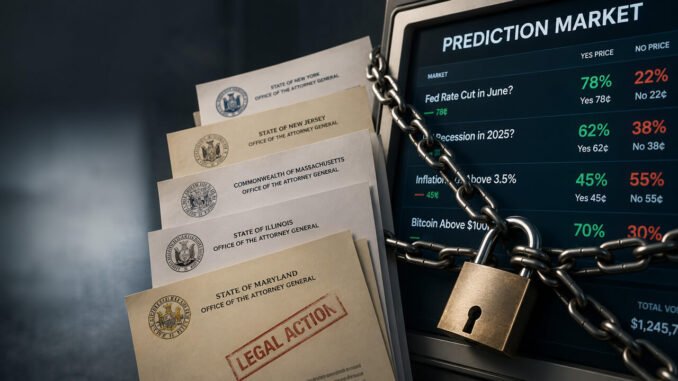

On the American Gaming Association’s website, a counter has been climbing for months, tallying what the casino-and-sportsbook lobby says states and tribes have lost to prediction markets. On Thursday, it rolled past $1 billion, and the AGA moved fast to make a headline out of it, with President Bill Miller going on CNBC to warn that states and tribes were losing money that would otherwise fund community programs.
Platforms like Kalshi and Polymarket let people trade contracts on real-world outcomes, and a fast-growing share of that activity amounts to sports betting by another route, with users buying yes-or-no positions priced like odds on questions such as who wins Sunday’s game.
Because the Commodity Futures Trading Commission (CFTC) regulates them at the federal level, these platforms have been able to operate in all fifty states, including the ones where traditional sportsbooks are heavily restricted or outright banned. State officials have spent more than a year insisting that the contracts are gambling, and that they should live under the same licenses, rules, and taxes every legal sportsbook already pays.
The assertion that these platforms led to a billion dollars of lost tax revenue boils a dense jurisdictional fight down to something the average voter can easily grasp.

However, it also comes at a pretty inconvenient time for the gambling industry in the US, as it just closed out its best year ever, generating $78.72 billion in revenue and a record $18.09 billion in gaming taxes for 2025.
One of the most profitable industries in America is currently the one telling Congress that it’s being robbed. The AGA exists to represent the casinos, sportsbooks, and tribal operators who already pay into the state system that prediction markets are accused of skipping, which is part of why its estimate carries political weight.
The platforms, for their part, dismissed the figure as fabricated, with Kalshi calling it “fake math from casinos” that are anxious about losing their monopoly, while the Coalition for Prediction Markets brushed off the estimate by saying the AGA’s underlying sources couldn’t be located.
The argument against prediction markets
The states have been having a hard time getting people on board with their philosophical case against prediction markets. Court rulings in almost every prediction market case have been split, and the CFTC keeps siding with the platforms in every new case that’s brought before regulators. CryptoSlate has previously covered the jurisdiction fight between US states and the CFTC, and there seems to be no end in sight for the ongoing war.
A dollar figure does an end run around all of that, especially when it’s over a billion dollars, because governors, attorneys general, and all kinds of regulators and lawmakers can point straight at education funds, pension contributions, and responsible-gaming programs and tell voters that’s where the billion is siphoned from.
The scale of the gambling market is best seen in New York, which taxes online sports betting at a 51% rate, the highest in the country. Despite the insanely high tax rate, the state pulled in roughly $1.3 billion from it in 2025.
The Federal government already collects a 0.25% excise tax on legal sports-betting handle, which AGA argues exists to target illegal bookmaking. Given the insane revenues gambling companies report, even this teeny tiny tax represents a significant revenue stream for the government. This means that we’re unlikely to see any kind of meaningful support for prediction markets coming from Washington, so the industry will have to take its chances at the state level.
Lawmakers seemed to be expecting that: in March, Senators John Curtis and Adam Schiff introduced the Prediction Markets Are Gambling Act, a bipartisan bill that would bar any CFTC-registered venue from listing a contract resembling a sports bet or a casino game. The pressure has been building on the agency from the states as well, with 41 attorneys general from across the political spectrum urging the CFTC to retreat from what they describe as regulatory overreach.
The lost tax revenue is a slam dunk to put in front of voters, but it’s just part of a much longer list of concerns that include consumer safety, game integrity, and who gets to control gambling in the first place. When someone places a bet through a licensed sportsbook, a whole apparatus of state oversight comes attached: a complaint process if a payout goes sideways, responsible-gaming safeguards, and monitoring designed to flag match-fixing or insider activity. Those protections reach the federally regulated platforms only at the edges, if they reach them at all.
There’s also the problem of tribal sovereignty, because many states handed tribes exclusive gaming rights through negotiated compacts that prediction markets step around completely. By now, it’s grown heated enough that the gambling industry has begun splitting against itself, and it’s pulled the White House directly into the middle of things.
The fracture inside the gambling business
This is such a complex problem that the industry can’t seem to hold one position.
DraftKings and FanDuel both resigned from the AGA in November, with Fanatics walking out in December after launching its own event-contract platform, all of them drawn by the way federally regulated contracts let them reach customers in states their conventional sportsbooks can’t.
The incumbents defending the state-regulated model and the operators chasing the federal route are now pulling toward opposite outcomes. This leaves the AGA representing a thinning coalition of land-based casinos and tribal operators against a new wave of companies that used to sit at its own table.
The political discourse escalated this week as well, when President Trump posted on Truth Social that it was “critically important” for the CFTC to keep exclusive authority over prediction markets, a position complicated by his son Donald Trump Jr.’s paid advisory role at Kalshi and his investment in Polymarket.
The administration has been litigating hard to back that view, with the CFTC suing Arizona, Connecticut, Illinois, New York, Wisconsin, and Minnesota. Minnesota recently became the first state to pass an outright ban on prediction markets under a bill signed by Governor Tim Walz, prompting a federal lawsuit aimed at blocking it before it takes effect on August 1. Minnesota’s law is part of a much broader push, with at least 15 states having introduced legislation this year to rein in the platforms.
But underneath all of that political action and legal noise lies the reason why prediction markets matter at all: sheer volume. Monthly prediction-market trading climbed from around $1.2 billion in early 2025 to more than $20 billion by early 2026. It’s an unparalleled growth rate, even in the crypto industry, and it led to a $2 billion investment from Intercontinental Exchange into Polymarket, valuing the company at $8 billion.
The American gaming industry posted record revenue, asking Congress and the courts to treat a billion-dollar estimate, one that the platforms dismiss as invented, as a public emergency. Prediction markets set out to win treatment as financial exchanges, while the AGA is working hard to recast them as untaxed sportsbooks, a fight many expect will reach the Supreme Court.
Whichever way that goes, the next phase will play out in the places the association keeps pointing toward, the statehouses, attorney-general offices, tribal governments, and congressional committees now watching a fast-growing market expand well beyond their reach.


Be the first to comment