


The breakdown of the key $1.30 support from the start of June invalidated the optimistic growth scenario for XRP that had been discussed throughout May and forced investors to urgently switch to defending local lows.
In particular, analyst Ali Martinez shared an updated XRP price roadmap, seeing the end of the token’s prolonged consolidation as a bearish breakout from a symmetrical triangle on the daily chart. The lower boundary of this triangle at $1.30 failed to withstand sellers’ pressure, resulting in the price settling near $1.26.
The key point is that, at the moment, the breakdown of this pattern points to an inevitable test of the next support benchmark at $1.14.

Why $136 million in ETF inflows can’t save XRP from a summer slump
The negative scenario is also supported by larger timeframes. The Bollinger Bands indicator on the monthly chart signals long-term weakness in the asset, allowing for a price decline below $1, where the lower band of the indicator is currently located.
The current decline exposed XRP’s vulnerability to broader market pressure, which completely erased the project’s local fundamental successes. Even sustained institutional capital inflows proved powerless against the global outflow of liquidity.
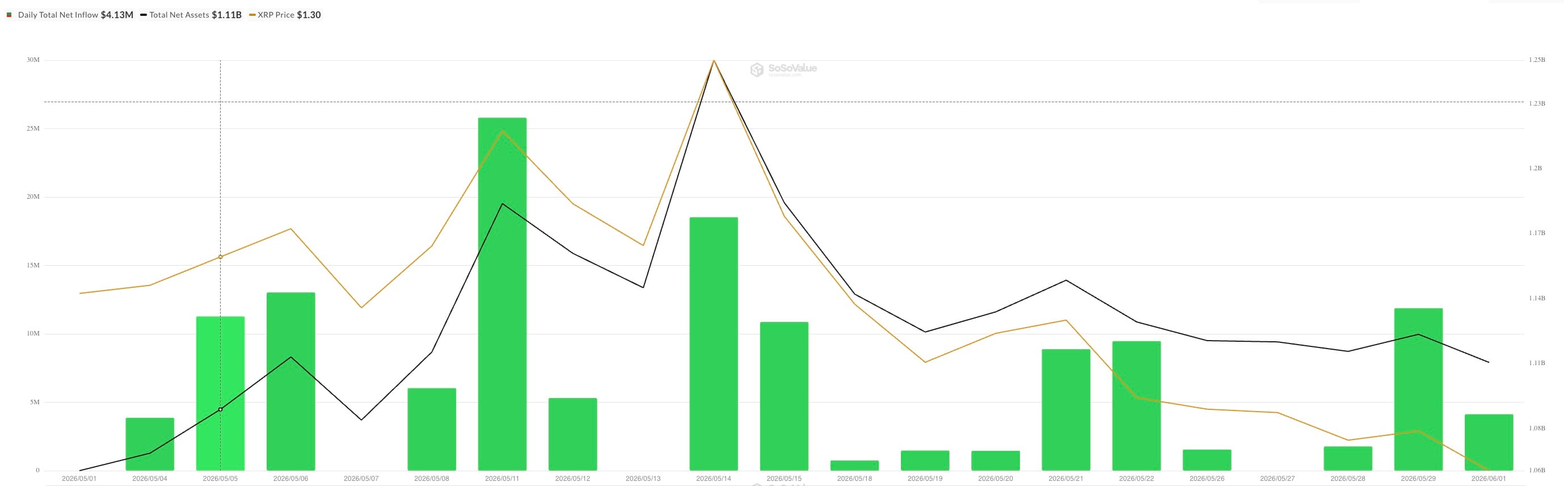
May closed for spot XRP ETFs in solid positive territory at $131.94 million, while the first days of June brought another $4.13 million, according to c. However, these volumes are not enough to hold back the prevailing bearish pressure.
You Might Also Like
Historical seasonality is also working against buyers, confirming the risks of prolonged summer stagnation. Statistics from recent years show that June has traditionally been one of the weakest months for XRP: the token’s average return at the start of summer stands at -5.12%, while the median decline reaches -8.20%.
The current June has already opened with a -5.35% decline, continuing the negative spring trend.
As long as XRP trades below the mirror level of $1.30, the initiative remains entirely on the sellers’ side, while historical and technical metrics point to a high risk of further downside. In this context, the worst may still be ahead.


Be the first to comment