



What to know:
- Japan’s Tokyo CPI at 1.3% may push BoJ to ease, shifting crypto liquidity.
- Lower inflation could move Japanese funds between yen and digital assets, help blockchain startups.
- Weakens Bitcoin hedge case, but aids stablecoin/CBDC use.

Japan’s Tokyo CPI (Consumer Price Index) inflation has fallen to +1.3% year-on-year in May, a level not witnessed for 4 years, and the sixth consecutive month of slowdown. The figure is now lower than the Bank of Japan’s 2% inflation target, hinting at changing macroeconomic conditions in one of the biggest Asian economies.
For those who invest in cryptocurrencies and work in blockchain development, these statistics are opening up a set of complex issues on monetary policy, the adoption of digital assets, and Web3 innovation under low inflation circumstances.
Macroeconomic Signals and Monetary Policy Outlook
The continued slowdown in Japan’s Tokyo CPI indicates that price pressures may be easing throughout the Japanese economy. Really, it has dropped below the Bank of Japan’s 2% target level, which may lead the central bank to reconsider its policy on interest rate increases and quantitative easing.


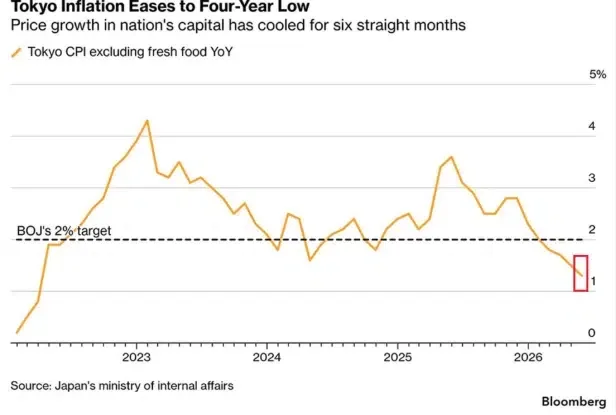
Changes in monetary policies tied to Japan’s Tokyo CPI data lead to adjustments in liquidity conditions and risk appetite, which is of key interest to the crypto market. Holding steady or easing policies could drive shifts in capital allocation to Bitcoin, Ethereum, and altcoins, and also impact institutional treasury strategies involving digital asset exposure.
Also Read: Japan Seeks Growth for Yen Stablecoins and Crypto ETFs
Impact on Crypto Adoption and Investor Sentiment
Lower inflation, reflected in Japan’s Tokyo CPI, helps to reshape consumer behavior and savings patterns, which indirectly affects retail participation in decentralized finance and tokenized assets. In Japan, where regulations about virtual assets are becoming clearer, lower inflation shown by Japan’s Tokyo CPI might change how households divide their money between digital currencies and traditional yen holdings.
For blockchain startups, less inflation puts less pressure on their costs, which can be very helpful as they continue developing their layer-1 networks, DeFi protocols, and NFT platforms.
Also Read: Japan Nikkei Surpasses 67,000 Milestone as SoftBank Leads AI Rally
Challenges and Opportunities for Blockchain Ecosystems
In fact, a lower inflation environment, as signaled by Japan’s Tokyo CPI, diminishes the need for inflation-hedge narratives mostly tied to Bitcoin. Still, it also opens up a world of possibilities. A stable price scenario might be the right trigger for a company to fully integrate a blockchain, to use stablecoins for cross-border transactions, and to carry out numerous experiments with CBDCs.
Also Read: Prediction Market Polymarket Targets Japan Entry by 2030


Be the first to comment