

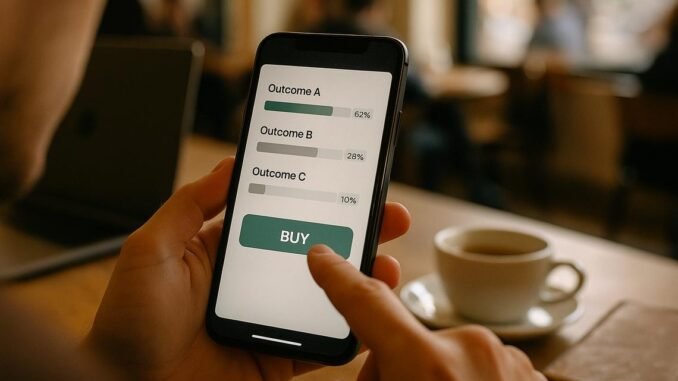

Crypto speculation is evolving as the new binance prediction feature goes live directly inside the exchange’s mobile wallet, linking real events with tradable probabilities.
Binance integrates on-chain prediction markets into its wallet
Binance has rolled out a native gateway to on-chain prediction markets from within its app, marking a new phase for retail crypto speculation. Accessible through the existing wallet interface, the tool lets users buy and sell outcome-linked probabilities in just a few taps, without using external DeFi dashboards.
Moreover, by embedding these mechanisms directly into a familiar centralized environment, the exchange is accelerating convergence between finance, real-time information flow, and blockchain infrastructure. Users never need to manage seed phrases or configure external wallets while still interacting with on-chain contracts.
Key features of Binance’s new prediction interface
According to the platform, the new functionality is designed to simplify crypto event probability trading for a broad user base. The exchange explains that it is “excited to introduce prediction markets, a new feature that allows users to participate in probability-based markets directly from the Binance app, thanks to integration with third-party platforms.” This confirmation frames the launch as a strategic enhancement of the app experience rather than an isolated experiment.

The integration relies on third-party protocols operating on the BNB Smart Chain, with connectivity notably routed through the Predict.fun DApp. However, users do not need to visit Predict.fun directly, as the experience is abstracted inside the Binance interface.
The main operational components are clearly defined. First, participants can buy shares priced between 0.01 and 0.99 dollars, with each winning share settling at exactly 1 dollar if the predicted scenario occurs. This structure mirrors classic prediction market payoffs where price reflects implied probability.
Second, access runs through a specific “Prediction Account” embedded in the app, ensuring that these positions are segregated from spot or derivatives balances. Third, the underlying setup uses a wallet model without visible key management, which removes the typical technical burden associated with DeFi self-custody.
Moreover, the process requires no external configuration. Everything from discovery to order placement happens inside the existing Binance ecosystem, bringing a DeFi-style product closer to mainstream retail usage than most standalone DApps currently allow.
A hybrid model between centralized access and on-chain execution
Beyond the feature itself, Binance is stressing its limited operational role. The exchange positions itself as an access layer and user interface, not as a direct counterparty to trades. That said, this distinction is crucial at a time when regulatory and risk profiles differ sharply between centralized exchanges and permissionless protocols.
Under this model, the actual prediction markets are run by third-party platforms on-chain, while Binance manages user onboarding, account flows, and transaction routing from its centralized app. However, settlement logic and outcome resolution remain anchored to smart contracts rather than the exchange’s internal order books.
This architecture aligns with a broader push to expand DeFi prediction market access without forcing users into complex self-directed setups. By allowing app users to interact with on-chain mechanisms while staying inside a familiar centralized interface, Binance is effectively creating a hybrid centralized decentralized interface that blends both worlds.
Moreover, the initiative embeds an implicit promise: these tools should become as accessible as conventional crypto trading pairs while still preserving the core decentralized logic that underpins them. The ability to “participate in probability-based markets” directly via the Binance app illustrates this attempt to reconcile usability with blockchain-native infrastructure.
Implications for trading behavior and market perception
Embedding prediction functionality in a mainstream exchange app could substantially reshape how retail traders view outcome markets. Over time, such integration may normalize these products alongside spot pairs, futures, and options, making them a standard part of the Binance prediction toolkit for event-driven strategies.
In the medium term, this convergence may also influence how traders incorporate information about elections, macro data, or protocol upgrades into their positions. However, broader adoption will likely depend on user education, the range of events listed, and liquidity depth on the connected protocols.
The move inevitably raises regulatory questions as responsibilities are shared between Binance as an access provider and the external protocols delivering the markets. That said, by clearly separating its role from direct market operation, the exchange appears to be testing a structure that could prove influential for other large platforms.
If successful, this hybrid pattern may foreshadow major exchanges evolving into universal interfaces aggregating decentralized services behind a single login. In that scenario, users gain smoother access to multiple on-chain products, while still enjoying the convenience of a centralized user experience.
In summary, Binance’s integration of on-chain prediction markets into its app marks a significant step in merging DeFi-style products with centralized exchange usability, potentially redefining how retail traders engage with real-world event speculation.



Be the first to comment