



What to know:
- Bitcoin mining profitability drops as costs surge and miners face mounting losses
- Rising electricity costs and falling hashprice push many miners below breakeven levels
- Miners shift toward AI while selling Bitcoin to survive worsening market conditions


Bitcoin mining profitability is tightening, with up to 20% of miners operating at a loss, according to CoinShares. In a March 25, 2026 report, the firm highlighted worsening conditions as mining costs rise and revenues decline.
This illustrated the extent to which the current conditions have deteriorated for participants within the mining industry.

Bitcoin mining became unprofitable after a significant downturn in price, from a peak of $124,500 to a low of around $86,000. The substantial drop in value caused the income generated for miners to decrease substantially. Also, their hashprice reached historic lows (prices below those experienced prior to halving).
Hashprice Collapse Pushes Bitcoin Miners Below Breakeven
Current hashprice sits at around $33 per PH/s/day, according to the Hashrate Index data. The previous lowest point for hashprice occurred in early 2026 when it hit $28-30 per PH/s/day.
CoinShares estimates that 15%-20% of the total global mining fleet is currently running unprofitably. Even though all miners are vulnerable, those utilizing older equipment and paying above $0.06/kWh will be affected the most in terms of losses.

The average cost to mine one BTC has risen to nearly $79,995 among public miners. This represents significant upward pressure on Bitcoin mining profitability, even though hashprice has slightly recovered.
There have been three consecutive decreases in mining difficulty between late 2025 and early 2026. This is the first of such a trend since July 2022 and suggests miner capitulation.
The last decrease was 7.7%, further demonstrating strain within the mining network. Lower difficulty provides temporary relief, but it is a reflection of declining participation from high-cost miners.
Also Read | Cango’s Q4 Loss Highlights Challenges in Bitcoin Mining
Miners Sell Bitcoin Holdings
Publicly traded mining firms have begun liquidating portions of their Bitcoin reserves due to rising operational expenses. On average, publicly listed miners have sold roughly 15,000 BTC since they reached peak inventory levels.
Core Scientific sold roughly 1,900 BTC ($175 million) in January. MARA Holdings reported that it had sold roughly 15,000 BTC in February. These sales introduce additional supply into the market, which can impact the Bitcoin price direction in the short term.
AI Shifts Reshape Bitcoin Mining Industry Structure
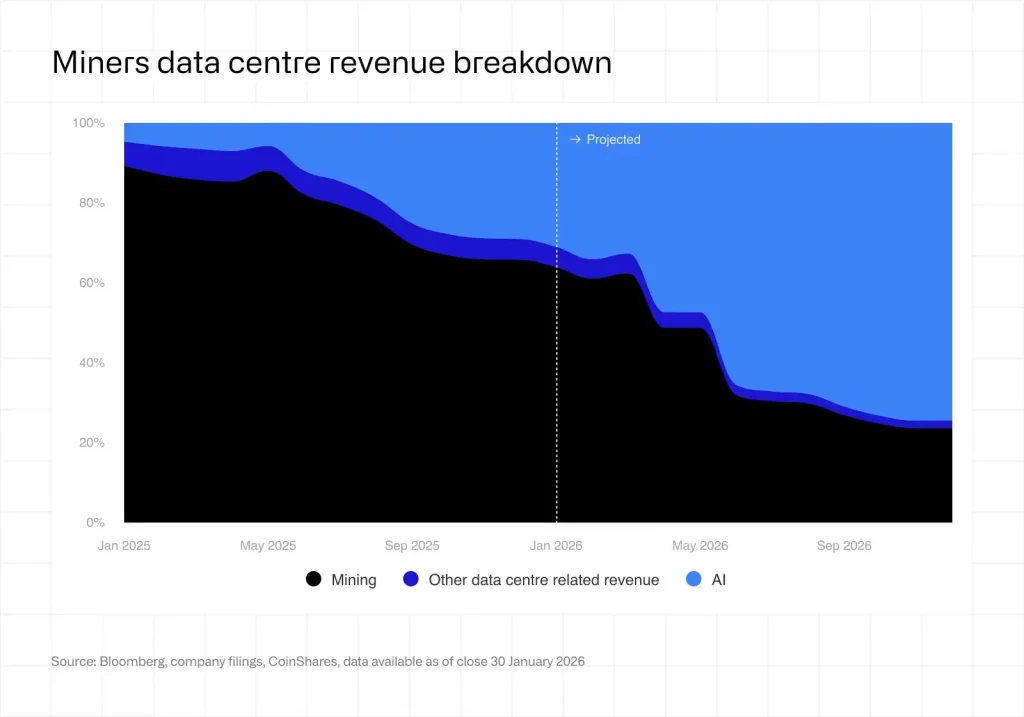
CoinShares also stated that a large portion of the industry is shifting towards AI-based and high-performance computing (HPC) solutions. Over $70 billion in AI-related contracts have been signed by various mining companies.
According to CoinShares, certain companies may generate 70% or more of their revenue through AI-related activities over the next few years. As a result, there exists a clear divide forming between traditional miners and hybrid HPC/AI solution providers.
Hashrate Continues Resilient Growth
The Bitcoin network has maintained a relatively stable hashrate level of ~1020 EH/s. CoinShares projects that by year-end 2026, the hashrate would have increased to approximately 1.8 zeta hashes.
Approximately 68% of the world’s hashrate is within the US, China, & Russia. However, emerging countries like Paraguay & Ethiopia continue to aggressively gain a share of the world’s overall hashrate.
This article contains market analysis and price predictions. These are not guarantees. Crypto markets are volatile. Always DYOR. Not financial advice.
Also Read | Bitcoin (BTC) Struggles Near $70K as Bearish Pressure Persists



Be the first to comment