



Bitcoin’s journey reflects a remarkable transition from obscurity to global relevance. What began as a niche idea discussed in online forums has evolved into one of the most influential forces shaping today’s financial landscape. No longer just a digital experiment, Bitcoin has emerged as a powerful catalyst that is redefining how value is created, stored, and exchanged.
This transformation has not come without challenges. Bitcoin has endured sharp price volatility, intense regulatory scrutiny, and persistent skepticism from traditional institutions. Each downturn tested its resilience, while every recovery strengthened its credibility. Over time, these cycles have turned Bitcoin from a misunderstood concept into a benchmark for the broader crypto market, driving interest in Bitcoin price prediction and shaping conversations around Bitcoin future price predictions as investors attempt to understand its trajectory.
Today, Bitcoin stands for more than just a digital asset. It represents the convergence of technological innovation and financial independence. With increasing adoption, evolving transaction layers, and expanding real world use cases, it continues to bridge the gap between traditional finance and the decentralized economy. As a result, discussions around Bitcoin long term price prediction have gained prominence, reflecting its growing role in global finance. Its journey is a testament to how transformative ideas often begin quietly before reshaping entire systems.
Bitcoin (BTC) Price and Technical Analysis
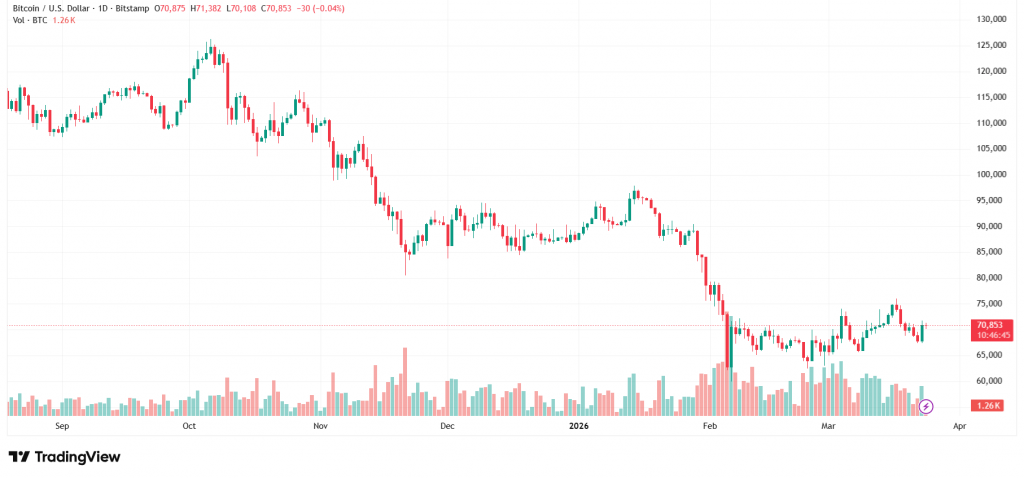
Price and technical analysis play a crucial role in anticipating market trends. Most traders rely heavily on price movements and a variety of technical indicators to guide their buy or sell decisions.

Analyzing past price movements and broader market behavior allows traders to identify patterns that might hint at future trends, though no prediction is ever guaranteed. Technical analysis serves as a vital tool in this process, offering data-driven insights into momentum, support, and resistance levels. By combining these indicators, investors can better manage risk and make more informed decisions amid crypto’s constant volatility, establishing it as a core element of any trading approach.
Also Read: What is Bitcoin Mining
A Snapshot of Key Bitcoin Metrics
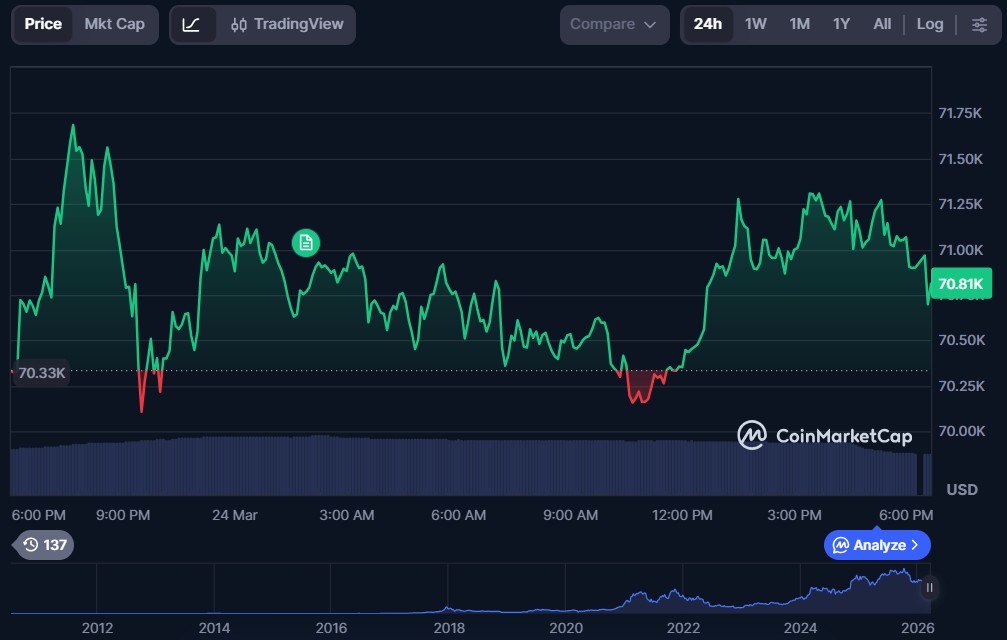
| Current Price | $70,769.59 |
| Market Capitalisation | $1.41 trillion |
| 24-Hour Volume | $37.70 billion |
| 50 Day SMA (1 Day) | $69,046 |
| 100 Day SMA (1 Day) | $79,000 |
| 200 Day SMA (1 Day) | $92,171 |
| 14-Day Relative Strength Index (1 Day) | 51 |
| Bitcoin All-Time High | $126,272 |
| Bitcoin Circulating Supply | 20 million |
| Total Supply | 21 million |
Also Read: Why is Bitcoin Down Today? BTC Price, Prediction, and Market Analysis
Historical Price Movement of Bitcoin
When Bitcoin first appeared in 2009, it didn’t arrive with the polish of a finished financial product. It entered the world more like a quiet experiment—an unfamiliar idea tested by a small group of curious minds. Yet over the years, that experiment has grown into a phenomenon that influences markets, institutions, and national strategies.
Its price has moved in ways few assets ever do—skyward leaps followed by heavy drops—but what stands out is how consistently it manages to find its footing again. Each major shift leaves it a little stronger, a little more understood, and a little more integrated into the larger financial conversation.
What’s unfolded around Bitcoin is just as important as the asset itself. Developers keep building, infrastructure keeps improving, and participation keeps expanding. From regular investors to global companies and policy makers, more groups are weaving Bitcoin into their long-term thinking. Despite regulatory hurdles and uncertain economic conditions, it continues to hold its ground—less as a speculative novelty and more as a technological foundation with staying power.
What Affects the Value of Bitcoin?
The price of Bitcoin is influenced by several key factors:
1. Market Demand and Supply: Similar to traditional assets, Bitcoin’s price is determined by the basic principles of supply and demand. When more people want to buy Bitcoin than sell it, the price rises, and vice versa. Also, Bitcoin is a deflationary asset with its supply reducing over time. If the market demands remain constant or grow, the price should increase because the supply is decreasing.
2. Adoption and Acceptance: Wider adoption of Bitcoin as a means of payment or store of value can positively impact its price. Acceptance by businesses and institutions can boost investor confidence.
3. Regulation: Government regulations and policies significantly affect Bitcoin’s price. Favourable regulations can encourage investment and drive up prices, while restrictive measures can have the opposite effect.
4. Technological Developments: Changes and advancements in the underlying technology of Bitcoin, like upgrades to the blockchain, can influence investor sentiment and price movements.
5. Market Sentiment: News, social media, and public perception can sway sentiment quickly, causing rapid price fluctuations. Positive news often leads to price increases, while negative news can trigger sell-offs.
6. Global Economic Events: Economic crises, inflation fears, and currency devaluation concerns can drive individuals and institutions to seek alternatives like Bitcoin, boosting its price.
7. Whale Activity: Large holders of Bitcoin, known as “whales,” can impact the market by buying or selling substantial amounts.
8. Market Liquidity: Thin trading volumes can lead to price manipulation and sharp price swings. Increased liquidity can stabilize prices.
9. Competition: The presence of other crypto tokens and digital assets can affect Bitcoin’s market dominance and, consequently, its price.
Also Read: What Is Bitcoin Halving
Key Factors That Influence Bitcoin Price Predictions
Supply and Demand Dynamics
At its core, Bitcoin’s price is driven by the fundamental principle of supply and demand. With a fixed supply capped at 21 million coins, scarcity plays a defining role in shaping its value. As demand rises, whether from retail investors, institutions, or new market entrants, upward price pressure tends to follow. Conversely, periods of reduced interest or profit booking can lead to corrections. This balance is central to most Bitcoin price prediction frameworks, as even small shifts in demand can have a significant impact on price movements.
Bitcoin Halving Events
Bitcoin halving events are among the most closely watched milestones in the crypto ecosystem. Occurring roughly every four years, these events reduce the reward miners receive for validating transactions, effectively slowing the rate at which new Bitcoin enters circulation. Historically, halvings have preceded major bull cycles, as reduced supply meets sustained or growing demand. This pattern often becomes a key reference point in Bitcoin future price predictions, especially when analysts attempt to map long term cycles.
Institutional Adoption
The entry of institutional players has significantly altered Bitcoin’s market dynamics. From hedge funds to publicly listed companies and asset managers, institutional participation brings both capital and credibility. This influx tends to reduce volatility over time while also increasing liquidity. As more institutions integrate Bitcoin into their portfolios, confidence in its long term viability grows, influencing Bitcoin long term price prediction narratives and reinforcing its position as a mainstream financial asset.
Global Macroeconomic Conditions
Bitcoin does not operate in isolation. Broader macroeconomic factors such as inflation, interest rates, geopolitical tensions, and currency devaluation can all influence its price. In times of economic uncertainty, Bitcoin is often viewed as a hedge or alternative store of value, similar to gold. On the other hand, tighter monetary policies or reduced liquidity in global markets can impact investor appetite. These external forces play a crucial role in shaping both short term movements and long range forecasts.
Also Read: A New Chapter: Understanding the SEC’s Latest Crypto Update
Role of Technical Analysis in Bitcoin Price Forecasts
Moving Averages
Moving averages are among the most widely used tools in technical analysis. They help smooth out price data to identify trends over specific time periods. Common indicators include the 50 day and 200 day moving averages, which are often used to detect bullish or bearish momentum. Crossovers between these averages can signal potential entry or exit points, making them an essential component in many Bitcoin price prediction strategies.
Relative Strength Index (RSI)
The Relative Strength Index measures the speed and magnitude of recent price movements to determine whether Bitcoin is overbought or oversold. Typically ranging between 0 and 100, an RSI above 70 may indicate overbought conditions, while below 30 suggests oversold territory. Traders use this indicator to anticipate potential reversals, adding another layer of insight to short term forecasts.
MACD Indicator
The Moving Average Convergence Divergence indicator focuses on the relationship between two moving averages of Bitcoin’s price. It helps identify changes in momentum, trend direction, and potential turning points. When the MACD line crosses above the signal line, it is often interpreted as a bullish signal, while a crossover below may indicate bearish momentum. This makes it a valuable tool for refining entry and exit decisions.
Bitcoin Price Prediction Models Explained
Stock-to-Flow Model
The Stock-to-Flow model evaluates Bitcoin’s scarcity by comparing its existing supply (stock) to the rate of new production (flow). Assets with higher stock to flow ratios are generally considered more scarce and potentially more valuable. Bitcoin’s predictable issuance schedule makes it particularly suitable for this model, which has been widely used in Bitcoin future price predictions despite ongoing debates about its accuracy.
On-Chain Analysis Models
On-chain analysis looks directly at blockchain data to assess network activity and investor behavior. Metrics such as active addresses, transaction volumes, and holding patterns provide insights into market trends. These models help analysts understand whether Bitcoin is being accumulated or distributed, offering a data driven perspective that strengthens Bitcoin long term price prediction efforts.
Market Sentiment Indicators
Market sentiment plays a powerful role in Bitcoin’s price movements. Indicators such as the Fear and Greed Index, social media trends, and trading volumes help gauge investor psychology. Extreme fear can signal potential buying opportunities, while excessive greed may indicate overheating markets. By combining sentiment analysis with technical and fundamental factors, analysts can develop more balanced and informed forecasts.
Price Predictions
2026
If major macroeconomic factors remain stable, experts predict the price of Bitcoin will continue to rise and can touch the $150K mark by the end of 2026.
2027
Experts predict BTC will continue its bullish trend, with some predicting its value to touch the $160K mark.
2028
As per experts, the lowest price of BTC will be around $174K and the maximum price will be about $191K by the end of 2028.
2029
Crypto analysts predict the upward price trend will continue in 2029. They predict the minimum price of BTC will be around $200K, and the maximum price could touch approximately $240,000 by the end of 2029.
2030
Although the crypto market is volatile, experts predict the value of BTC will grow in the long term. They predict the price of BTC to touch $340,000, with a minimum value of $270K if global macroeconomic factors remain constant.
How Investors Use Price Predictions in Crypto Strategies
Bitcoin price prediction insights play a key role in shaping how investors approach the market. While no forecast guarantees accuracy, these projections help investors build structured strategies rather than relying purely on speculation.
Short term traders often use forecasts alongside technical indicators to identify entry and exit points. By aligning signals such as momentum trends or support and resistance levels with broader Bitcoin future price predictions, traders attempt to capitalize on market volatility.
Long term investors, on the other hand, rely on Bitcoin long term price prediction models to guide accumulation strategies. This may include systematic approaches such as dollar cost averaging, where investments are spread over time to reduce the impact of price fluctuations and improve overall entry efficiency.
Portfolio diversification is another area where predictions come into play. Investors assess Bitcoin’s potential growth relative to other assets and adjust allocations accordingly. In this context, Bitcoin price prediction frameworks act as a reference point to balance risk and opportunity in an increasingly dynamic market.
Key Considerations Before Relying on Bitcoin Price Forecasts
Despite their usefulness, Bitcoin price prediction models should be approached with caution. The crypto market is highly dynamic, and prices can be influenced by a wide range of unpredictable factors.
Volatility remains one of the biggest considerations. Bitcoin’s price can shift rapidly due to market sentiment, regulatory developments, or macroeconomic changes. While Bitcoin future price predictions attempt to capture trends, they cannot fully account for sudden disruptions or black swan events.
Another important factor is the limitation of models. Whether based on historical data, technical indicators, or on chain metrics, every model relies on assumptions that may not hold true in changing market conditions. This is particularly relevant when evaluating Bitcoin long term price prediction models that project outcomes far into the future.
Investors should also be mindful of bias. Some forecasts may lean overly optimistic or pessimistic depending on the source or market cycle. Cross referencing multiple Bitcoin price prediction perspectives can provide a more balanced view.
Ultimately, forecasts should complement, not replace, independent research. A well informed approach that combines analysis, risk management, and market awareness is essential for navigating the crypto space effectively.
Is Bitcoin a Good Investment?
By 2026, Bitcoin has firmly taken on the role of the market’s anchor. When it moves, the rest of the crypto ecosystem reacts—sometimes with confidence, sometimes with caution. Its shifts ripple through trading desks, influence allocation models, and shape how investors everywhere interpret the broader landscape. The opportunities it creates can be substantial, but they also come with the unmistakable reminder that digital assets live in a world defined by rapid swings.
While tools like charts and indicators can help map out possibilities, they aren’t the whole story. The investors who tend to thrive are those who approach the market with a clear head and a long view. In an industry where trends can change overnight, the combination of solid understanding, measured decision-making, and emotional steadiness often matters more than any single strategy. Those qualities give investors the resilience to navigate uncertainty—and the clarity to capture value over time.
Also Read: Crypto Trading Strategies
Should I Invest in Bitcoin?
How people approach Bitcoin often says a lot about the kind of investor they are—whether they lean toward long-term conviction or prefer navigating short-term swings. Interest from major institutions has only intensified, with companies like Strategy (formerly MicroStrategy), BlackRock, Fidelity, and ARK Invest steadily adding to their holdings through ETF inflows. Their continued accumulation signals a growing belief within mainstream finance that Bitcoin is here to stay and will play an important role in future portfolios.
Regulatory clarity has also contributed to a more confident market atmosphere. On-chain metrics reveal that more than 60% of all circulating Bitcoin has remained untouched since early 2022—a powerful indicator of how committed long-term holders have become. This level of holding behavior reinforces Bitcoin’s reputation as a durable asset, trusted for its scarcity and long-term stability.
You can now buy Bitcoin on ZebPay. Keep yourself up to date with the latest crypto news on ZebPay blogs!
FAQs on Bitcoin Price Prediction
What factors influence Bitcoin price predictions?
Bitcoin price prediction is influenced by factors such as supply and demand dynamics, halving events, institutional adoption, regulatory developments, and global macroeconomic conditions. Market sentiment and technological advancements also play a role in shaping Bitcoin future price predictions.
How reliable are Bitcoin price prediction models?
No Bitcoin price prediction model is completely reliable. While some models offer valuable insights based on historical trends or blockchain data, the unpredictable nature of the market means outcomes can vary widely. They are best used as directional guidance rather than absolute indicators.
What role does Bitcoin halving play in price predictions?
Bitcoin halving reduces the rate of new supply entering the market, which can create upward pressure on price when demand remains strong. Because of this, halvings are often a central component in both Bitcoin future price predictions and Bitcoin long term price prediction models.
How do analysts use technical indicators to forecast Bitcoin prices?
Analysts use tools such as moving averages, RSI, and MACD to identify trends, momentum, and potential reversals. These indicators help refine short term Bitcoin price prediction strategies by offering data driven insights into market behavior.
Can institutional adoption impact Bitcoin’s future price?
Yes, institutional adoption can significantly influence Bitcoin’s trajectory. Increased participation from large investors enhances liquidity and market confidence, often strengthening Bitcoin long term price prediction outlooks.
What risks should investors consider when relying on Bitcoin price predictions?
Investors should consider risks such as volatility, regulatory uncertainty, model limitations, and sudden shifts in sentiment. Over reliance on any single Bitcoin price prediction without proper risk management can lead to unfavorable outcomes.
How do macroeconomic trends affect Bitcoin price forecasts?
Macroeconomic factors such as inflation, interest rates, and global economic conditions influence investor behavior. These elements are often incorporated into Bitcoin future price predictions to better understand how external forces may impact the market.
Should investors rely solely on Bitcoin price predictions when making decisions?
No, investors should not rely solely on Bitcoin price prediction models. While they provide useful insights, they should be combined with thorough research, diversification strategies, and a clear understanding of risk to make well informed investment decisions.
Disclaimer:
Crypto products and NFTs are unregulated and can be highly risky. There may be no regulatory recourse for any loss from such transactions. Each investor must do his/her own research or seek independent advice if necessary before initiating any transactions in crypto products and NFTs. The views, thoughts, and opinions expressed in the article belong solely to the author, and not to ZebPay or the author’s employer or other groups or individuals. ZebPay shall not be held liable for any acts or omissions, or losses incurred by the investors. ZebPay has not received any compensation in cash or kind for the above article and the article is provided “as is”, with no guarantee of completeness, accuracy, timeliness or of the results obtained from the use of this information.


Be the first to comment