


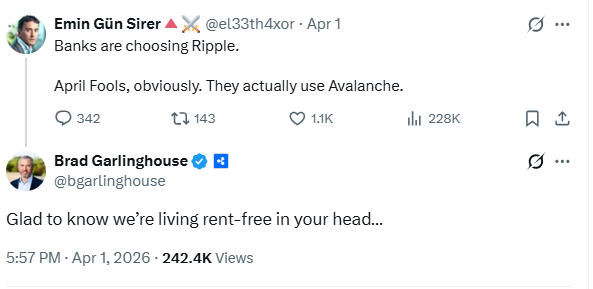
A lighthearted exchange between Emin Gün Sirer, Founder and CEO of Avalanche (Avalanche), and Brad Garlinghouse, CEO of Ripple (XRP), drew attention across the crypto community after Sirer joked that while banks were choosing Ripple, financial institutions were in fact leaning toward Avalanche’s technology.
The exchange took place on April 1, when Sirer tweeted, “Banks are choosing Ripple. April Fools, obviously. They actually use Avalanche.”

Brad Garlinghouse fired back swiftly, saying he was pleased to know Ripple was “living rent-free” in Sirer’s head.
Notably, while the exchange had a humorous tone, it highlighted the ongoing competition among blockchain networks vying to become the preferred infrastructure for global financial institutions.
Both Ripple and Avalanche have been positioning their platforms as viable solutions for banks exploring blockchain technology, though they focus on different use cases.

 
Ripple has long targeted cross-border payments as its core market. Its infrastructure revolves around the XRP ecosystem and the XRP Ledger.
Through Ripple Payments, financial institutions can convert fiat currency into XRP or the company’s stablecoin RLUSD, send the value across the network within seconds, and convert it back into the destination currency. The process aims to eliminate delays and costs associated with the traditional correspondent banking system.
According to Ripple’s CEO, Ripple’s treasury infrastructure handled about $13 trillion in payments in 2025, and he expects further growth in 2026 following the rollout of an upgraded Treasury Management System (TMS) that allows institutions to manage both digital and fiat assets within a single platform.
The network has also processed over $1 billion in transaction volume with global partners, with collaborations with SBI Holdings and Banco Santander highlighting Ripple’s continued push into blockchain-powered cross-border settlement solutions.
Ripple is also advancing its push into regulated finance, securing a conditional national trust bank charter from the Office of the Comptroller of the Currency (OCC) last December.
Ripple’s subsidiary Standard Custody has also applied for a Federal Reserve master account, which would enable the firm to hold stablecoin reserves directly with the central bank and access key payment systems such as Fedwire and FedNow.
On the other hand, Avalanche has focused on providing customizable blockchain environments for enterprises. Its architecture allows organizations to create dedicated networks known as subnets, which can be configured for specific institutional use cases such as asset tokenization and digital securities issuance.
This approach has attracted attention from major financial institutions experimenting with blockchain infrastructure. For instance, since 2024, JPMorgan Chase has been conducting blockchain experiments through its digital assets division, while Citigroup has explored tokenization initiatives involving Avalanche technology.
That said, approval of Ripple’s banking license could boost RLUSD use and strengthen XRP’s appeal to banks, especially for cross-border payments. As institutional adoption grows, demand and trading volume for XRP are likely to rise, boosting the crypto’s price.





Be the first to comment