



What to know:
- Coinbase, Stripe, Cloudflare launch foundation to scale AI agent payments globally
- x402 protocol enables instant machine payments without human involvement using stablecoins
- Big Tech and finance firms race to dominate AI agent payments infrastructure

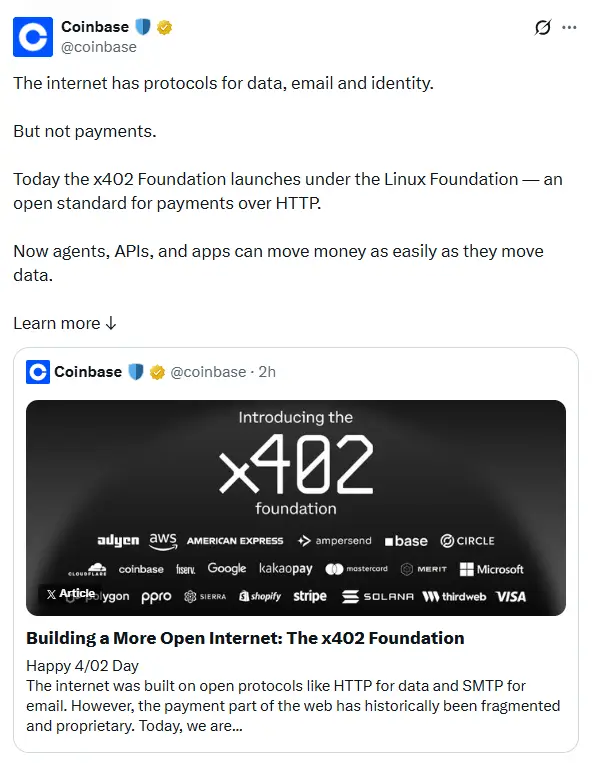
Coinbase, Cloudflare, and Stripe have created a new foundation focused on advancing AI agent payments on April 2, 2026. The new foundation will focus on developing the x402 Protocol, which is an Open-Source Protocol that creates instant M2M (machine-to-machine) payments. It enables seamless stablecoin payments without the need for humans in the payment process.
The foundation will be run by the Linux Foundation and includes more than 20 large companies. These include Microsoft, Google, American Express, Circle, Solana Foundation, and Amazon Web Services.
The creation of this foundation represents increasing competition for creating a dominant platform for global AI Agent payment infrastructure.

x402 Protocol Aims for Autonomous Payments
According to Coinbase, the x402 protocol uses blockchain technology to create instant transactions for AI Agents. The protocol was first introduced by Coinbase last year and utilizes the “HTTP 402 Payment Required” Code, originally developed for Machine Commerce.
Stablecoin payments within this protocol enable apps and bots to perform transactions efficiently. Since the launch of this protocol, it has been used to complete almost 97 million transactions on the Base blockchain.
However, due to the low number of transactions being completed each day, there is still a long way to go before widespread adoption occurs.
Also Read | Telegram’s Wallet Integrates Perpetual Futures Trading with Lighter in 2026
Dominating the AI Agent Payments Ecosystem
According to a Bloomberg report, Stripe has also entered into the development of a competitor protocol called Machine Payments Protocol (MPP). Also, Paradigm has partnered with Tempo blockchain to develop another AI agent payments protocol.
The MPP provides Pre-Funded Sessions for high-frequency transactions to allow AI agents to make multiple transactions without having to request approval each time. Stripe is currently working with two protocols. One being the x402 and the other being their own MPP protocol.
By doing so, they are positioning themselves as a leader in this payment space. Tempo blockchain received $500 million in funding to develop a stablecoin-based settlement for MPP.
The amount of money invested by Tempo blockchain demonstrates the growing importance of establishing default rails for AI agent payments.
Big Tech and Financial Institutions Bet Big
There is no shortage of investment from big tech and financial institutions looking to stake their claim in the AI agent payments infrastructure. Visa and Mastercard are making investments to support stablecoin capabilities as well as invest in technology that makes them competitive in this rapidly changing marketplace.
Mastercard made a huge bet when it purchased BVNK for $1.8 billion. They plan to utilize BVNK’s stablecoin infrastructure to enhance their position in AI agent payments.
Stripe made similar bets with the acquisition of Bridge and Privy. Both acquisitions were made to help further expand their capabilities in crypto and wallets.
These moves demonstrate that these organizations believe that high-frequency, low-cost AI agent payments are inevitable throughout the world markets.
Regulators Provide Clarity to Support Adoption
In 2025, the U.S. Congress passed the GENIUS Act, which provided federal oversight of stablecoin issuers and established a framework for regulation. One key requirement included a full dollar backing of stablecoins.
Additionally, Cloudflare announced that they intend to issue a stablecoin that is specifically backed by U.S. Dollars for use with this payment infrastructure. As regulatory bodies provide greater clarity regarding the rules surrounding autonomous payments, more organizations are beginning to adopt them as part of their financial systems.
The success or failure of any organization attempting to establish standards for this payment system will depend mostly on the ability of developers and ecosystems. They need to grow and continue to adapt.
If successful, this payment system may eventually become as necessary as card networks have been throughout history in all aspects of global finance. However, this achievement will require a significant increase in transaction volume for AI agent payments.
Why Does This Matter?
AI agent payments could disrupt traditional card network operations because they would enable faster and less expensive automated global transactions.
Also Read | Polygon (POL) Price Faces Pressure Despite Polygon Integration on Coinbase x402



Be the first to comment