



In just over a decade, Ethereum has evolved from a bold experiment into the backbone of decentralized innovation. What began as a vision for a programmable blockchain has transformed into a thriving ecosystem that powers decentralized finance (DeFi), non-fungible tokens (NFTs), and a rapidly expanding universe of Web3 applications. Where Bitcoin reimagined money, Ethereum reimagined what could be built on top of it, unlocking a new era of open, permissionless creation and global collaboration.
Today, Ethereum is not just a network; it is a digital infrastructure layer for the future of the internet. Developers across the world are leveraging its smart contract capabilities to build financial systems, gaming economies, digital identities, and more, without relying on traditional intermediaries. This composability has become one of Ethereum’s greatest strengths, enabling innovation to move faster than ever before.
With its transition to Ethereum 2.0, the network has taken a significant leap forward. The shift to a Proof-of-Stake consensus mechanism has dramatically improved energy efficiency while laying the groundwork for enhanced scalability and performance. Upgrades such as sharding and rollups continue to push Ethereum closer to mass adoption, addressing long-standing challenges around congestion and transaction costs.
Against this backdrop of technological evolution, market interest remains strong. Ethereum’s surge to $4,955 reflects not only bullish sentiment but also growing confidence in its long-term potential. This has naturally led to increasing discussions around Ethereum price predictions, as investors and analysts evaluate its role in the broader crypto landscape. While no price prediction for Ethereum can be certain, many view its expanding utility, developer activity, and institutional interest as key factors that could influence its future trajectory.

As Ethereum continues to mature, it stands at the intersection of technology and possibility, shaping a world where decentralized systems redefine how we transact, create, and connect.
Also Read: Everything You Need to Know About dApps
What Is Ethereum and Why Does Its Price Matter?
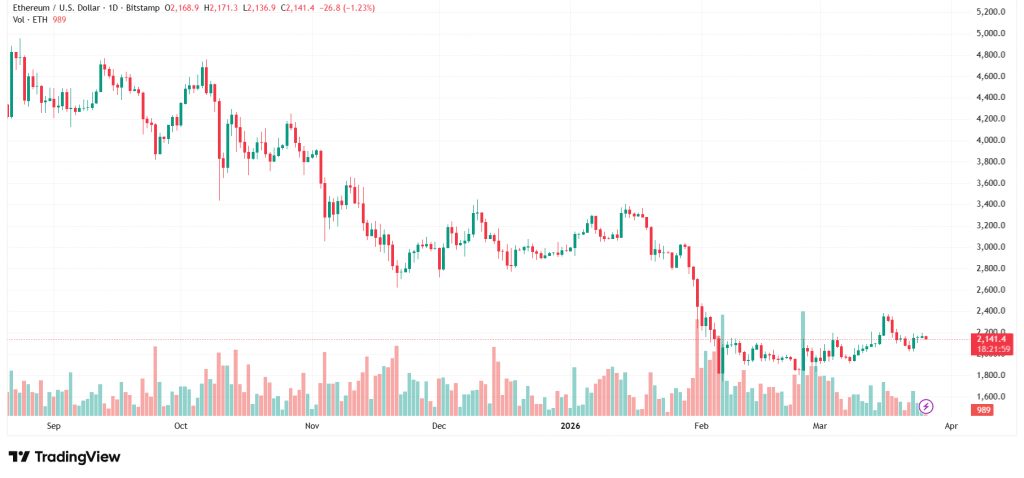
Ethereum is a decentralized, open-source blockchain platform that enables developers to build and deploy smart contracts and decentralized applications (dApps). Unlike Bitcoin, which primarily serves as a store of value, Ethereum functions as a programmable ecosystem, fueling everything from DeFi protocols and NFT marketplaces to gaming and digital identity solutions.
Its native token, Ether (ETH), plays a crucial role in powering this ecosystem. It is used to pay for transaction fees (gas), secure the network through staking, and facilitate value exchange across applications. This deep integration means that Ethereum’s price is not just a market metric, it’s a reflection of network usage, developer activity, and overall ecosystem health.
As a result, Ethereum price predictions are closely watched by traders, investors, and builders alike. The price impacts transaction costs, user participation, and even the viabilig rebound through 2023 and 2024 restored investor confidence across the crypto space. With consistent network upgrades and growing global adoption, the Ethereum ecosystem now appears poised for sustained growth and a deeper role in the evolving digital economy.
Also Read: What is Ethereum 2.0
Ethereum (ETH) Price and Technical Analysis
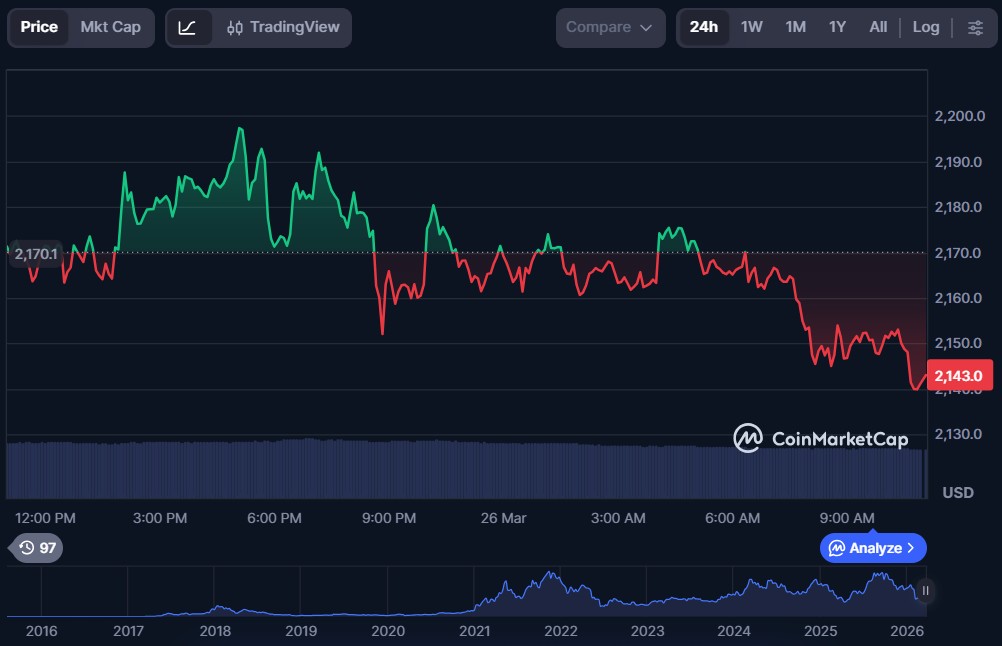
| Current Price | $2,142.62 |
| Market Capitalization | $258.60 billion |
| 24-Hour Volume | $16.37 billion |
| 50 Day SMA (1 Day) | $2,042.5 |
| 100 Day SMA (1 Day) | $2,503.7 |
| 200 Day SMA (1 Day) | $3,116.1 |
| 14-Day Relative Strength Index (1 Day) | 51.5 |
| All-Time High | $4,955 |
| Circulating Supply | 120.69 million ETH |
Also Read: Ethereum Technical Analysis Report – 24th March 2026
Key Factors That Influence Ethereum Price Predictions
Supply and Demand Dynamics
At its core, Ethereum’s price is shaped by basic economic principles. The introduction of mechanisms like EIP-1559, which burns a portion of transaction fees, has added a deflationary aspect to ETH’s supply. Combined with staking in Ethereum’s Proof-of-Stake model, a significant portion of ETH is locked, reducing circulating supply. When demand rises, driven by DeFi, NFTs, or new applications—this supply constraint can amplify price movements, making it a critical input in Ethereum price predictions.
Network Upgrades and Ethereum Development
Ethereum’s roadmap plays a major role in shaping market expectations. Upgrades aimed at improving scalability, reducing gas fees, and enhancing security often act as catalysts for price momentum. Developments such as rollups, sharding, and continued optimization of the network strengthen Ethereum’s long-term value proposition, directly influencing any forward-looking price prediction for Ethereum.
Institutional Adoption
Institutional interest has grown steadily, with asset managers, hedge funds, and corporations increasingly exploring Ethereum-based solutions. From staking services to tokenized assets, institutional participation adds credibility and liquidity to the ecosystem. This growing adoption is often viewed as a bullish signal in Ethereum price predictions, as it indicates long-term confidence in the network.
Global Macroeconomic Conditions
Ethereum does not exist in isolation. Broader economic factors, such as interest rates, inflation, regulatory developments, and global liquidity, can significantly impact crypto markets. In risk-on environments, capital tends to flow into assets like ETH, while tighter financial conditions may lead to pullbacks. These macro trends are essential when forming any realistic price prediction for Ethereum.
Network Activity Metrics
Network activity metrics provide valuable insight into how actively Ethereum is being used, making them an important factor in Ethereum price predictions. Indicators such as daily active addresses, transaction volume, gas fees, and total value locked (TVL) reflect real user demand and ecosystem growth. Rising activity often signals stronger adoption and utility, which can positively influence market sentiment and support a more optimistic price prediction for Ethereum.
Also Read: Aptos Technical Analysis Report – 25th March 2026
Price Predictions
2026
By the end of 2026, Ethereum is projected to hover around the $2,750 mark, reflecting steady but measured growth.
2027
Moving into 2027, the price prediction for Ethereum suggests a gradual climb toward the $3,000 level, indicating strengthening market confidence.
2028
For 2028, Ethereum price predictions point to a potential rise up to $3,150, driven by continued ecosystem expansion and adoption.
2029
By 2029, Ethereum is anticipated to trade close to $3,250, maintaining a consistent upward trajectory.
2030
Looking ahead to 2030, Ethereum could approach the $3,300 milestone, signaling long-term optimism around its role in the evolving blockchain landscape.
Risks and Uncertainties in Ethereum Price Predictions
While Ethereum price predictions offer valuable insights, they are inherently uncertain due to the volatile nature of the crypto market. Factors such as regulatory changes, technological disruptions, market sentiment shifts, and macroeconomic conditions can quickly alter price trajectories. Even for a well-established network like Ethereum, unexpected events, such as security vulnerabilities or delays in upgrades, can impact confidence and valuation. As a result, any price prediction for Ethereum should be viewed as a scenario-based outlook rather than a guaranteed outcome.
How Investors Use Price Predictions in Crypto Strategies
Investors often use Ethereum price predictions as a reference point when shaping their crypto strategies. These forecasts help in identifying potential entry and exit levels, planning long-term holdings, and managing risk exposure. For some, predictions support strategies like dollar-cost averaging (DCA), while for others, they guide short-term trading decisions based on anticipated market movements. By combining forecasts with technical and fundamental analysis, investors aim to make more informed decisions rather than relying purely on speculation.
Key Considerations Before Relying on Ethereum Price Forecasts
Before acting on any price prediction for Ethereum, it is important to consider the broader context in which these forecasts are made. No single model can account for all variables, so relying on multiple data points, such as on-chain metrics, technical indicators, and market sentiment, is essential. Investors should also evaluate their own risk tolerance, investment horizon, and financial goals. Ultimately, Ethereum price predictions are best used as guiding tools, not definitive answers, helping users navigate a complex and rapidly evolving market with greater clarity.
Is Ethereum a Good Investment?
As Ethereum persists in its inventive strategies and punctual objective accomplishment, there are anticipations of robust token performance. Despite the existence of potential contenders aiming to surpass Ethereum, the blockchain has effectively preserved its supremacy in the domains of NFTs and dApps, resolutely cementing its role in shaping the future of Web 3.0.
Should I Invest in Ethereum?
Ethereum is witnessing a renewed wave of investor confidence, driven by the recent approval of Ethereum-based ETFs and a more supportive regulatory tone under Donald Trump’s 2025 presidency. This changing landscape has encouraged deeper institutional participation, breathing new life into both Ethereum’s price momentum and the broader crypto market sentiment.
Although short-term fluctuations remain part of the journey, Ethereum’s steady pace of innovation—spanning upgrades in scalability, energy efficiency, and developer adoption—continues to solidify its reputation as a cornerstone of the blockchain world. Its ability to adapt to evolving market and policy environments positions it as a long-term leader in shaping the decentralized future.
Also Read: Crypto Trading Strategies
If your goal is to achieve high returns quickly, exploring other crypto tokens might be a more suitable choice. Nevertheless, investing in Ethereum translates to supporting one of the most robust crypto platforms available in the market.
In the grand scheme of things, ZebPay blogs are here to provide you with crypto wisdom. Get started today and join 6 million+ registered users to explore endless features on ZebPay!
FAQs on Ethereum Price Prediction
What factors influence Ethereum price predictions?
Ethereum price predictions are shaped by a mix of factors, including supply and demand dynamics, network activity, technological upgrades, institutional adoption, and broader market sentiment. Macroeconomic conditions and regulatory developments also play a significant role in determining the price trajectory of Ethereum.
How reliable are Ethereum price prediction models?
No prediction model is entirely reliable, as the crypto market is highly volatile and influenced by unpredictable events. While models based on historical data, on-chain metrics, and technical analysis can provide useful insights, they should be treated as directional indicators rather than precise forecasts.
How do network upgrades impact Ethereum price forecasts?
Network upgrades often improve scalability, efficiency, and security, which can enhance Ethereum’s long-term value proposition. Positive developments tend to boost investor confidence, making them a key consideration in any price prediction for Ethereum.
How do analysts use technical indicators to forecast Ethereum prices?
Analysts rely on indicators such as moving averages, RSI, and MACD to identify trends, momentum, and potential reversal points. These tools help structure Ethereum price predictions by offering data-driven insights into market behavior.
Can institutional adoption impact Ethereum’s future price?
Yes, increasing participation from institutions can significantly influence Ethereum’s price. Institutional adoption brings greater liquidity, credibility, and long-term capital, all of which are often viewed as bullish signals in Ethereum price predictions.
What risks should investors consider when relying on Ethereum price predictions?
Investors should account for risks such as market volatility, regulatory uncertainty, technological challenges, and sudden shifts in sentiment. Even strong price prediction models cannot fully eliminate these uncertainties.
How do macroeconomic trends affect Ethereum price forecasts?
Macroeconomic factors like inflation, interest rates, and global liquidity conditions can impact investor appetite for risk assets. These trends directly influence Ethereum price predictions, as they determine how much capital flows into the crypto market.
Should investors rely solely on Ethereum price predictions when making decisions?
No, relying solely on predictions can be risky. Investors should combine Ethereum price predictions with fundamental analysis, technical insights, and their own financial goals to make well-informed decisions in a rapidly evolving market.
Disclaimer:
Crypto products and NFTs are unregulated and can be highly risky. There may be no regulatory recourse for any loss from such transactions. Each investor must do his/her own research or seek independent advice if necessary before initiating any transactions in crypto products and NFTs. The views, thoughts, and opinions expressed in the article belong solely to the author, and not to ZebPay or the author’s employer or other groups or individuals. ZebPay shall not be held liable for any acts or omissions, or losses incurred by the investors. ZebPay has not received any compensation in cash or kind for the above article and the article is provided “as is”, with no guarantee of completeness, accuracy, timeliness or of the results obtained from the use of this information.


Be the first to comment