

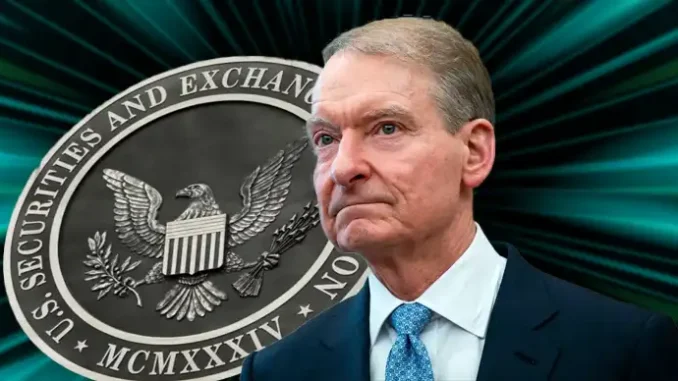

- SEC Chair Paul Atkins says new crypto interpretation marks an early step, not a final regulatory framework.
- Most cryptocurrencies are seen outside securities laws, except tokenized traditional financial assets.
- SEC and CFTC sign pact to coordinate oversight as Congress advances market structure bill.
Chair of US Securities and Exchange Commission, Paul Atkins, has hinted at a change in how the agency plans to deal with cryptos, and clarified that further measures are on the way.
Speaking at an industry event hosted by the Practising Law Institute, SEC Chair Paul Atkins said the regulator’s latest interpretation of crypto laws should be seen as an early stage in a global process. He described the guidance as necessary, though incomplete, and added that more work will follow as the agency refines its approach.
SEC’s Crypto Laws – Just a Start: Paul Atkins
The comments followed days after the SEC issued an interpretive notice that explained how federal securities laws are applied to cryptos. The text represents a change in tone. The agency’s previous leadership had been known to use enforcement actions to settle disputes. According to Atkins, the initial phase is slowly but surely transforming into a more organized system. He told attendees that the commission would begin by explaining how current laws apply to different categories of cryptos.
The idea is to build up a more clear-cut framework for market participants and also keeping within the confines of today’s laws, he explained, in an effort to maintain a more predictable environment. The very interpretation is itself quite clear-eyed on the nature of the asset types.

The SEC’s interpretation on crypto assets is just the beginning and serves as a bridge while Congress works to advance market structure legislation.
Our rules must be clear enough to guide markets, flexible enough to accommodate innovation, and firm enough to protect investors. pic.twitter.com/mVnkdetojZ
— Paul Atkins (@SECPaulSAtkins) March 19, 2026
Most cryptocurrencies are unlikely to fall under securities laws, the SEC says. The small percentage tokenized version of legacy financial instruments is the exception. These are still subject to existing securities regulations, the agency said. Well beyond it, some segments of the crypto market seem to lie outside the SEC’s direct oversight. Those features include digital commodities, utility-oriented tokens, collectibles like NFTs, and stablecoins
The purpose of grouping assets in this manner is to reduce confusion surrounding classification, the regulator says.
The framework further proposes a method based on a taxonomy. Tokens are sorted as per their function, structure, and issuance method. This system is designed to help regulators and market participants better understand where each crypto fits within the global legal landscape.
The guidance, Atkins emphasized, is not a final word. He described it as a starting point, noting that interpretation alone cannot address every aspect of a rapidly evolving market.
Future rulemaking and coordination with other agencies will play a key role in shaping the next phase. That coordination is already underway. The SEC signed a MoU earlier this month with the Commodity Futures Trading Commission. The agreement is intended to improve cooperation between the two agencies, particularly in areas where their responsibilities overlap.
The MOU seeks to guide co-rules of governance, shared information systems and an enforcement cooperation. It’s also intended to streamline reporting of platform reporting and to make regulatory scrutiny easier for platforms that operate across several regulatory categories. Officials have characterized it as part of a progress toward closer coordinated oversight of cryptos.
For years, the two regulators positioned themselves differently on the market. The SEC had claimed securities laws apply to many tokens, but the CFTC has tended to consider major assets, like Bitcoin and Ether, as commodities. The new agreement moves both to fill that gap and to define sharper boundaries.
Atkins also noted that previous disagreements among agencies had created uncertainty. Overlapping rules and jurisdictional friction had had ,at times, slowed innovation and displaced activity outside the United States, he said. This is the current work to balance those concerns against market control.
Meanwhile, legislative developments continue in Washington. A market structure bill, known as the CLARITY Act, is moving through Congress. The proposal is expected to define regulatory responsibilities more clearly and grant the CFTC a larger role in controlling cryptos.
Also Read: SEC Clarifies Securities Laws Application to Crypto Assets



Be the first to comment