



What to know:
- Regulators now require real-time balance checks every five minutes to stop transactions if any major discrepancies are detected.
- Crypto Exchanges must strengthen internal controls by adding risk officers, and monthly external audits to reduce human error and restore users trust.

South Korea’s financial regulator has introduces a new system to tighten crypto oversight on exchanges after a major payout error exposed weaknesses in the system.
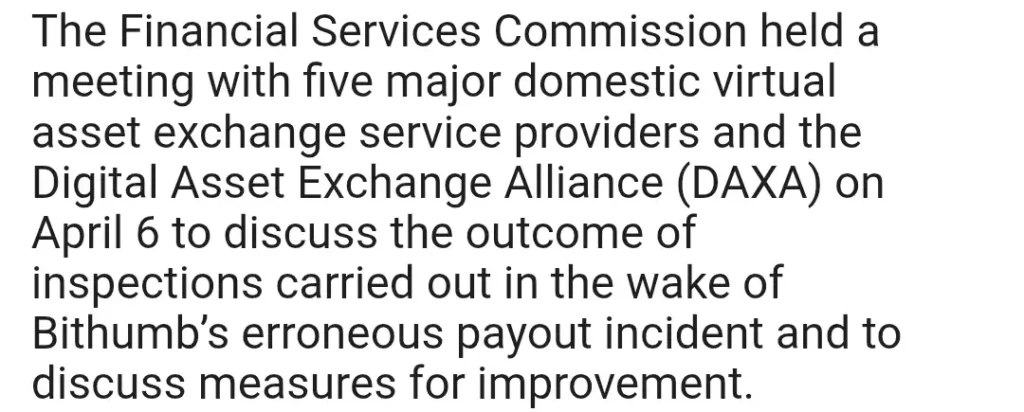
The Financial Services Commission (FSC) met with leading virtual asset exchanges and industry representatives to address the recent failures the crypto space faces.
Source: fsc.go

The discussions focused on preventing similar incidents and restoring trust in the market. The move follows an investigation triggered by a payout incident involving Bithumb, one of the country’s largest crypto exchanges.
South Korea’s authorities reviewed how exchanges manage user funds, their system vulnerabilities, and the strength of their internal controls. Findings from investigators inspection showed that several exchanges were not monitoring balances between their internal records and actual wallet holdings in real time.
This delay means errors or unauthorized payouts may not be detected quickly. South Korea regulators now want exchanges to check these balances every five minutes and also introduce an automatic shutdown systems, known as “kill switches,” if large discrepancies are detected.
Also Read: South Korea’s Opposition Party Pushes to Scrap Planned 22% Crypto Tax
The FSC also raised concerns about how exchanges handle high-risk transactions. Many of these transactions, such as reward payouts, still depend on manual input, increasing the risk of human error. To fix this, exchanges will be required to introduce automated checks, separate high-risk accounts, and enforce stricter approval processes, including multiple levels of authorization.
Another major issue identified was weak internal control systems across the industry. While general guidelines exist, there has been little enforcement or monitoring of compliance. Regulators now plan to introduce standardized internal control programs and increase inspection frequency from once a year to every six months.
Stronger Controls and South Korea Industry Reforms
To prevent users from risk , all crypto exchanges operating in South Korea will also need to adopt a more structured approach by appoint risk officers and also set up a very dedicated risk management committee to help users.
External audits, which currently happen quarterly, will be conducted monthly, with more detailed public disclosures about asset holdings. The FSC and industry bodies aim to finalize these new rules within April and implement system upgrades by May. These measures are also expected to be included in a broader digital asset law currently under review.
Meanwhile, authorities have confirmed that Bithumb’s internal control failures will likely lead to sanctions once legal reviews are completed, signaling a tougher regulatory stance on crypto exchanges going forward.
Also Read: Bitcoin (BTC) Falls to $68K as Oil Surges on Middle East Tensions


Be the first to comment